
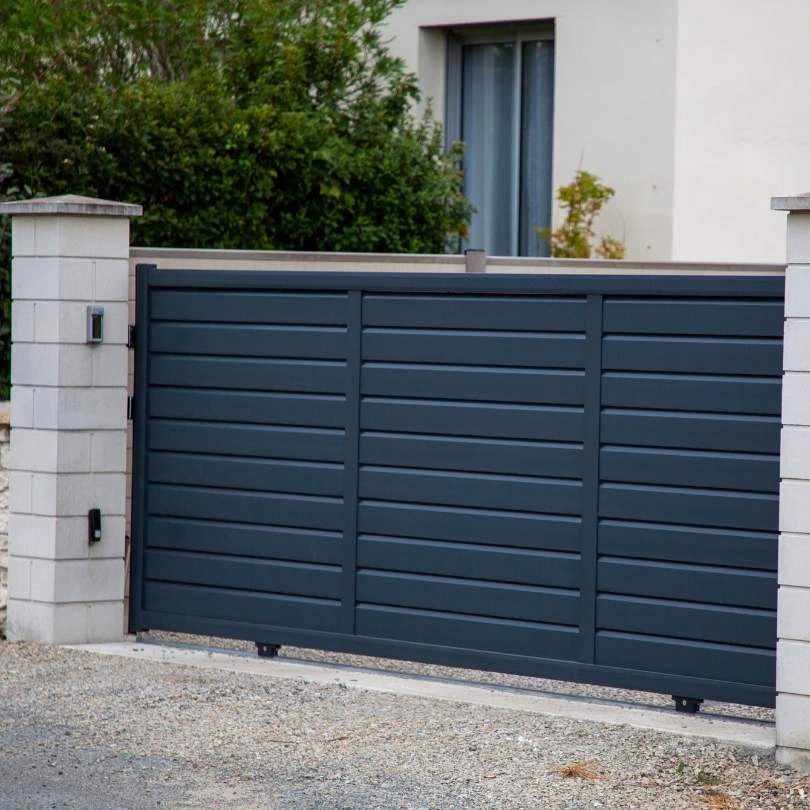
An open electric gate creates both an access problem and a temptation to make it close immediately. The safest first step is to identify the behavior without creating another hazard. A sliding gate, a single swing gate and a two-leaf entrance have different movement paths. Their operators and protective devices also vary. A useful observation is specific: “Both leaves open; the right one starts closing and reverses after a few inches” gives a technician more information than “the gate is broken.”
Secure the area before troubleshooting
Keep children, pets and pedestrians away from the entrance. Use a separate pedestrian route where one is provided. Do not stand between a moving gate and a post, wall, fence or parked vehicle. Stay clear of the area behind a sliding gate and the full arc of a swing gate.

At a shared entrance, tell the responsible manager what happened before changing controls. A delivery schedule, access-control setting or deliberate hold-open command may be involved. Do not disable building access or safety systems as an experiment.
Describe which closing failure you have
| Observed behavior | What to record | What not to assume |
|---|---|---|
| Gate remains fully open | Whether a normal close command produces a light, sound or movement | That the motor has failed |
| Gate begins closing and reverses | Where reversal occurs and what is near the movement path | That more force is the solution |
| Gate stops at the same place | Approximate position, sound and any visible obstruction | That a travel setting should be changed |
| Only one leaf moves | Which leaf, its position and whether the sequence changed | That both leaves can safely be forced together |
| Problem follows a power interruption | When power returned, operator indicators and any battery warning | That every operator has working backup power |
Use observations you already have. Do not keep cycling a faulty gate to fill every box. If a safe video can be taken from outside the movement area without provoking another cycle, it may help document an intermittent problem. Avoid filming access codes, residents or vehicle plates unnecessarily.

Look for a visible obstruction from outside the travel zone
Check the approach and the areas where the gate moves. A bin, parked vehicle, accumulated debris or a displaced object may explain a change in behavior. Note recent landscaping, pavement work, deliveries or an impact. Photograph the obstruction from a safe position if useful.
Do not reach through a gate, into rollers or under a suspended section to retrieve something. If clearing an object requires entering a movement or pinch area, leave it for someone who can safely isolate and service the system. An operator can receive a command from somewhere other than the control in your hand.
After rain or wind, record the conditions without treating weather as a diagnosis. Wet ground, vegetation near a device or debris in the opening may be relevant, but they do not prove a particular component has failed.
Recognize safety devices without bypassing them
Gate systems can use photoelectric sensors, sensing edges and other protection appropriate to their installation. LiftMaster's safety guidance emphasizes protecting entrapment areas and maintaining separation between pedestrians and vehicle gates. The required arrangement depends on the system; a garage door sensor diagram is not a substitute for a gate assessment.

From a safe position, note visibly damaged housings, displaced brackets, vegetation blocking a device or an indicator that differs from the usual state. Use the owner's manual to identify an accessible indicator. Color alone is not a universal diagnosis across brands and models.
If the manual describes ordinary owner cleaning that can be done without entering a hazard area, follow that procedure. Otherwise record what you see and leave adjustments to a professional. Wiring, alignment, force, travel limits and safety-system testing belong in a controlled service process.
Separate access commands from the gate's ability to move
Consider what changed immediately before the fault. Was a new remote issued, an access schedule changed or a hold-open mode selected? Ask the authorized manager whether the open position is intentional. Do not press unfamiliar switches inside the operator enclosure.
If the usual control gives no response, record that fact. If one approved control works while another does not, identify them in your service request. There is no need to open a keypad, bridge terminals or repeatedly reprogram devices to establish that difference.
An accessible display or app may show a diagnostic message. Copy it exactly, together with the operator model if the label can be read safely. Avoid clearing the message before recording it. A generic online fault list may cover a different controller or firmware revision.
Handle power and manual release conservatively
Check for a known property-wide outage and tell the technician whether other equipment lost power. Do not open mains-voltage compartments, repair wiring or work around standing water. A battery-equipped operator may still need model-specific diagnosis; the presence of a battery does not establish its condition.
A manual release can change how the gate is restrained. On a slope or in wind, an unsupported gate may move unexpectedly. Do not improvise a release procedure, force the leaf or remove drive components. Follow the exact owner's instructions only if you are the authorized operator and can meet their safety conditions. If you cannot, keep the area clear and arrange assistance.
Make the service request useful
For electric gate diagnosis and repair, provide the gate type, operator brand/model if known, observed closing behavior and when it began. Include recent weather, power interruptions, impacts or changes to access controls. Explain whether the opening serves a single home or shared property and whether vehicles can use an alternative route.
- What happened: one concise description of the movement or lack of response.
- What is visible: an obstruction, damaged component or exact displayed message.
- What changed: recent work, outage or access-setting change.
- What was attempted: only the actions actually taken, including any reset.
- What is urgent: trapped access, unsafe structure or an entrance that cannot be secured.
Before returning the gate to normal use, ask the service professional to explain the cause, the repair and the safety checks performed. The useful outcome is reliable operation with the protective system intact, not simply one successful closing cycle.