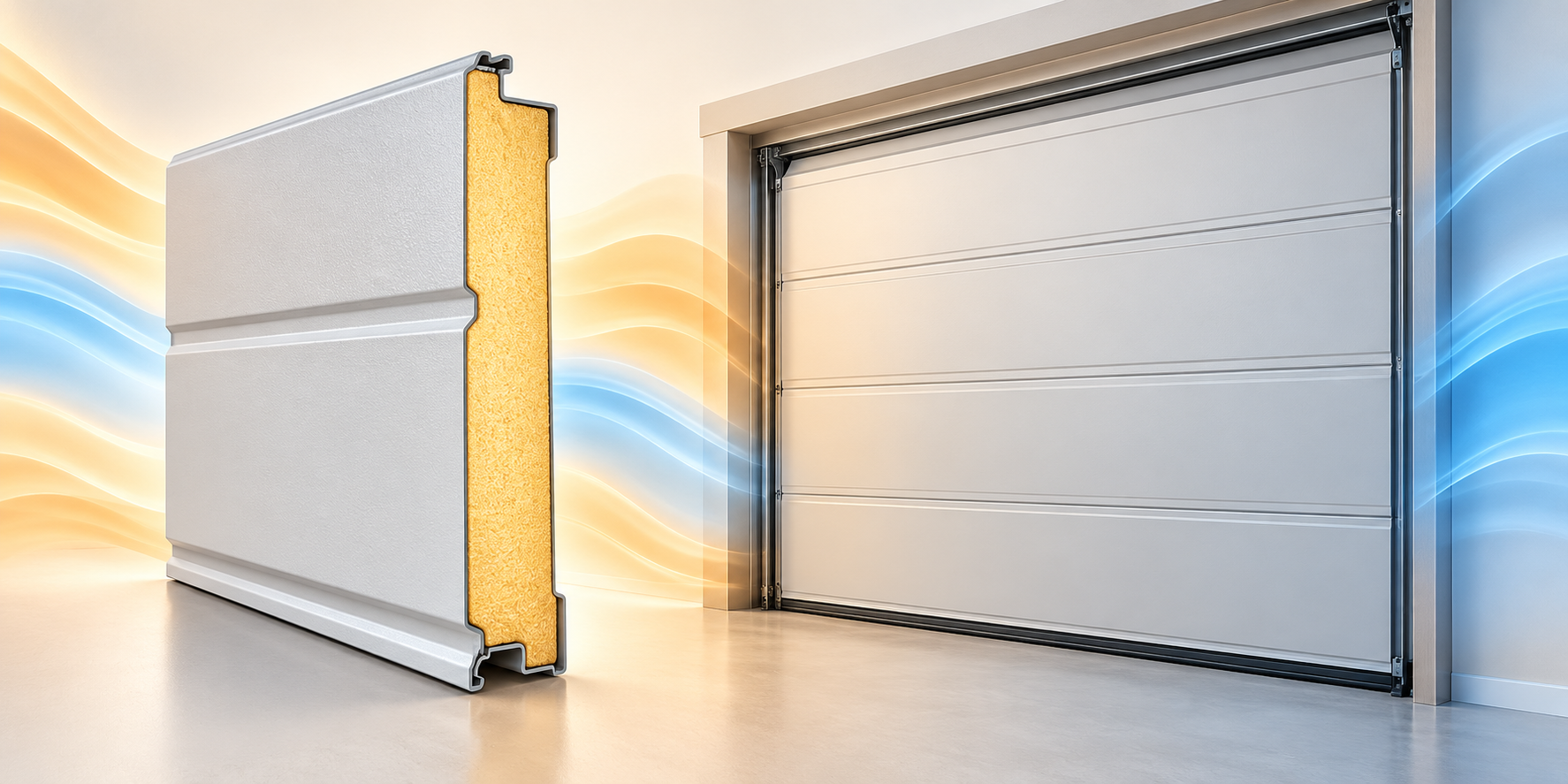
A section and an assembly are different evaluation scopes.
R-value and U-factor describe different thermal measures and scopes. Check whether the number refers to insulation, a section or the complete assembly before comparing doors.
A garage door with a larger advertised R-value is not automatically the better complete door when the competing product is described by U-factor. The two numbers commonly published for garage doors may evaluate different things: a calculated door section and a tested door assembly. Treating one as the reciprocal of the other can create a comparison that the data does not support.
The first useful question is therefore not “Which number is highest?” It is “What exactly does this number measure?” Once the metric, test scope and configuration are clear, you can compare thermal specifications without turning them into invented temperature or energy-savings promises.
R-value describes resistance; U-factor describes transmission
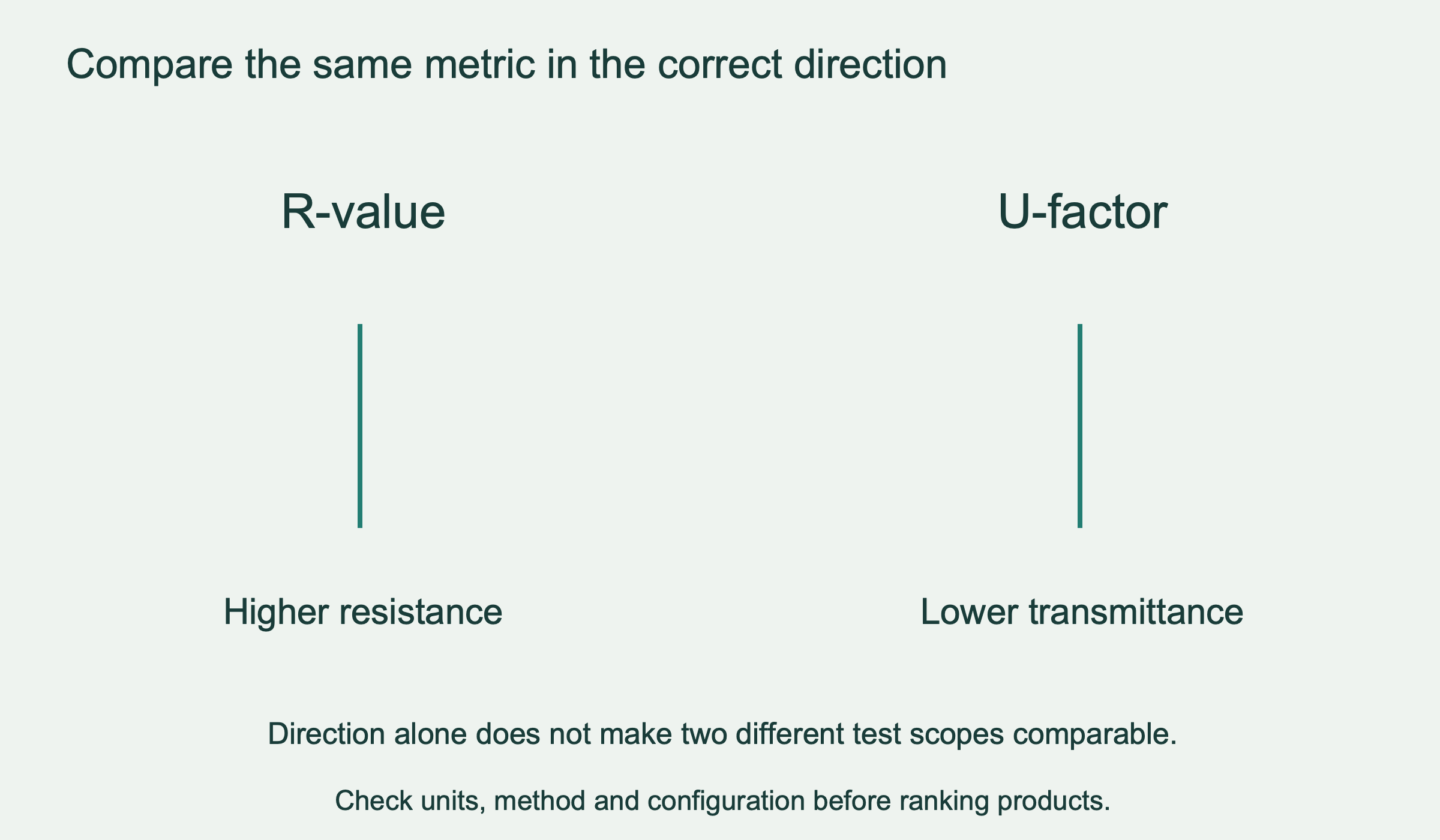
R-value expresses thermal resistance. Within a comparable method and scope, a higher value indicates greater resistance to heat flow. U-factor expresses thermal transmittance; within a comparable method and scope, a lower value indicates less heat transfer.
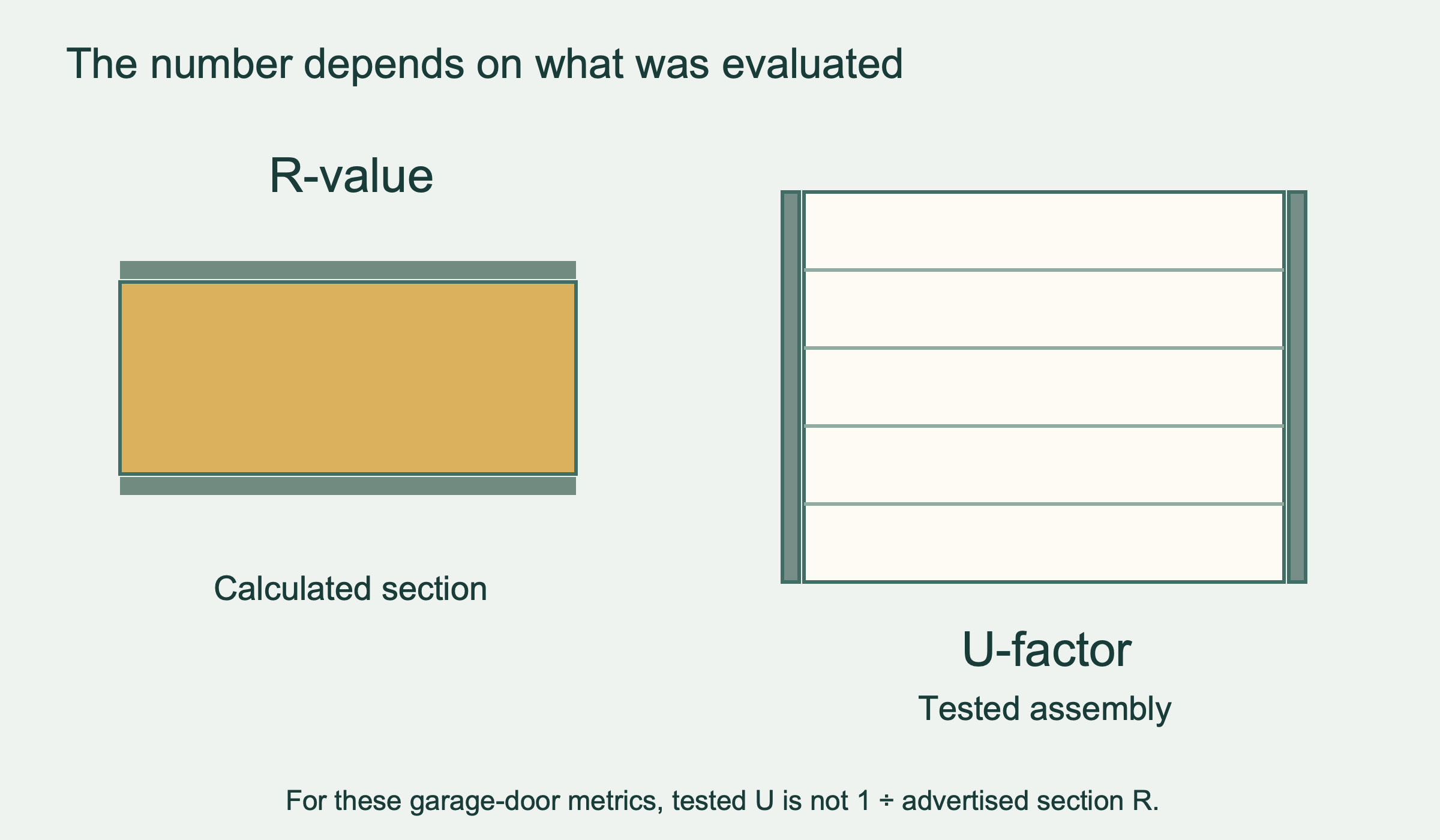
DASMA’s TDS163 describes the common garage-door distinction: a calculated R-value for the section versus a tested U-factor for the installed assembly. The section calculation does not capture all the effects of the assembled joints and other components. The whole-door test evaluates the combined construction rather than only the insulating core.
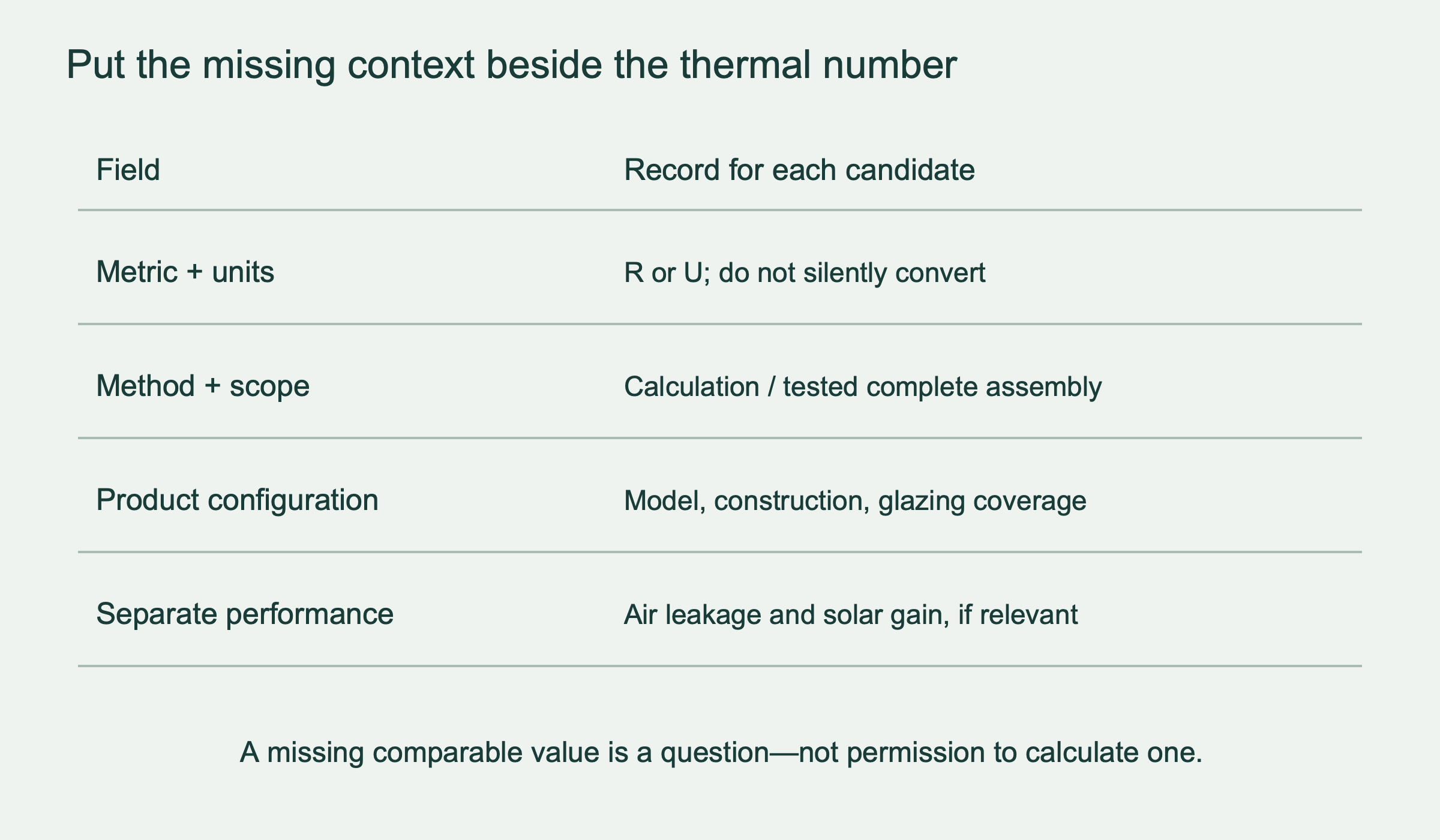
Write the metric name and units beside the value. In U.S. documents, U-factor is commonly reported in Btu/(h·ft²·°F), with R-value using the reciprocal unit form. Products or documents using another unit system need a properly identified conversion; an unlabeled number is not ready for comparison.
 Select the diagram to view it at full size.
Why the tempting reciprocal calculation is misleading
For the garage-door figures discussed in TDS163, the published calculated section R-value and tested assembly U-factor are not reciprocals. Dividing one by the advertised R-value does not create a measured U-factor for the complete door. It creates a number that lacks the required whole-assembly evidence.
Think about the scope rather than memorizing a prohibition. The section’s core is only part of the door. Joints, interfaces, hardware and perimeter construction participate in the assembled result. A calculation for one part and a test of the whole product cannot be made equivalent merely by changing the arithmetic format.
A manufacturer can legitimately publish both values when each is identified. Their numerical relationship does not need to match a reciprocal calculation, because the scope and method differ. That is not, by itself, evidence that one of the numbers is wrong.
 Select the diagram to view it at full size.
Read the test or verification reference
Ask which method supports the reported U-factor and which model it covers. DASMA’s TDS196 describes assembly testing under ANSI/DASMA105 and a verification program administered with ICC-ES using approved third-party laboratory data. That gives a buyer something concrete to look for beyond a large insulation number in a brochure.
The program is not a certification that every property of the door has been measured. TDS196 states that air infiltration and solar heat gain are outside its scope. It also distinguishes participating sectional doors from other vehicular door types that are not included in that program.
Where a verification mark is shown, check the actual listed product and its coverage. Do not assume a badge on a manufacturer’s website applies to every collection or every option sold by that manufacturer. The model and applicable configuration still need to connect to the quotation.
Conversely, absence from this particular program is not permission to invent a poor rating or accuse a product of failing. Ask what test information the supplier can provide. A meaningful comparison states the evidence available and what remains unknown.
Check how the selected windows and construction are covered
Record the exact model, section construction and glazing choice. A product-family page may show several thicknesses, insulation options or window arrangements. Make sure the value being compared belongs to the configuration you are considering rather than the best-performing option somewhere in the same range.
Do not assume that every small window change demands a unique published number, either. Verification programs can define how configurations are grouped. TDS196 describes coverage for sectional doors with up to 16% window area, while larger glazed areas have different testing and labeling provisions. Ask the supplier how your chosen layout is covered instead of applying that threshold yourself as a design approval.
For a full-view or heavily glazed door, obtain the relevant product data rather than borrowing a value from an insulated solid section. The appearance may meet your priorities, but the thermal comparison needs to remain honest about the construction.
Keep the order and specification aligned. If you change the window layout, finish system or section option during selection, ask whether the previously discussed performance information still applies. The useful number is the one supported for the actual order.
Keep heat transmission separate from drafts and room temperature
A thermal rating does not tell you that an installed door has no air leakage. Air moving through a gap is a different issue from heat passing through the assembly. If leakage performance matters to the project, request its own test information and ask how the installation details will be addressed.
Likewise, a favorable U-factor is not a guaranteed winter temperature. The garage’s walls, ceiling, other openings, heating arrangement, weather and door-opening pattern all affect the space. A door specification can support a component comparison without predicting the entire building’s behavior.
Be especially cautious when a percentage improvement in a product metric becomes a percentage reduction in a household bill. Those are not the same calculation. A claim about savings needs a defined building and usage analysis, not just two brochure numbers.
If your actual problem is a draft, identify where it occurs before assuming a higher section R-value is the solution. If the question is which new door has better supported thermal performance, keep the comparison at that product level. Separating those questions prevents useful specifications from being asked to answer something they do not measure.
 Select the diagram to view it at full size.
Build an apples-to-apples shortlist
For each candidate, copy the exact thermal value with its metric, units, supporting method and model reference. Record the selected glazing and the supplier’s explanation of how it is covered. Put missing information in a visible “not provided” field instead of treating it as zero or estimating it.
Compare tested assembly U-factors when suitable comparable data is available. Use section R-values for the narrower information they provide, not as a substitute for the entire assembly result. If the available documents cannot support a direct ranking, say so and ask for the missing evidence.
Then consider the other requirements independently: opening fit, wind or impact specification where applicable, daylight, appearance, maintenance and installation scope. The lowest U-factor does not automatically make a door the right choice if the configuration does not fit the project or satisfy another required property.
Before ordering, retain the product sheet or verified listing with the quote. For a garage door selection assessment, bring those records rather than just an R-value remembered from an advertisement. A reliable thermal comparison ends with a documented product choice—not a reciprocal conversion, a promised room temperature or a bill-saving percentage that the evidence cannot establish.