
The exterior alone does not identify the locking system.
Garage security combines the door, controls, access permissions and household routines. Match any lock to the actual door and opener arrangement, and keep safe entry and exit in the plan.
Locking a garage door starts with knowing what is holding it closed. A manual slide bolt, an opener's wall-control lock button and an automatic garage door lock do different jobs. Treating them as interchangeable can leave a security gap—or cause an opener to pull against a locked door.
The useful question is not “How many locks can I add?” It is “Which security measures work with this door and opener, and can everyone still operate the system safely?” Use the checks below to review your setup without altering tracks, springs or emergency-release hardware.
Three different meanings of a garage door lock
| Device or feature | What to establish | Important distinction |
|---|---|---|
| Manual lock, latch or slide bolt | Whether the door manufacturer permits it for your operating setup | A mechanical lock must not remain engaged when the opener moves the door. |
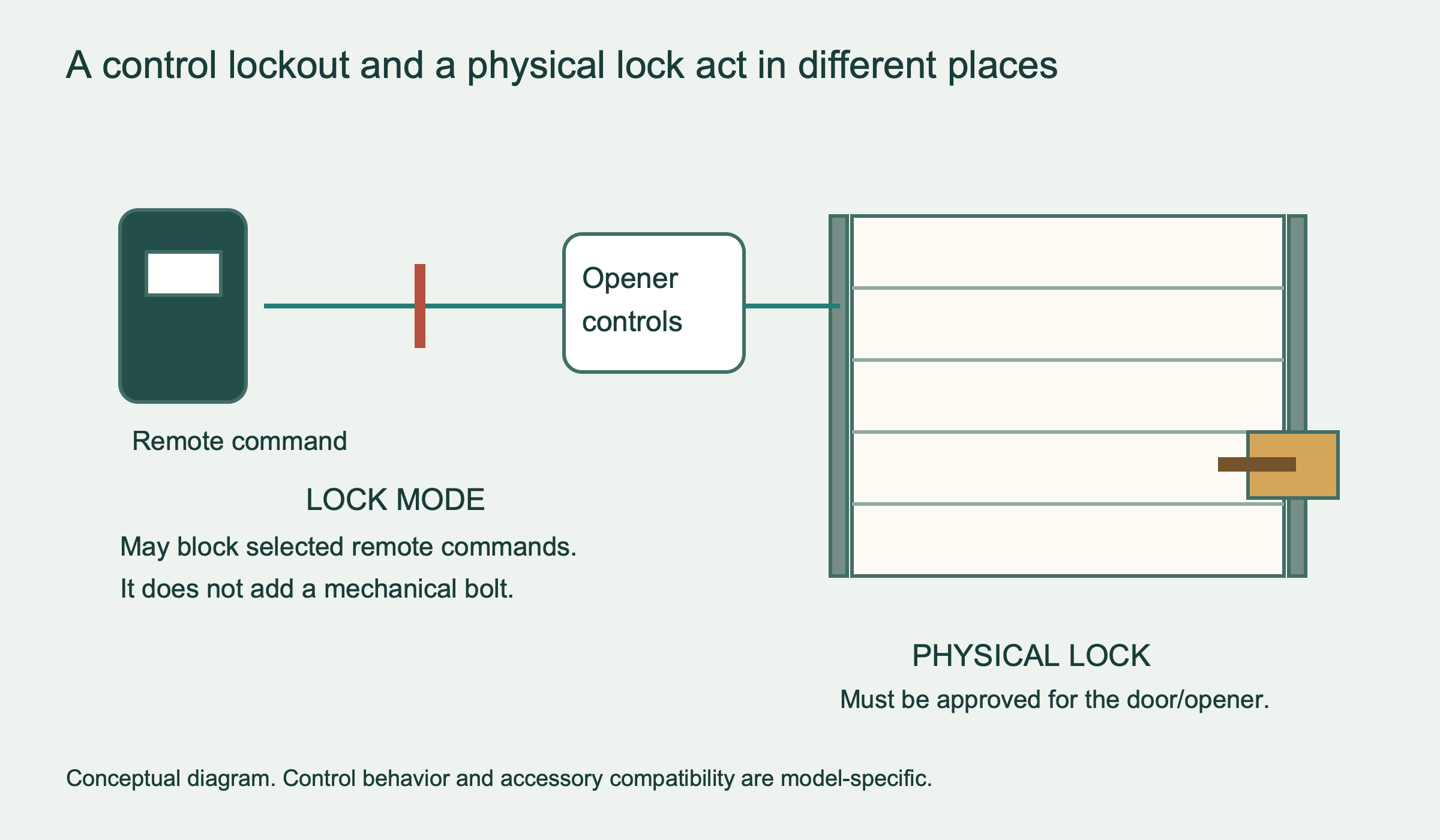
| Opener lock or vacation mode | Which remotes or controls the exact model disables | Blocking selected commands is not the same as adding a physical deadbolt. |
| Compatible automatic door lock | Opener model, lock model, voltage and installation requirements | Not a universal accessory; it must operate as part of an approved system. |
For example, Chamberlain's documentation describes lock mode that prevents handheld remotes from operating while the wall-control indicator flashes. Other controls and features depend on the model. Read your manual rather than assuming a button marked “lock” makes every access method inactive.
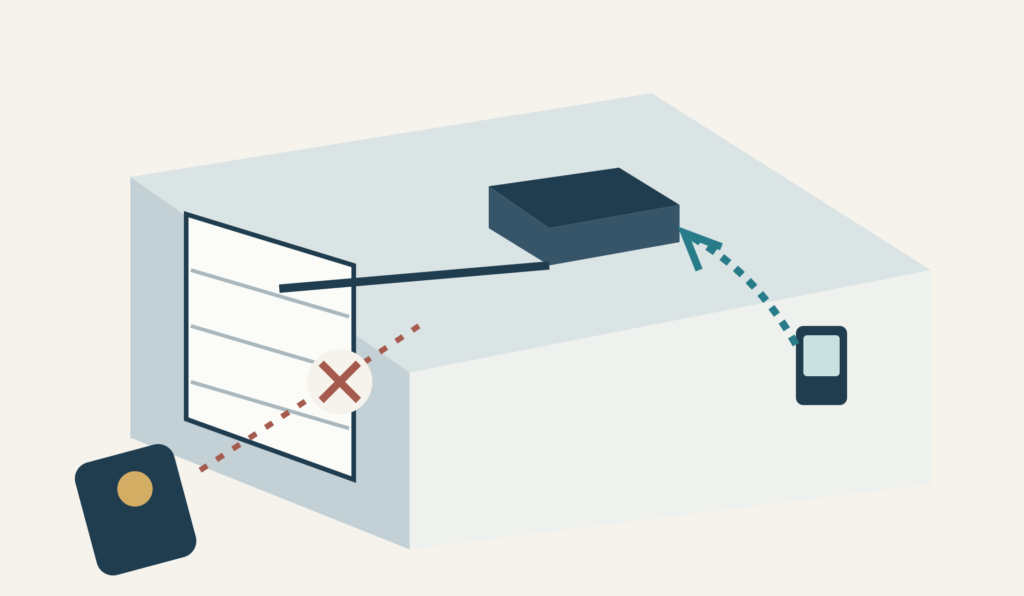
 Select the diagram to view it at full size.
Start by identifying what you already have
Stand clear of the closed, stationary door and make an inventory without dismantling anything. Does a keyed exterior handle connect to a manual latch? Is there a slide bolt on the inside? Does the wall control have a Lock button? Is a powered lock mounted near the track? Record those as separate items. A key cylinder in the outside face may instead belong to an emergency-release kit; its presence does not establish that it locks the door against lifting.
Then identify how the door normally moves. A door operated entirely by hand needs a different security routine from one connected to a motor. If both a manual bolt and an opener are present, do not experiment by engaging the bolt and pressing the remote. Have the installation reviewed before changing its operating routine. The failure to avoid is simple: one device restrains the door while another tries to move it.
If your garage door is manually operated
Start with the existing manufacturer's locking arrangement. With the door fully closed and stationary, look for visible damage to the handle, latch and surrounding panel. A lock that only catches when you push the door sideways is a reason for inspection, not a reason to force the latch or enlarge a track opening.
Check that the people who need access have an appropriate key or other authorized entry method. Consider what happens if someone locks the overhead door from inside while another person expects to enter from outside. A garage without a separate entry door needs a particularly clear access plan.
If a key sticks, use the lock manufacturer's maintenance instructions. There is no single lubricant recommendation that fits every cylinder and lock mechanism. Avoid flooding the assembly with an unfamiliar product or forcing a key that may break.
If an automatic opener operates the door
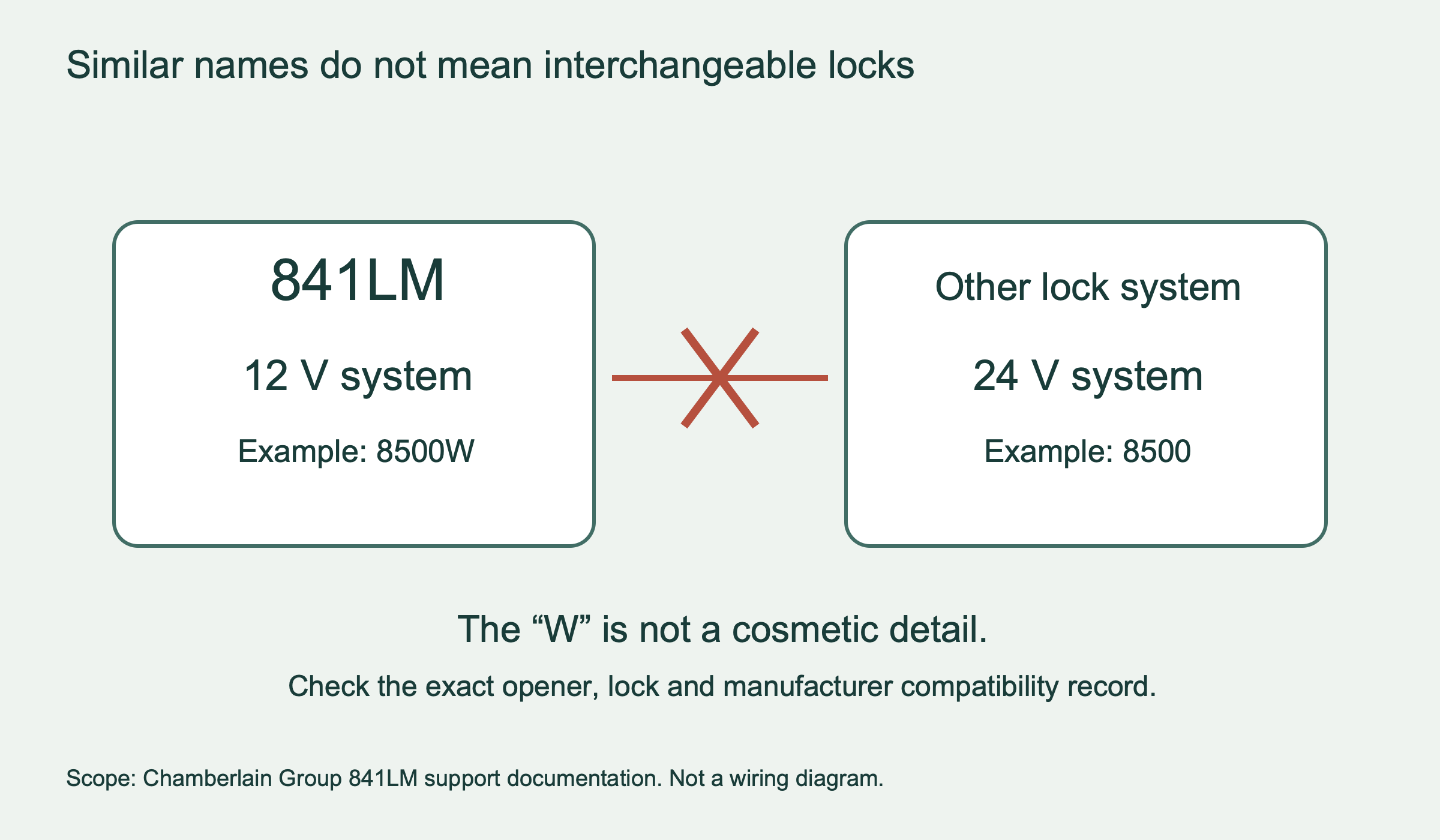
A compatible automatic lock is different: the opener and lock are designed to work together. Compatibility must be checked by exact model, not by brand name alone. LiftMaster's 841LM documentation, for example, distinguishes 12-volt systems from other lock systems. A connector that appears to fit is not enough to establish compatibility.
Ask the installer to explain what the selected lock does during a power outage, how manual access works, and what happens when power returns. Do not assume a battery-backed opener means every accessory behaves exactly as it does on household power.
 Select the diagram to view it at full size.
One letter can change the accessory
Here is a concrete compatibility trap. The 841LM support document names the 8500W among its 12-volt applications, but distinguishes the 24-volt lock used on the 8500, 3800 and 3900. “LiftMaster wall-mount opener” is therefore not a sufficient parts description. The full model designation matters before any purchase, even when the two assemblies look similar.
The same document says that on its described DC battery-backed systems the lock disengages once during an outage and does not activate again until power returns. That is an accessory-specific limitation, not a statement about every automatic garage lock. It is a reason to learn the outage behavior in advance, rather than discovering it after switching off household power for a trip.
Never secure the door by disabling its emergency release
Do not zip-tie, tape, shorten or otherwise obstruct the emergency-release mechanism as a security shortcut. It is part of the opener's manual-operation system. Any additional security accessory should be approved for the exact equipment and must preserve the manufacturer's release function.
Also avoid experimenting with the release on an open, crooked or damaged door. A door with a spring or cable problem can fall when disconnected from the opener. Chamberlain's manual-operation guidance warns against manual operation when components are damaged or the door is unusually heavy. Keep people away and arrange service instead.
Review access, not just the overhead door
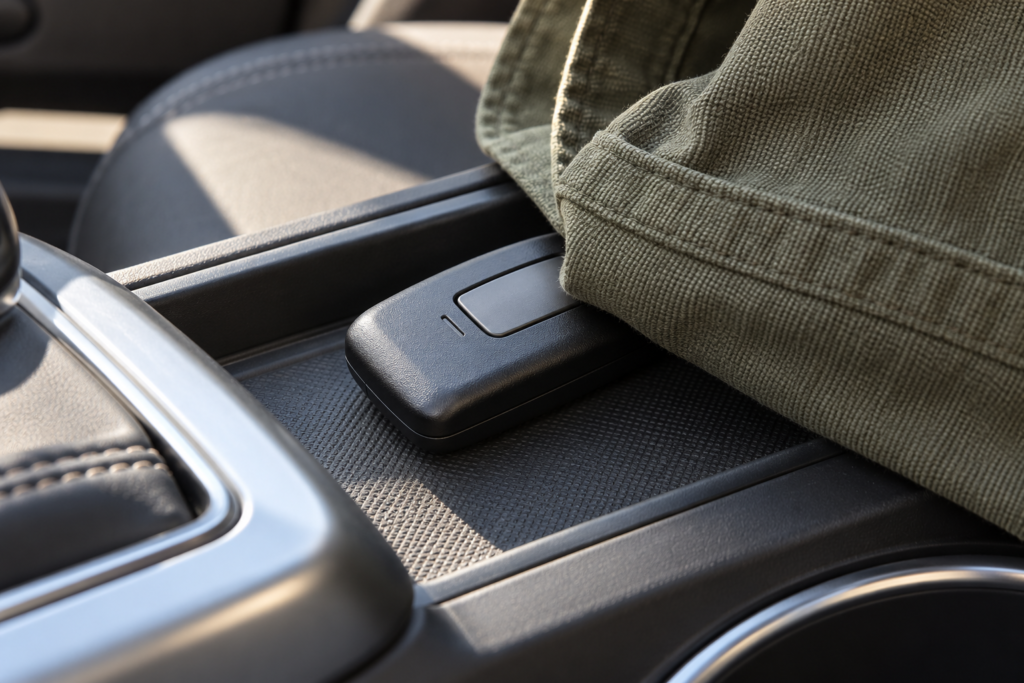
- Remotes: Keep them out of unattended vehicles when practical. Treat a missing remote as an access-control issue, not merely an inconvenience.
- Keypads: Review who knows the code. Follow the exact model's instructions to change it when access needs change.
- App access: Review invited users and remove access that is no longer needed. Use the account's available security protections and avoid sharing the owner's login.
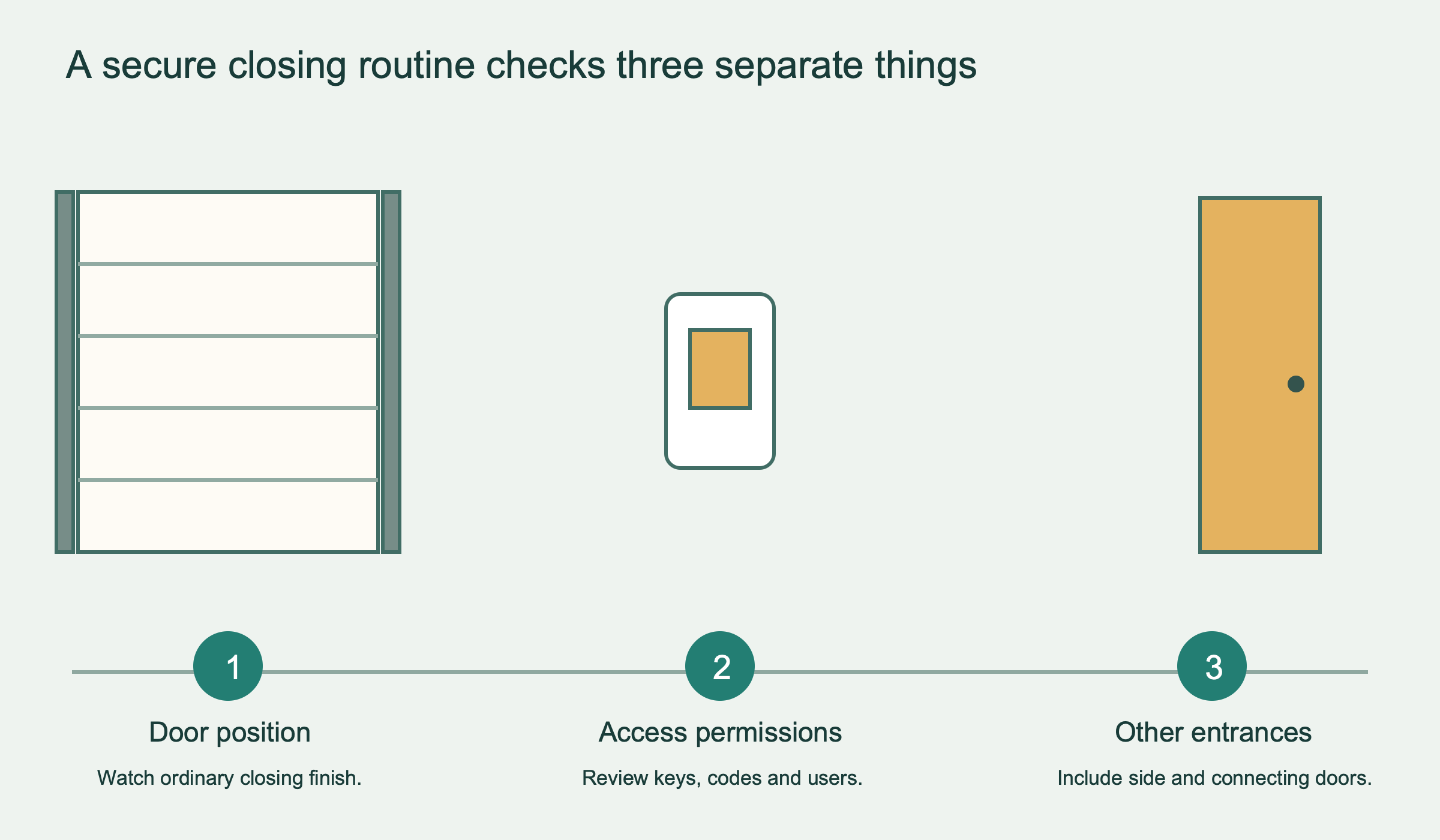
- Other entry doors: Include the side door and the door between the garage and the home in your closing routine.
- Visibility: Avoid leaving valuable equipment on display. Any window covering should suit the glazing and must not obstruct the door's operation.
When a remote is lost, ask what the reset will erase before performing it. Some programming procedures remove multiple saved devices. Plan how the household will regain authorized access rather than leaving someone unexpectedly locked out.
If a remote or access code has been lost
First list the access methods that need attention: handheld remote, keypad code, shared app invitation or a physical key. Changing one does not necessarily remove the others. An app-user invitation should be managed through the account's access controls; a missing handheld transmitter may require the opener's model-specific memory procedure. Do not confuse deleting an app from a phone with revoking its account access.
Before a reset, note which authorized devices will need to be enrolled again and make sure another legitimate way into the property remains available. Do not press and hold an unfamiliar Learn button simply because an online video calls it a reset. Follow the exact manual or obtain help with the access change. Afterwards, verify the intended authorized devices while keeping everyone clear of the door.
 Select the diagram to view it at full size.
A practical before-you-leave check
Watch the door finish closing from a safe position. A command sent from a remote or phone is not, by itself, proof that the opening is secure. If the door reverses, investigate the closing problem instead of using a lock to hold it down.
Look for a door sitting unevenly, a visibly damaged section or a lock that fails to engage normally. Do not reach around rollers or cables to investigate. Record what you can see from a safe distance and share that information with a technician.
For longer absences, review the manual's vacation-mode instructions and your authorized-user list. Make sure any person responsible for the property knows how the system is intended to work. Good security should not depend on a hidden trick that only one person remembers.
Common questions
Does the opener's lock button physically lock the garage door?
Not necessarily. On systems with remote lockout, it restricts specified controls rather than driving a separate mechanical bolt. Check your opener and wall-control manuals.
Can I fit any smart lock to an existing garage door opener?
No. A smart entry-door lock is not automatically suitable for an overhead garage door. Use only a system approved for the door and opener, with professional installation where the manufacturer requires it.
What if the garage door will not stay closed?
Do not use a latch to defeat reversal or conceal a mechanical fault. Start with our garage door not closing guide, and stop operating the door if there is visible damage.
For a compatibility or operating problem, see garage door opener service. Local Garage Experts takes calls daily from 6 a.m. to 11 p.m. at (323) 924-8777, with free estimates, free diagnostics and no service call fee.