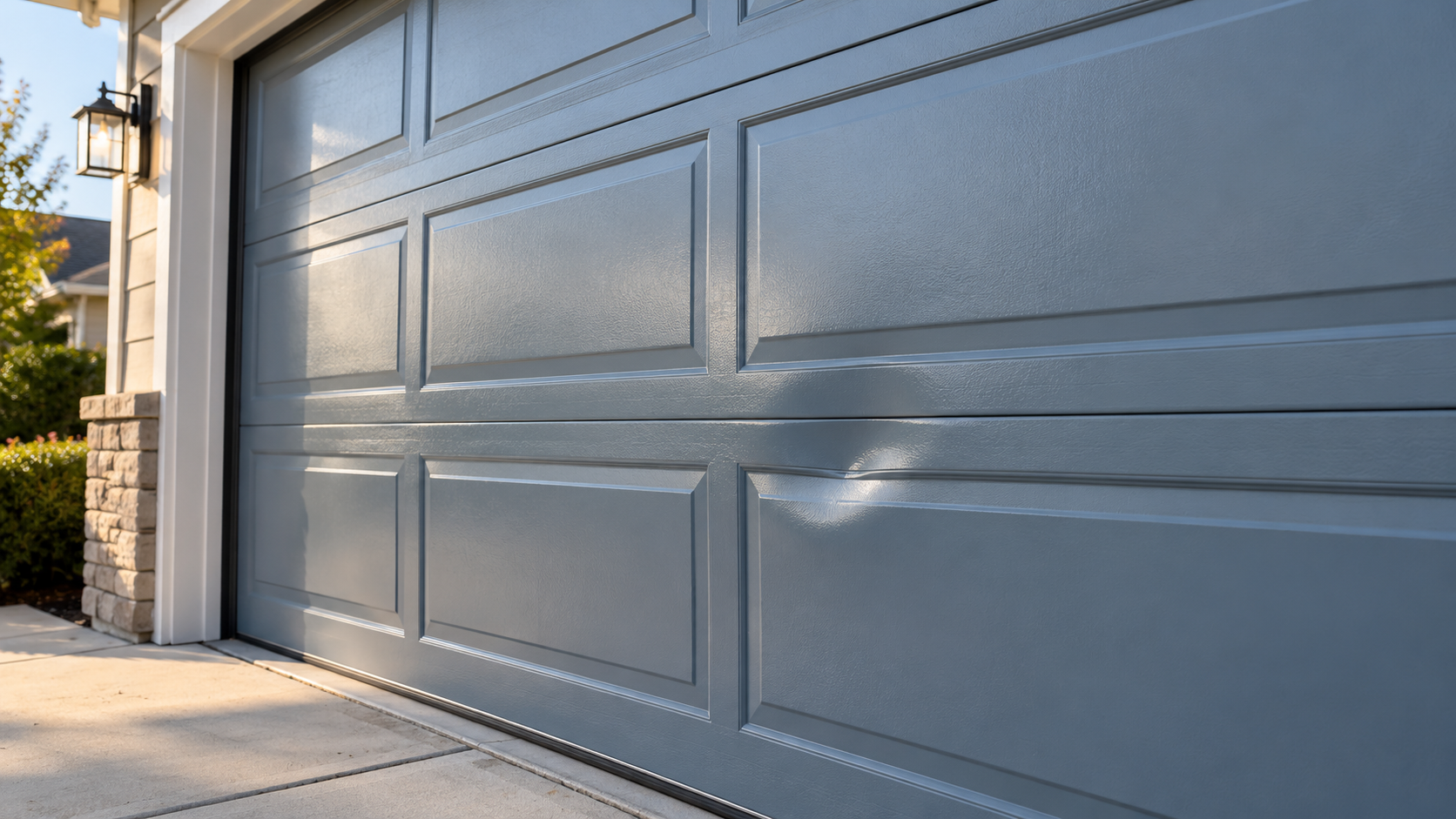
Appearance alone does not establish whether the door is safe to operate.
A dent may be cosmetic or may affect a joint, attachment or door movement. Appearance alone cannot establish safe operation; keep a damaged or unstable door out of use until it is assessed.
A dent can be a cosmetic concern, but a photograph of the outside face does not always tell the whole story. The location of the impact, the door’s construction and any change in its movement matter when deciding what should happen next.
Before examining the dent, consider what happened
Was there a light object strike, a vehicle impact or an unexplained mark discovered during cleaning? Those histories are not interchangeable. Tell the service provider what you actually know, including whether the door was moving and whether the impact involved its edge or support area. Avoid guessing about an event you did not witness.
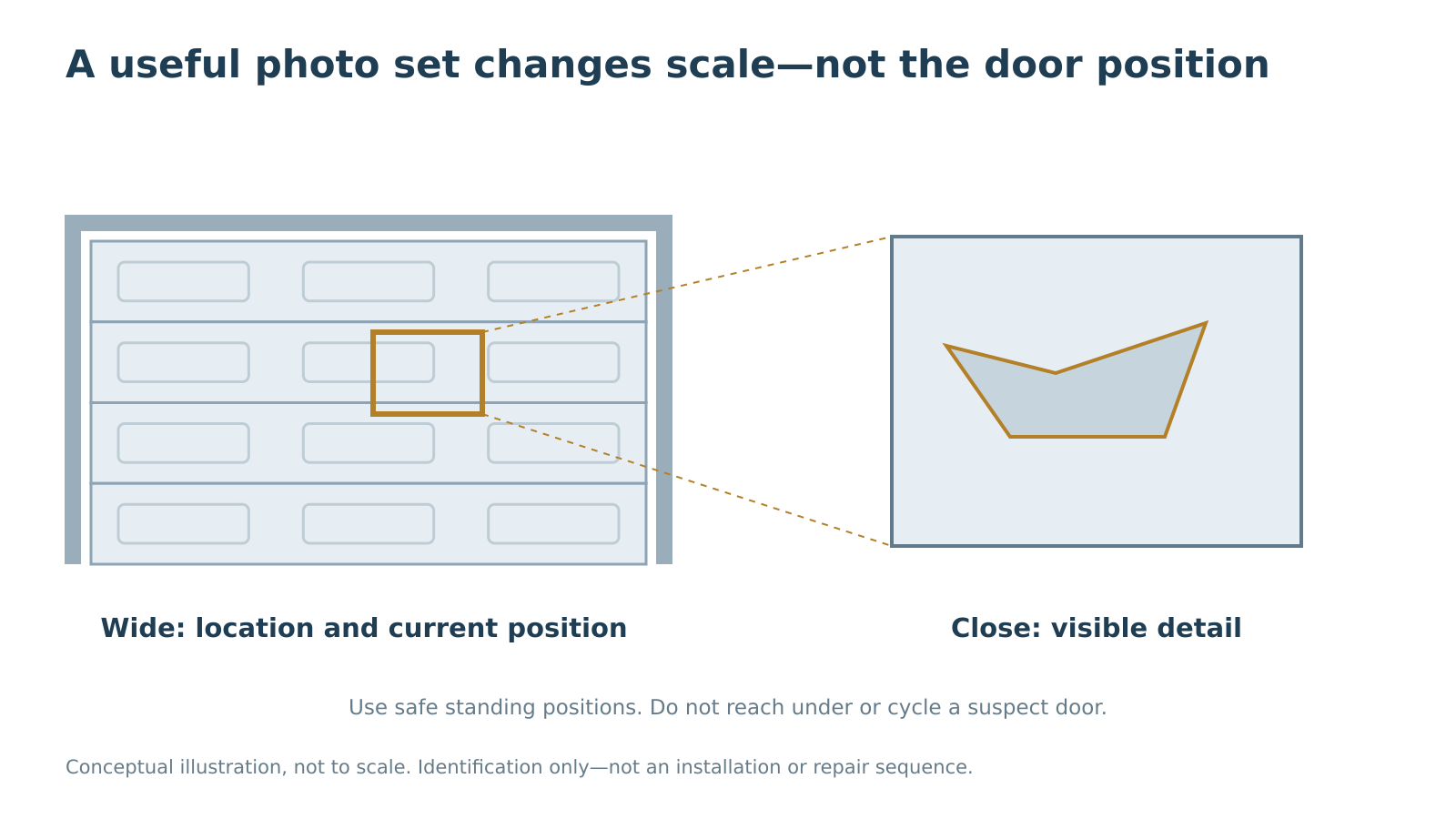
If the door is stationary and accessible without entering a hazard area, take a wide photograph before a close-up. The wide view records where the mark sits in the assembly. A tightly cropped image of a dent can hide the very context needed to decide what requires inspection.
 Select the diagram to view it at full size.
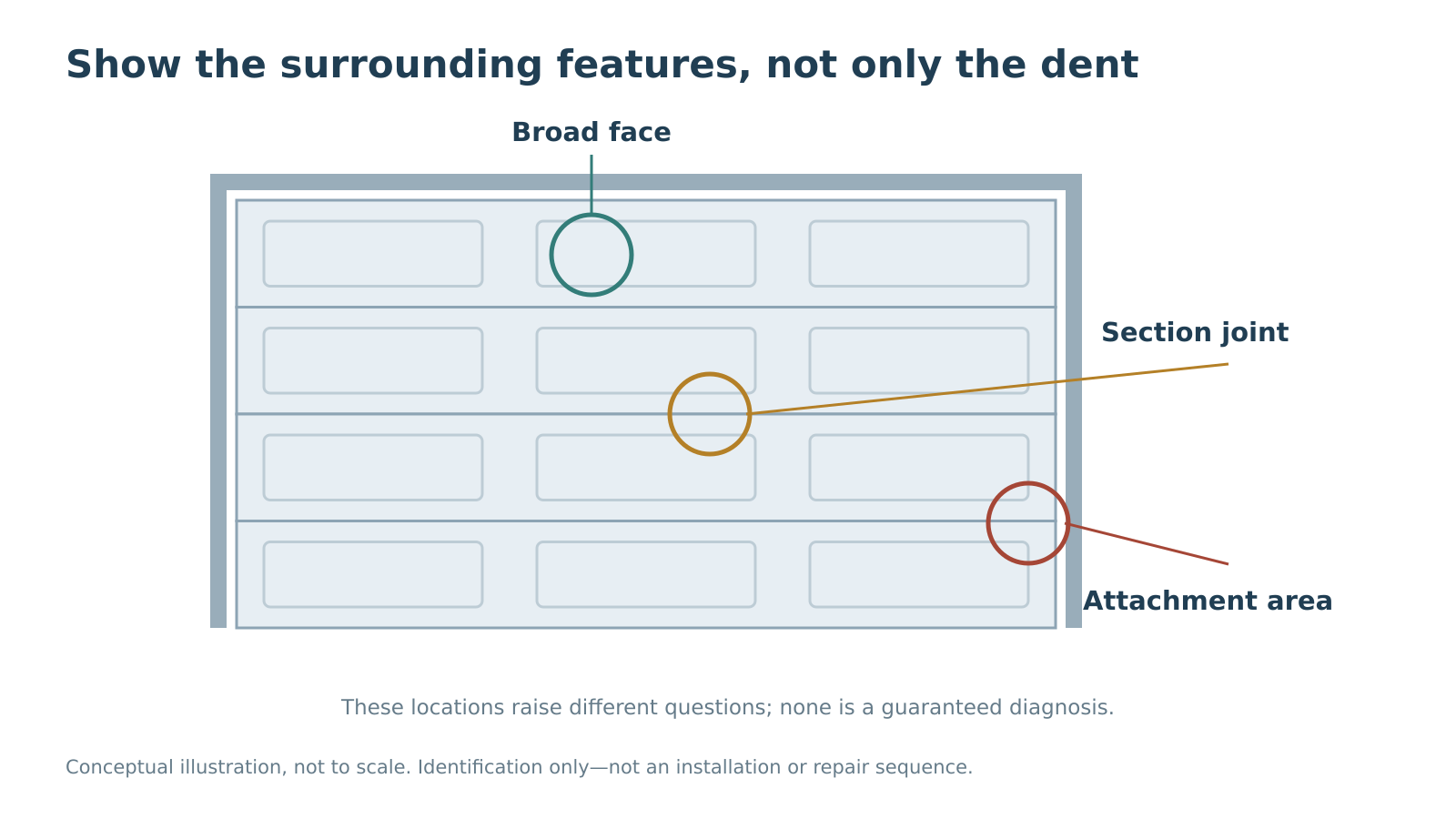
Why the dent’s position matters
A depression in the broad face of a section presents a different assessment question from distortion along the joint between sections or near a hardware attachment. That does not mean one location is automatically harmless. It means the surrounding features must be included in the inspection.
For a mark near a joint, show the adjacent section in the photograph. For damage near an attachment, show the surrounding door material without removing the hardware. If a roller, hinge or support appears displaced, describe that separately from the cosmetic damage.
Do not decide that a dent is safe because it is small. Nor should a large visible mark automatically be treated as proof that the complete door must be replaced. The correct recommendation needs the construction and condition of the affected area, not only the area of the dent in a picture.
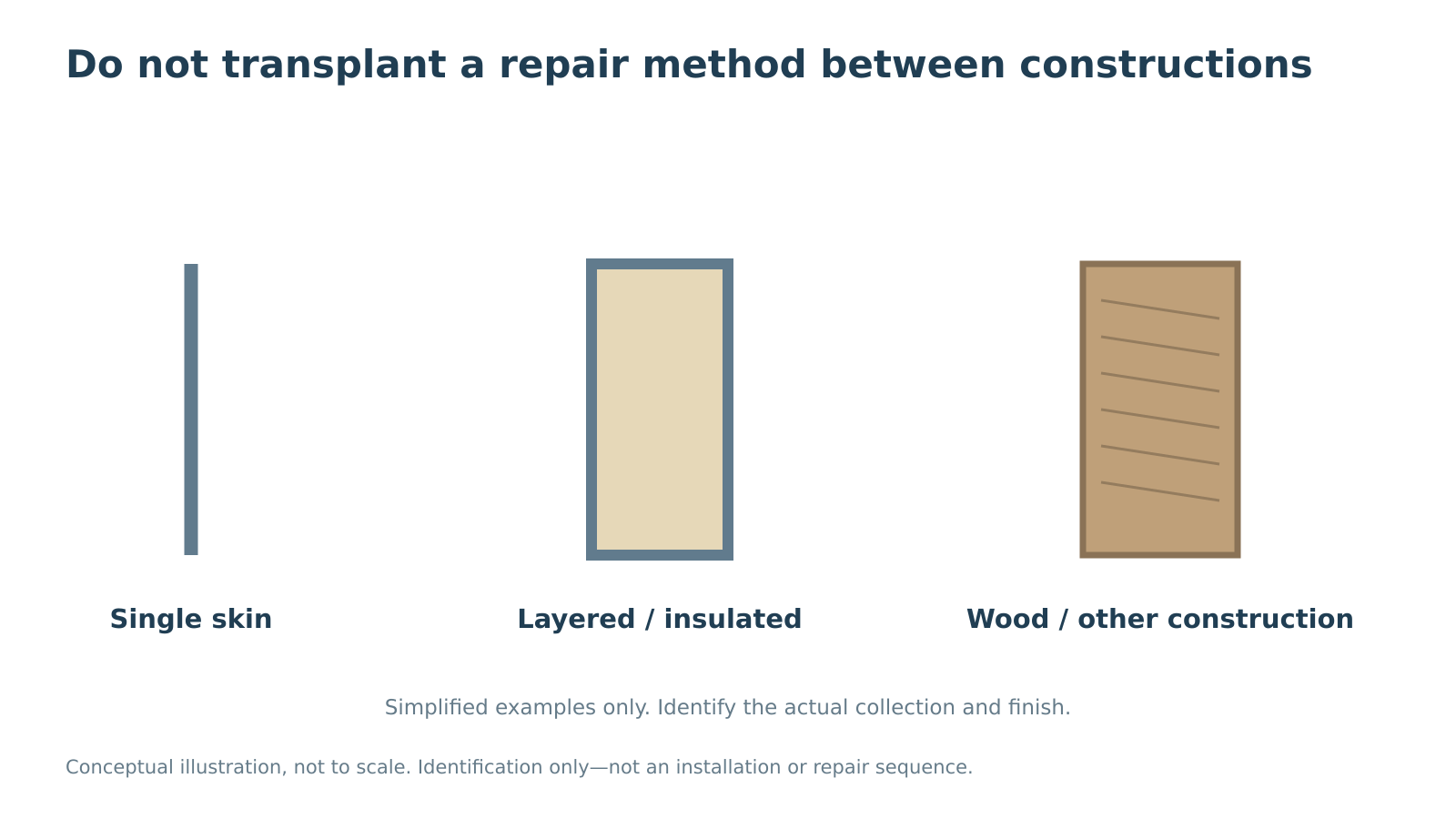
Construction changes what a repair can involve
A single exposed sheet, an insulated multi-layer section and a wood or composite door do not respond to cosmetic repair in the same way. A method demonstrated on one construction is not automatically suitable for another. Identify the collection or model before considering any finish or repair procedure.
Clopay’s damaged-section guidance separates minor surface care from major damage and provides different instructions for different collections. That is the useful principle: find the relevant material and finish instructions instead of applying a universal dent-removal recipe.
A photograph of the outside can leave hidden details unresolved. If an assessor says a closer inspection is needed, ask which question the visit will answer. It may concern the section itself, nearby hardware or the door’s operation. You do not need to dismantle the section to fill that gap in the evidence.
 Select the diagram to view it at full size.
A paint mark and a change in shape are different observations
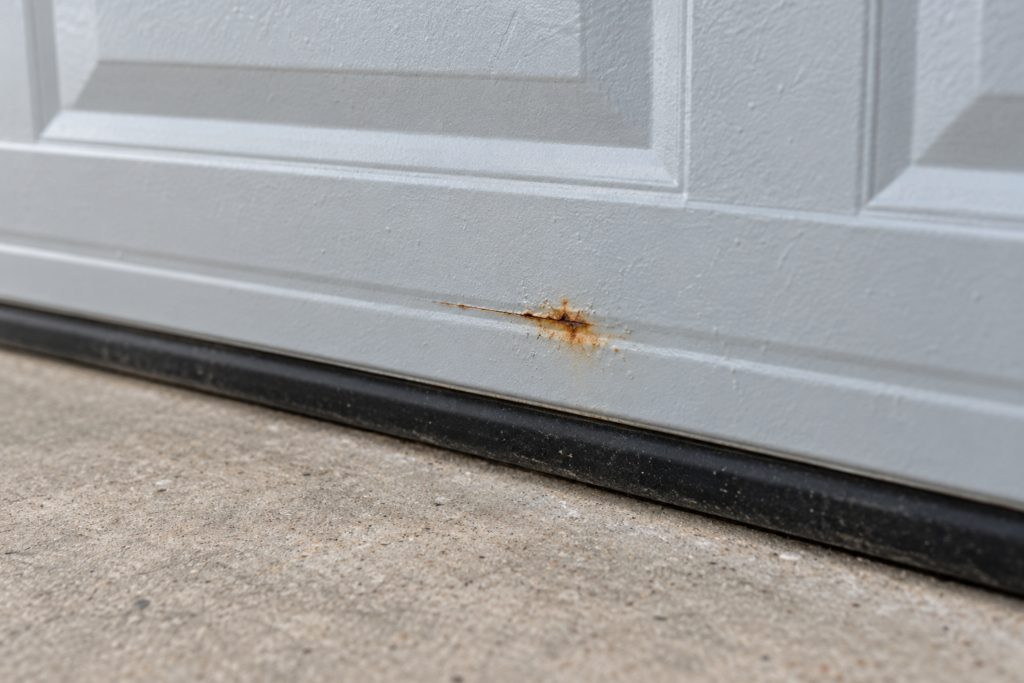
Record whether the surface has only a transferred mark or scratch, whether the finish is broken, and whether the section appears deformed. Do not scrub aggressively to establish the difference. A cleaning product or abrasive can change the evidence and damage a finish that might otherwise have needed a limited treatment.
For a clearly identified finish-only concern, follow the collection’s care instructions. If bare metal, a crack or a sharp edge is visible, keep hands away and ask what treatment is appropriate. This article does not prescribe a product across steel, coated aluminum, wood and composite surfaces.
When the shape is uncertain, use neutral language: “There is a crease beside the joint” is better than “the panel is structurally ruined” or “it is only cosmetic.” A precise observation lets the assessment remain evidence-led rather than steering it toward a conclusion you cannot verify.
What to do with a change in operation
If you already noticed scraping, uneven movement, an unexpected stop or section flexing after the impact, report the sequence. Did the change begin immediately, or was it noticed later? Which part of the movement was affected? Do not repeat the operating cycle simply to make a recording.
A door that closes once after an impact has not thereby passed a complete inspection. A successful motor command does not establish that every damaged part remains suitable for service. Equally, a motor that refuses to move should not be overridden by increasing force or changing travel settings.
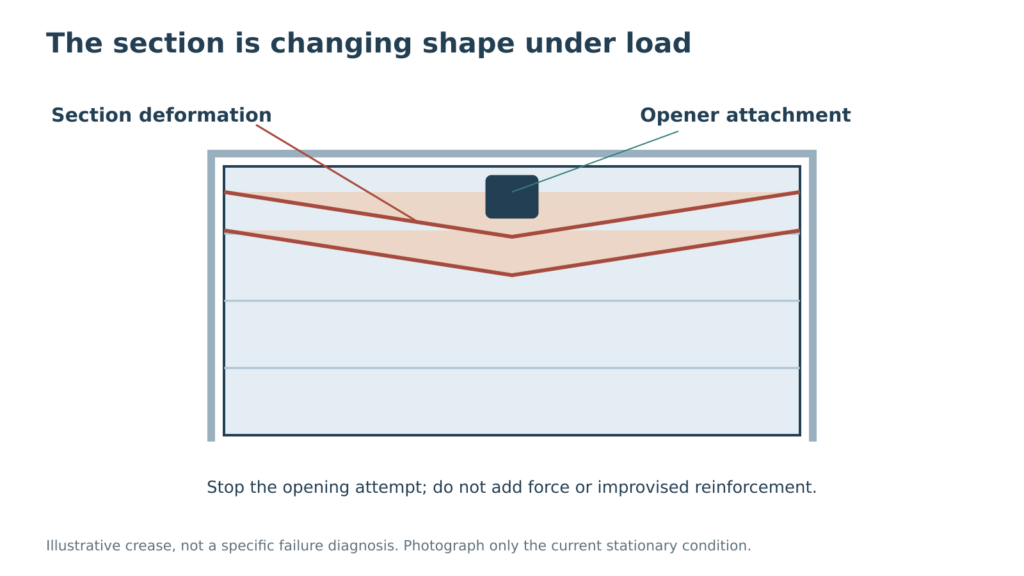
Visible damage accompanied by altered movement belongs in a professional assessment. If the door section itself buckles while opening, describe that as a separate symptom rather than treating it as a dent you can push out. The repair decision should address the condition that causes the abnormal movement, not merely hide the mark.
 Select the diagram to view it at full size.
Make a useful photographic record without creating a new risk
Use available daylight or normal room lighting and take images from stable, accessible ground. A wide view shows the whole opening; a medium view shows the affected section; a closer image can show the surface detail if you can take it without approaching damaged hardware. Keep the original files.
Do not include a ruler if doing so requires placing a hand beside a cable, under a raised door or against a sharp edge. You can describe approximate position in words, and the technician can obtain any necessary measurements safely. A slightly less detailed photograph is preferable to an unsafe one.
Include the door label or paperwork if it is already accessible. Do not climb next to the damaged assembly to complete a photo checklist. Tell the assessor if the inside face cannot be viewed safely; an unavailable view is a limitation to note, not a task you must force yourself to complete.
Ask for a repair decision, not just a cosmetic promise
A useful assessment distinguishes the visible finish damage from any section, joint or hardware problem. Ask what was found, what can be repaired, and what would require replacement. If a cosmetic improvement is possible, ask what appearance can reasonably be expected after the work rather than assuming the mark will become invisible.
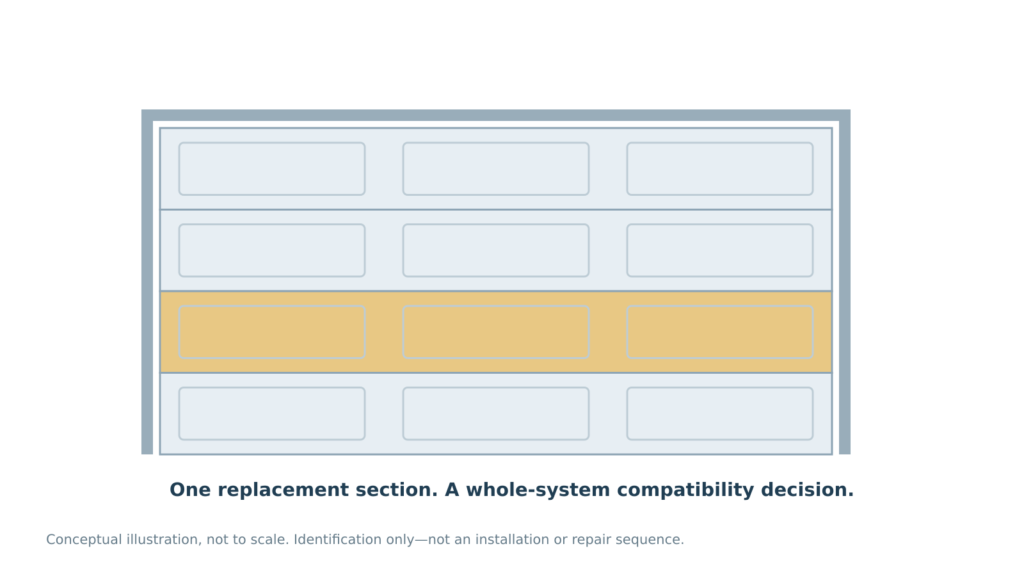
If one section is proposed for replacement, its compatibility and availability need confirmation. Our single-section replacement guide covers that decision separately. A section that matches width and color is not necessarily a suitable part for the door.
If a whole door is recommended, ask why a narrower repair is not appropriate. The answer might concern the extent of damage, the remaining assembly or part availability, but it should be explained for your situation. No generic dent-size threshold or invented price range can settle that decision from this article.
Avoid erasing the useful history
If an impact has just occurred, record the date, the door position and what you observed before cleaning or cosmetic work. This is a practical service record, not a determination of insurance coverage or responsibility. Keep any relevant earlier photographs too, because they may show which marks were already present.
Do not rely on memory to distinguish “the door was noisy before the impact” from “the noise began afterward.” That sequence can change what the technician needs to investigate. If you do not know, write “unknown.” Clear limits on the evidence are more helpful than a confident but inaccurate account. The objective is to understand the door’s condition, not to build a story that favors a particular repair.
Keep the before-and-after record
Save the original photographs, assessment and invoice together. If the work includes an agreed finish difference or leaves an unrelated concern for later attention, have that recorded clearly. This avoids confusing a pre-existing mark with a new issue during a future service visit.
At handover, ask what was checked before the door was returned to use and what maintenance applies to the repaired finish or new component. Do not assume that a different paint or material inherits the original care instructions unchanged.
For a damaged section or an uncertain repair-versus-replacement decision, see garage door replacement assessment. Local Garage Experts takes calls at (323) 924-8777 daily from 6 a.m. to 11 p.m., with free estimates, free diagnostics and no service call fee. Describe the location, the event and any change in movement; those details are more useful than a guess about whether the dent can be popped out.
Sources & manuals
Use the documentation for the actual installed model..