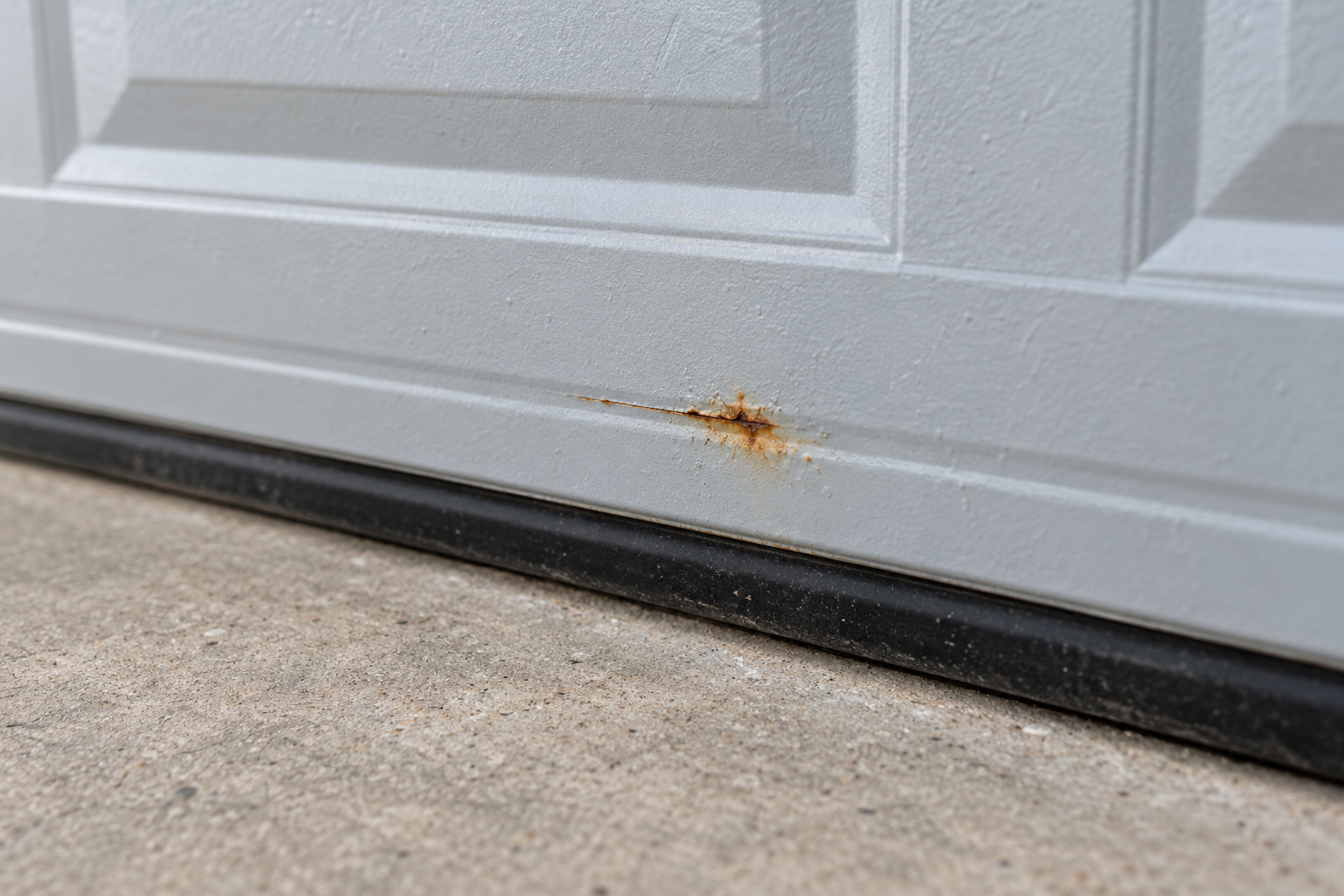
A rust-colored mark records a visible condition; it does not establish the remaining strength of the door.
Rust color alone does not establish the door’s remaining strength. Distinguish a surface finish concern from damage around joints, edges or attachments, and stop use if movement or structure is affected.
The most important question about garage door rust is not how orange it looks. It is where the corrosion is, what surrounds it and whether the door’s behavior has changed. A small mark in a painted panel and deterioration on a lift cable are not the same maintenance problem.
Locate the mark before deciding what it means
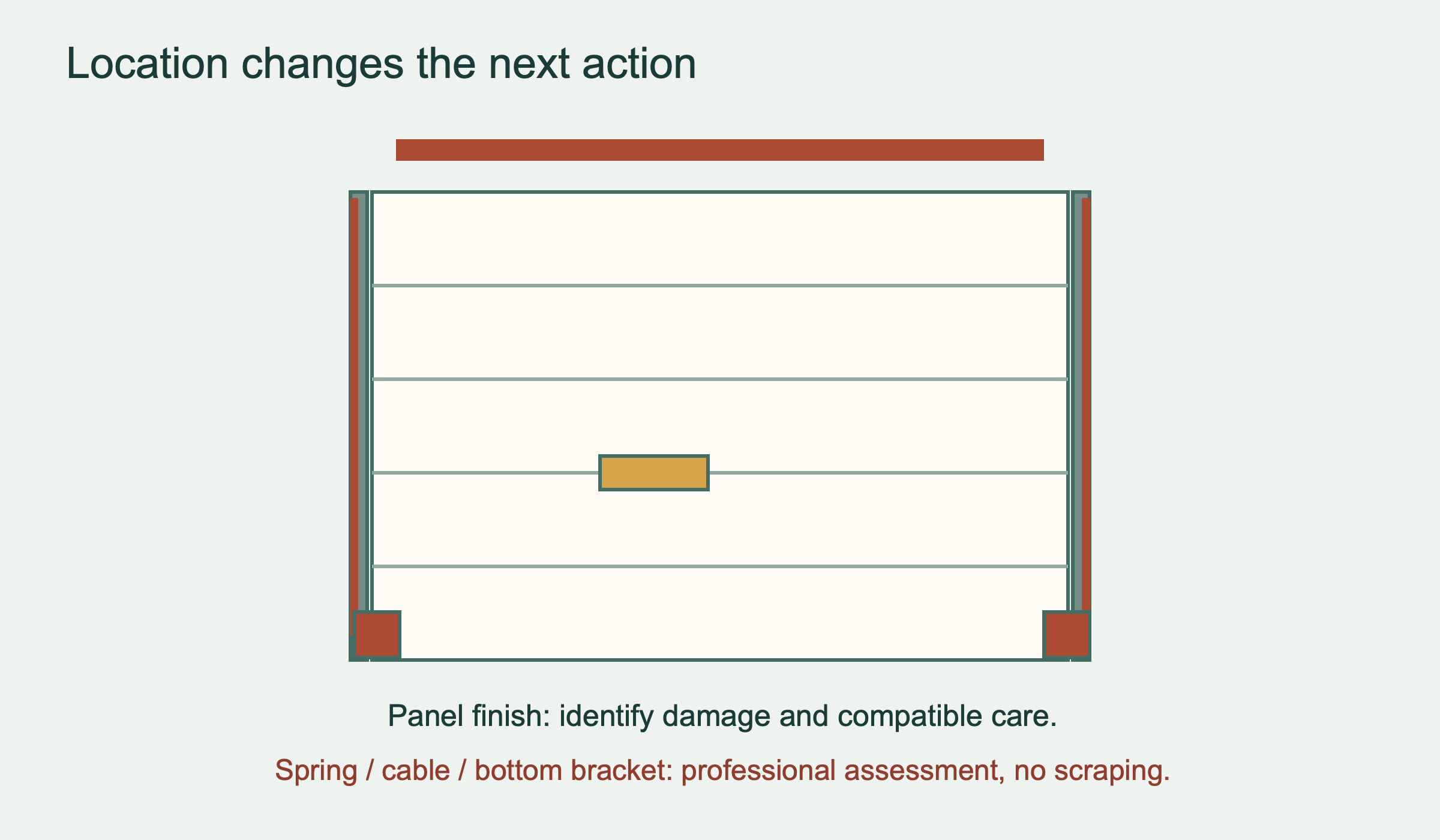
Describe the location in ordinary terms: outside face of the bottom section, edge near a panel joint, around a fastener, on the track, on a cable or on the spring above the opening. Include whether you can see the condition from outside or inside. This is more useful to a service provider than “the garage door is rusty,” because the same word can refer to a decorative finish or a load-bearing component.
On a painted steel face, look for a scratch, chip, lifting paint or a streak coming from somewhere above it. Do not assume the place where a stain collects is the place where it originated. An overall photograph helps reveal that context; an isolated close-up often removes it. Surface deposits, discoloration and corrosion cannot always be distinguished reliably from a phone picture.
At a joint or an attachment, record the surrounding condition too. A mark beside a straight, intact face is different from a mark beside a crack, distorted panel or loose mounting point. You do not need to decide whether the remaining metal is strong enough. That is precisely the question to leave for an in-person assessment when damage is more than an isolated coating defect.
 Select the diagram to view it at full size.
Know when to stop using the door
Stop operation and keep people away if you see a broken spring, a visibly damaged or frayed cable, a roller outside its track, loose supporting hardware, or a door that hangs crooked or is difficult to control. Do not pull the emergency release on a suspect open door. Do not increase opener force or repeat cycles to see whether the problem clears. These are mechanical warning signs, regardless of whether rust caused them.
Clopay’s steel-door care manual identifies springs, cables and bottom brackets as high-tension components and directs owners to seek help for damaged parts or abnormal movement. Its visual inspection is made with the door down. The useful boundary is clear: observing a condition does not authorize loosening, removing or testing the affected hardware.
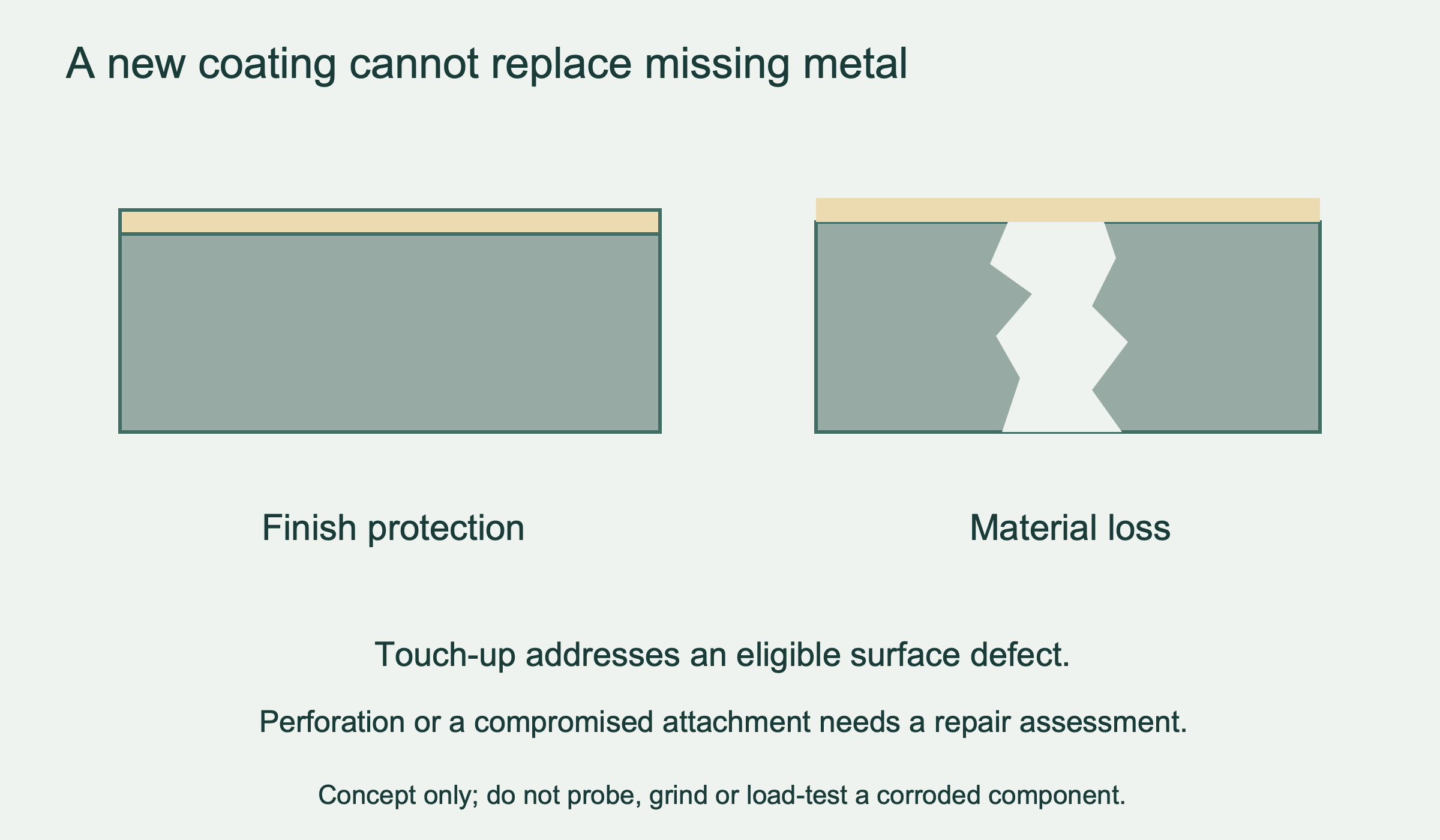
Heavy flaking, visible holes or deterioration at a connection also deserves prompt professional assessment. A photograph cannot tell you how much sound material remains behind a coating. Do not poke a hole, tap the component with a tool or scrape away layers to estimate thickness. If the affected part supports or guides the moving door, avoid further use until its condition is assessed.
A door that still moves has not thereby passed an inspection. The opener may complete a cycle without revealing the condition of a corroded attachment. Equally, a small visible panel mark does not by itself prove that the complete door must be replaced. Both decisions need evidence from the actual affected part.
Document the condition without disturbing it
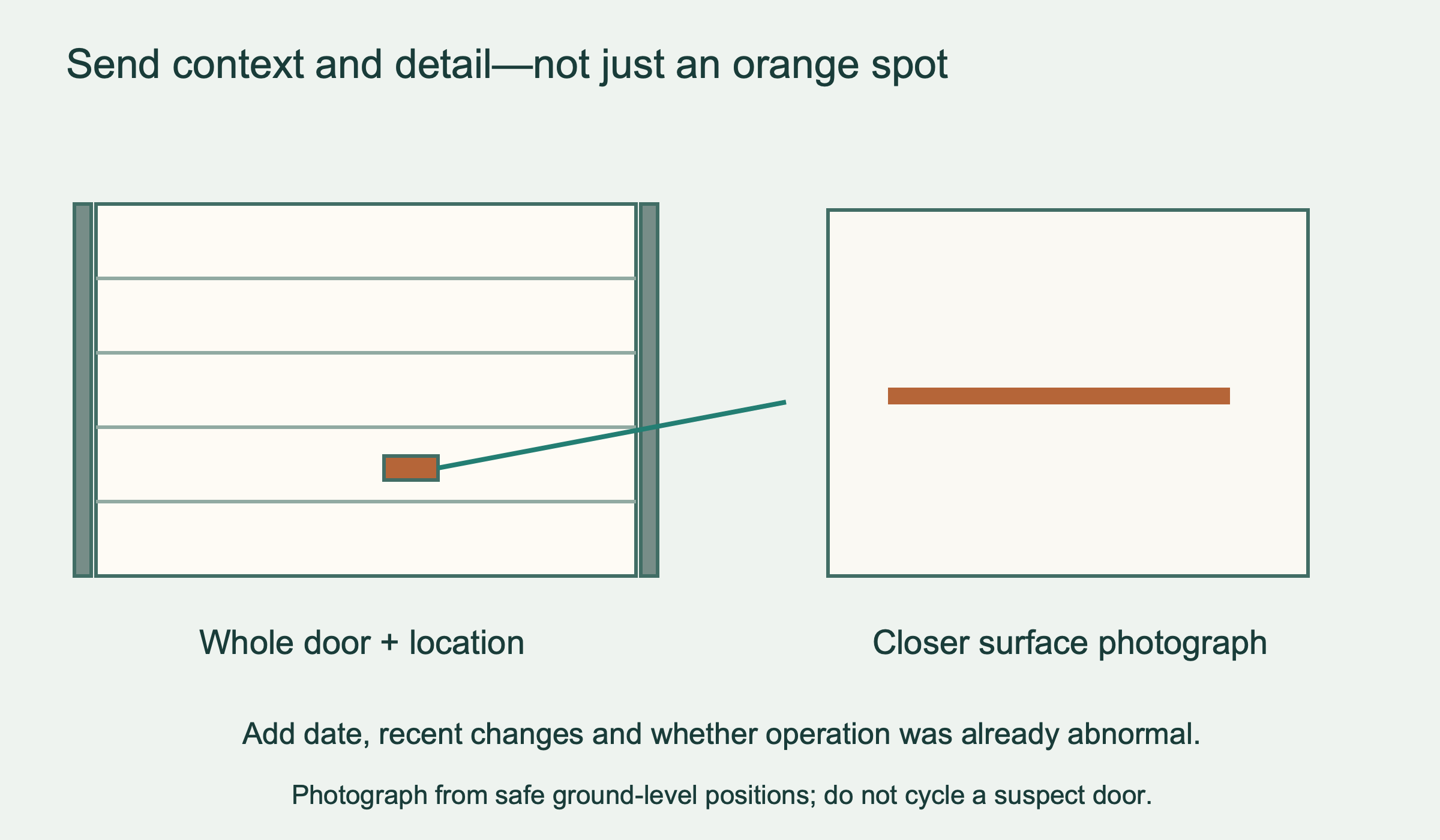
Take one photograph showing the complete closed door and another showing the affected area at a useful scale. Include the nearest section edge or other recognizable feature so the technician can locate it. If a label is readable without climbing or reaching into the mechanism, add that photograph. Leave inaccessible areas undocumented rather than creating an access hazard.
Write down when you first noticed the mark and whether you have an earlier photograph. Note recent impact, repainting, cleaning or water exposure if you know about it. State facts, not a guessed cause: “noticed after washing” is different from “washing caused corrosion.” If a previous touch-up exists in the same place, mention it and provide the product details if available.
Report changes in operation that you already observed: scraping, uneven travel, a new gap or a loose-looking part. Do not create new test cycles for the report. The service provider can decide what inspection is appropriate once the door’s condition and position are known.
 Select the diagram to view it at full size.
What finish care can—and cannot—solve
For the steel collections covered by its repair guidance, Clopay recommends addressing paint damage before exposed metal develops further corrosion. That does not mean every rusty surface should receive the same cleaner, abrasive or primer. Find the care instructions for the exact collection and factory finish before treating an eligible panel blemish.
Cleaning removes contamination; touch-up restores an approved coating at a limited damaged area; structural repair addresses damaged material or attachments. Those jobs have different purposes. A stain that disappears after approved cleaning does not establish the condition of hidden areas, and a fresh coat of paint cannot rebuild a perforated section or a compromised connection.
Use the manufacturer’s finish-specific cleaner and method. Clopay’s finish-care guidance distinguishes ordinary painted surfaces from specialty finishes, and its steel manual excludes pressure washing. Stronger chemicals and harder scrubbing are not automatically better. Avoid letting a general “rust remover” recommendation override the door or coating instructions.
For a small panel defect that has been confirmed as suitable for touch-up, follow the specified repair system or have a finisher do it. Keep the work limited to the eligible surface. If the damaged area reaches a seam, a reinforcement attachment or a part you cannot safely access, pause and have that boundary reviewed rather than expanding the repair by instinct.
 Select the diagram to view it at full size.
Ask for an assessment that names the affected part
A useful recommendation should identify the component, the observed deterioration and the proposed response. “Rust treatment” is too broad if it does not say whether the work concerns a painted face, a section edge or operating hardware. Ask what the inspection found and what the proposed work will restore.
If replacement is recommended, ask whether it is a component, a compatible section or the complete door. A section repair may depend on model availability and its compatibility with the existing system; appearance may also differ from weathered neighboring sections. Do not choose a replacement merely by matching the visible panel pattern.
Where the finding is cosmetic, ask which coating system will be used, what preparation is included and how the repaired area should be maintained. Where the finding is mechanical, request the specific repair scope and the condition of retained components. This keeps an optional repaint separate from work needed for safe operation.
There is no honest universal percentage of visible rust that decides repair versus replacement. Location, material condition, attachment integrity, compatible parts and the rest of the door all matter. Nor does a coastal address alone establish a remaining lifespan. Exposure informs inspection and care; it does not replace them.
Reduce recurrence without promising a rust-free door
Once the condition has been assessed, follow the current care schedule for the identified finish. Increase attention where the manufacturer calls for it because of salt or other harsh exposure. Record cleaning and touch-up dates so a recurring mark can be compared with earlier photographs instead of judged from memory.
Notice where water or debris repeatedly collects around the opening. Keep ordinary loose debris away from accessible surfaces without interfering with seals, tracks or sensors. Recurring wetting may need a separate drainage or building-envelope assessment; coating the door again does not explain why the same area stays wet.
Before making a warranty inquiry, retain photographs, purchase records and the model details. Coverage for a finish defect, surface rust and corrosion through a panel may differ. Let the written product warranty and provider’s inspection determine the claim, rather than assuming that a long paint warranty covers every orange mark.
For corrosion on operating components or any change in door movement, arrange a Local Garage Experts assessment. For an isolated finish issue, start with the collection-specific care instructions. The practical distinction is not “small rust versus big rust”: it is a documented surface-care problem versus a condition whose safety or integrity still needs to be established.