A Torrance repair quote should identify the actual fault and scope.
A useful repair estimate starts with the fault and a defined scope. Compare parts, labor, verification and any replacement alternative on the same basis rather than relying on an unexplained headline price.
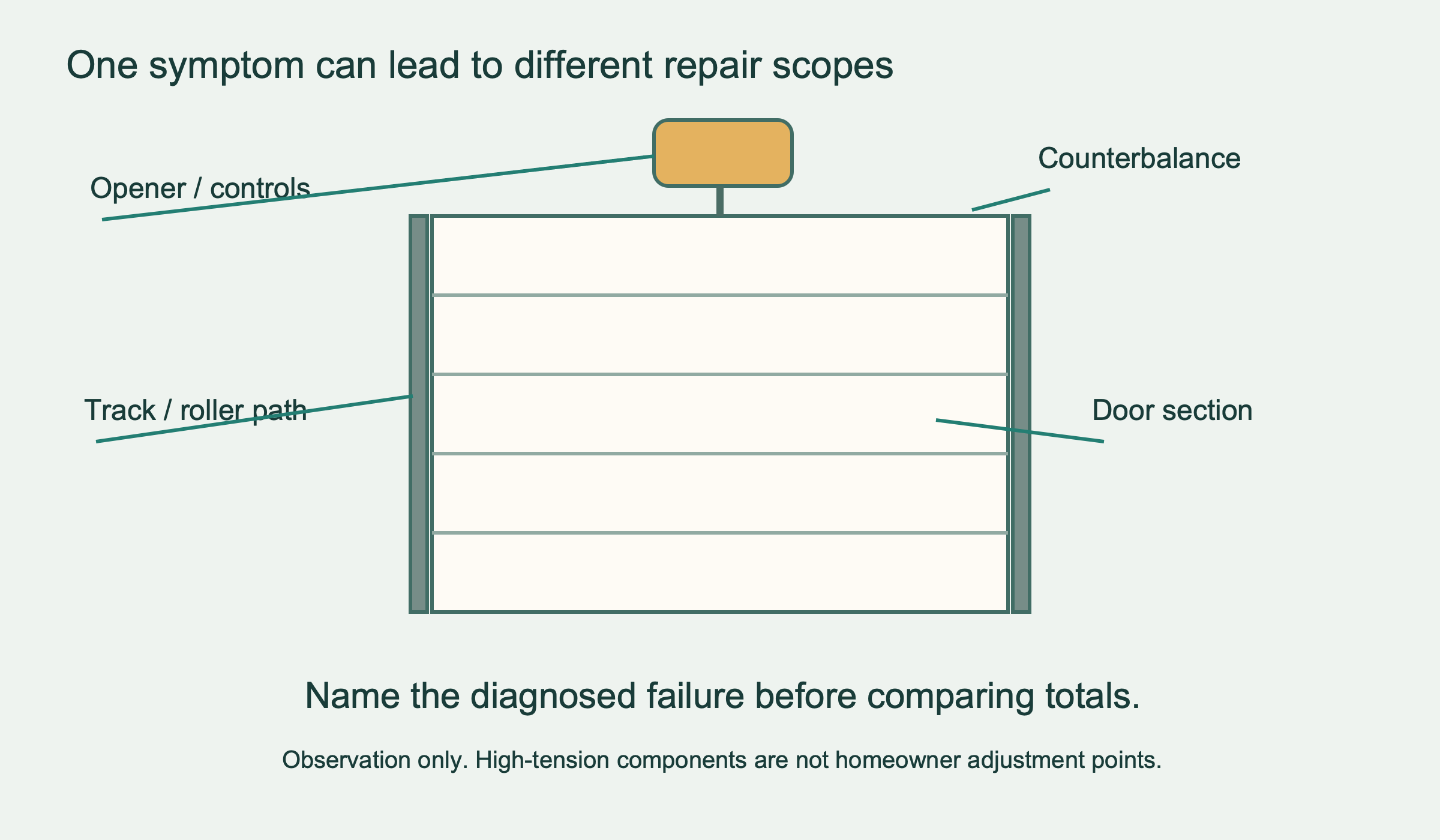
A garage door repair quote should explain the failure before it explains the price. “The door will not move” can describe a control problem, a damaged track, a failed spring or more than one fault. Those jobs do not require the same parts or labor.
For Torrance homeowners, the reliable way to compare garage door repair cost is to compare written repair scopes for the actual door. This article does not offer an invented local price list: we do not have a verified current dataset of equivalent Torrance repair jobs. Instead, here is how to recognize what belongs in a quote, what can change its scope and when replacement deserves a separate comparison.
First, decide whether it is safe to keep using the door
A closing problem without visible mechanical damage may permit a limited ground-level check for an obstruction. But repeatedly running a struggling opener is not a diagnostic method. Describe the symptom to the technician and leave the door undisturbed if you are unsure.
 Select the diagram to view it at full size.
Use the symptom to organize the estimate
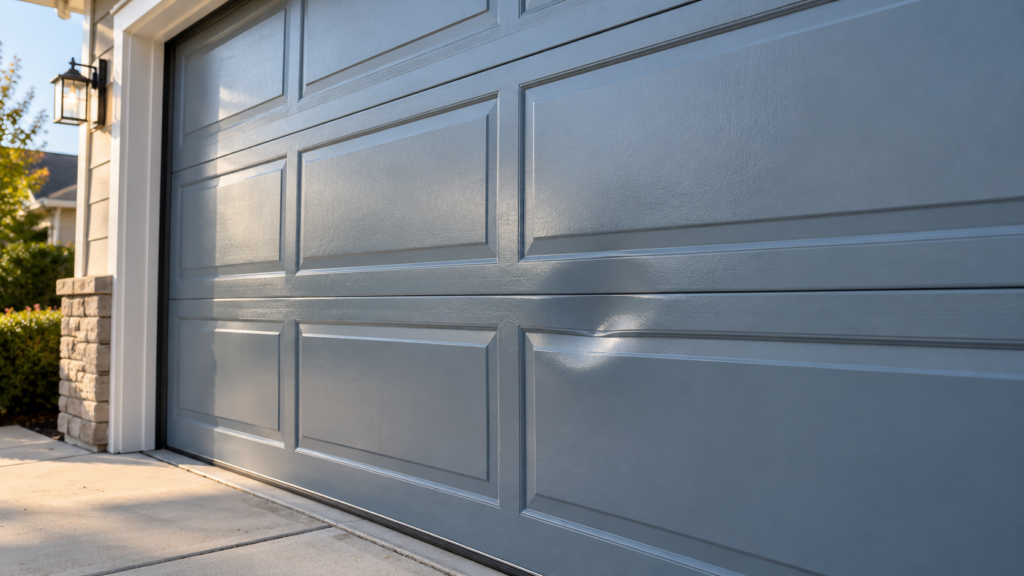
Suppose the door will not close from the remote. That description alone does not establish a failed motor. If the wall control operates it normally, the control path deserves attention. If it begins closing and reverses, the sensor system and physical movement become relevant. If the door is crooked with a loose cable, it is a stop-use mechanical problem. These are decision examples—not claims about actual customers—and they demonstrate why a single “won't close” price cannot be reliable.
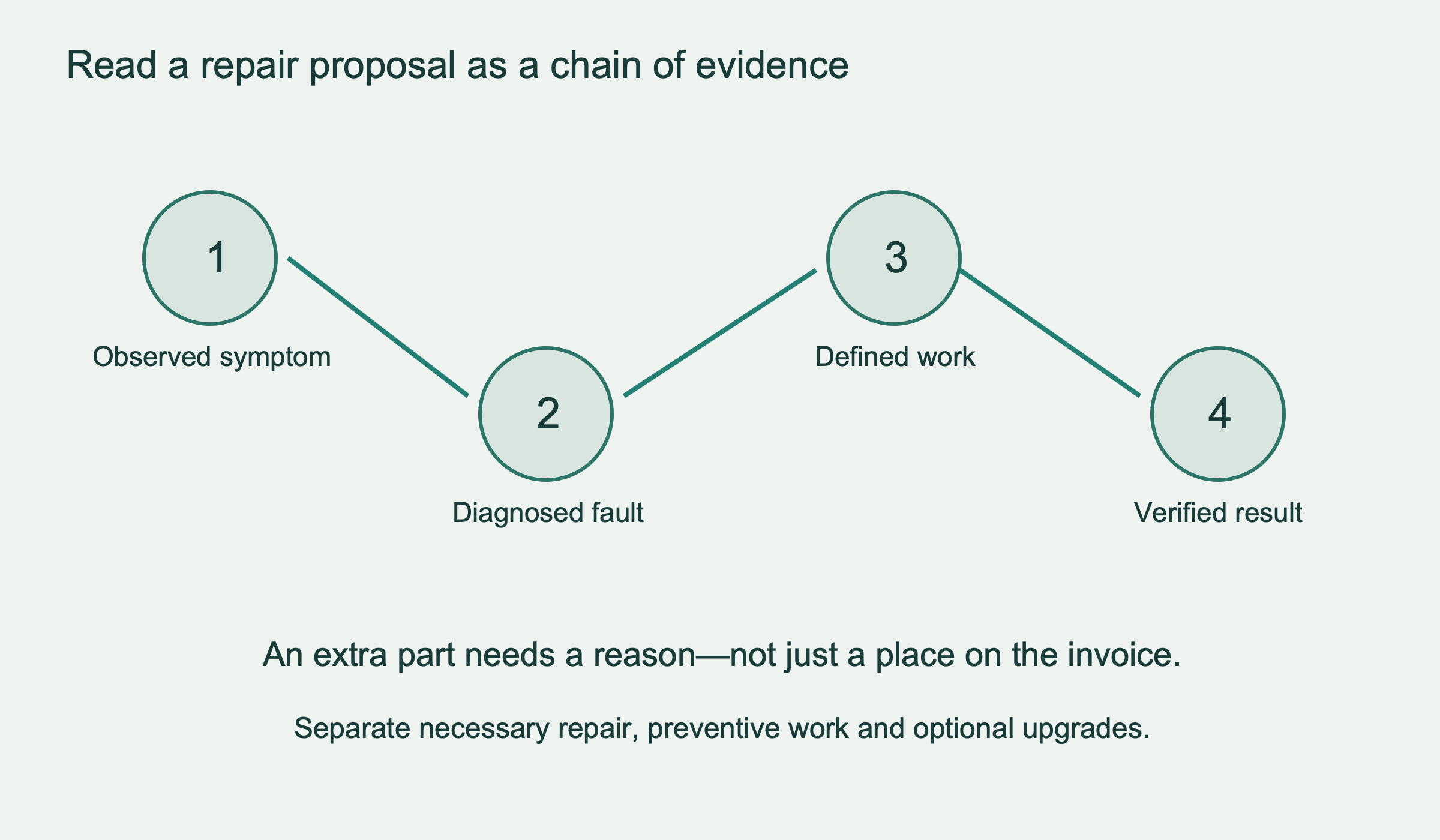
The first useful deliverable from a diagnosis is a clear explanation connecting the observed symptom to the proposed work. “Replace opener” is an action. “The existing control component has failed, a compatible part is unavailable, and this replacement supplies a complete supported system” is a rationale you can evaluate. The technician may find a different fault, but the structure of the explanation should still be understandable.
Keep that diagnosis separate from an optional upgrade. A camera, quieter drive or different door design may be desirable without being required to resolve the reported failure. When necessary repairs and preferences share one bundled total, it becomes harder to choose deliberately.
What changes the scope of a repair?
| Area of work | What a meaningful estimate identifies |
|---|---|
| Springs and counterbalance | The diagnosed fault, compatible replacement specification and checks of related components |
| Cables, rollers and tracks | Which parts are damaged and whether alignment or supporting structure is involved |
| Opener and controls | The failed component, compatibility, programming and safety checks |
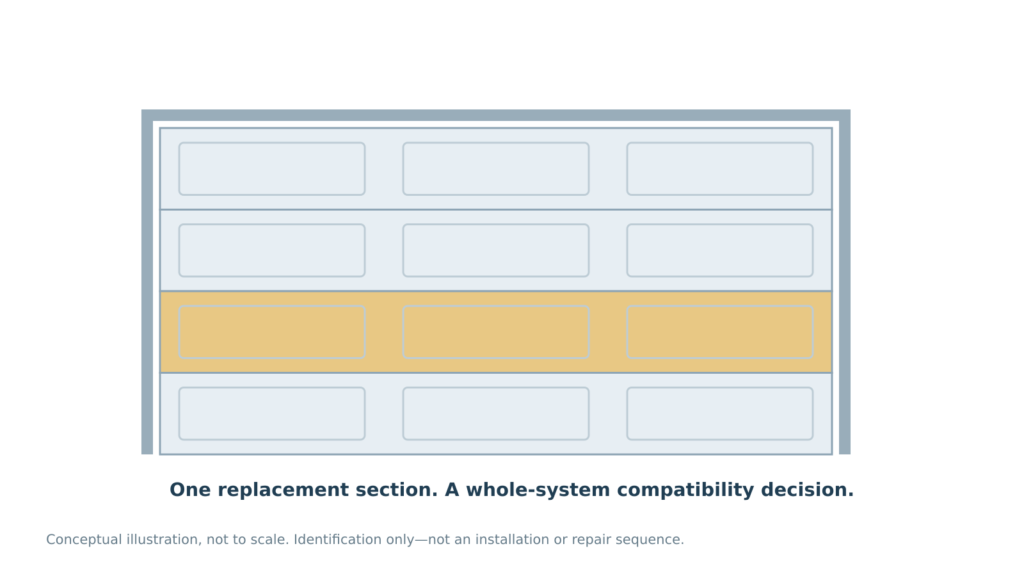
| Door sections | Whether a suitable replacement section is available and how it matches the existing door |
| Seals and minor hardware | The specific material, dimensions and installation included |
Ask the technician to distinguish the part that failed from any additional work recommended. A related defect may genuinely need attention, but “while we are here” is not a diagnosis. Have the estimate identify whether each item is necessary for safe operation, preventive maintenance or an optional improvement.
Parts that look similar are not necessarily interchangeable. Springs are not selected solely by how long the old spring appears, and opener components are not compatible merely because they share a brand. The quote should reflect the installed system rather than a generic replacement kit.
 Select the diagram to view it at full size.
Read the total, then read the exclusions
Ask whether the quoted amount includes parts, installation labor, setup, functional checks, removal of replaced components and applicable charges. Confirm whether the figure is an estimate pending inspection or a defined price for an identified scope.
Have the contractor explain the warranty in writing. Parts coverage and labor coverage can differ. Ask what is covered, for how long, who handles a claim and what exclusions apply. A longer-sounding warranty is difficult to compare if the covered component is not named.
For any additional work found during the visit, request an explanation and revised scope before it proceeds. Photos of the defect can help you understand the recommendation without approaching high-tension hardware yourself.
At Local Garage Experts, estimates and diagnostics are free and there is no service call fee. That does not mean repair parts and labor are free. Ask for the repair proposal before authorizing the work, and do not infer a repair price from the absence of a visit charge.
Does living near the coast change the answer?
Exposure matters, but a Torrance address alone cannot establish a part's remaining life or a repair surcharge. Look at the door's actual condition, its finish, the manufacturer's care instructions and the exposure at the property.
Clopay's finish-care guidance calls for more frequent cleaning in coastal or other harsh environments. That supports taking maintenance seriously; it does not support predicting that every coastal spring will fail after a fixed number of years.
Maintenance evidence is better than a postcode assumption
For a coastal-exposure concern, a useful record includes when the finish was cleaned, where deterioration first appeared and whether it is spreading. A photo of a panel surface does not establish the condition of a concealed cable or the remaining life of a spring. Avoid translating a rusty-looking surface directly into a replacement interval.
The relevant distinction is between care of an intact coating and repair of a component whose condition is in question. The former may follow a manufacturer's cleaning or touch-up instruction. The latter needs an assessment of the actual part. Buying a different coating or a more expensive metal does not remove the need to confirm compatibility with the door system.
 Select the diagram to view it at full size.
Repair or replace: compare complete options
A targeted repair can be worth considering when the rest of the system is serviceable and suitable parts are available. Replacement deserves a separate proposal when damage is extensive, a matching section is unavailable, or several substantial problems need to be addressed together.
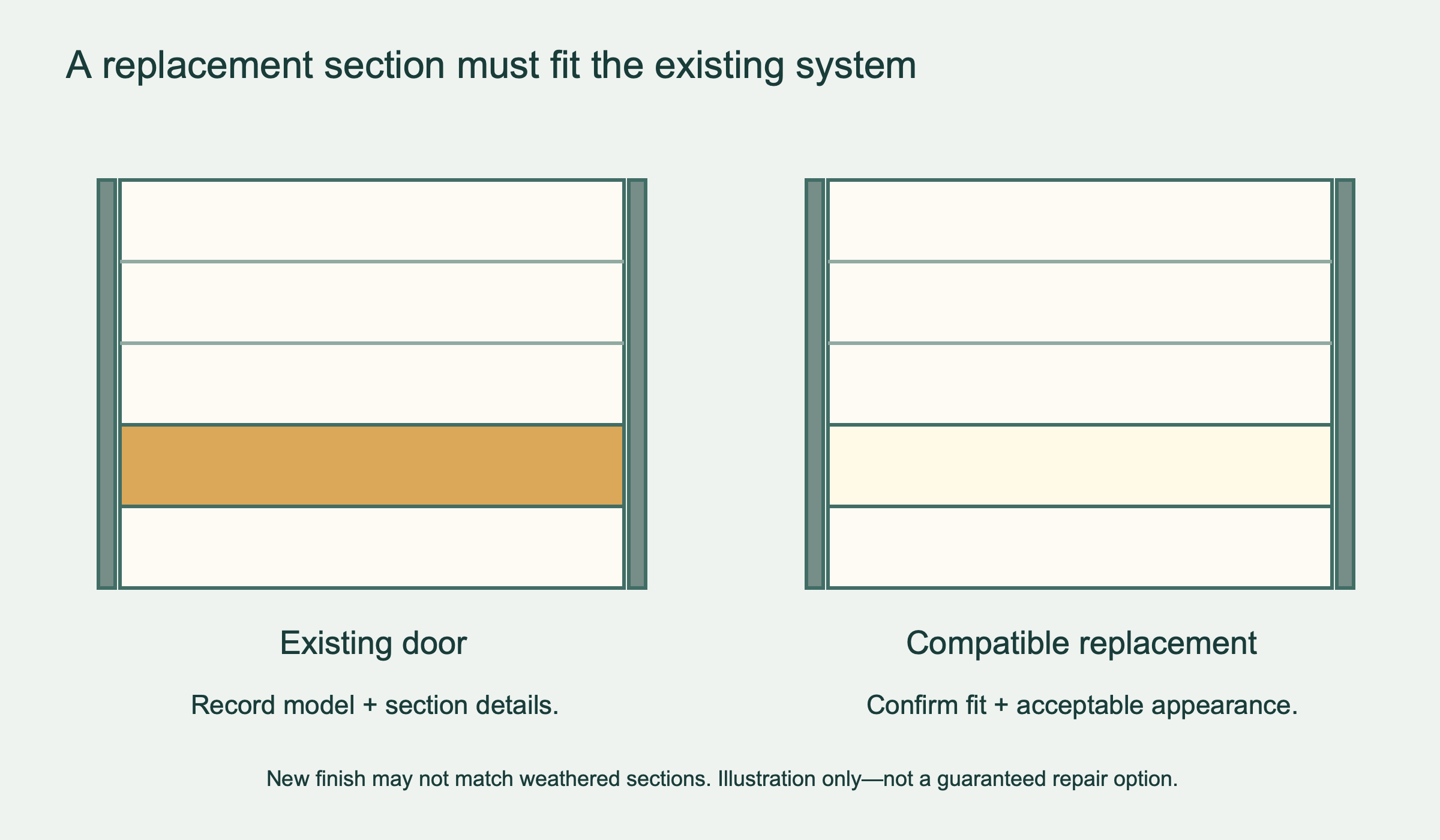
Clopay notes that replacement sections depend on the door model still being manufactured and that weathering can affect color matching. A panel-only repair should therefore answer two questions: will it function correctly, and will the appearance be acceptable?
Do not use a single percentage of “new door cost” as an automatic decision rule. Compare the actual repair proposal with the actual replacement proposal: retained components, new components, finish, insulation if relevant, warranties and disposal. Ask what problems each option resolves and what remains unchanged.
An opener and a garage door are separate parts of the system. Replacing one does not automatically require replacing the other. If both are recommended, ask for the reason for each and a clear breakdown rather than one unexplained package.
Compare what remains, not only what changes
A section replacement can leave the rest of the door in place. An opener replacement can leave the door and its counterbalance in place. A complete door proposal may or may not include a new opener. Write down the retained equipment beside each option. That makes it possible to compare the future system instead of assuming the word “replacement” means everything is new.
For each option, identify the unresolved concern. If the only concern is a damaged section, a suitable section repair may address it. If the proposal also aims to change appearance, insulation or configuration, those are additional goals. Separating them makes a larger project a conscious choice rather than an automatic response to one failed part.
Questions to ask before booking in Torrance
- What information would help you diagnose the issue safely—photos, model number or the sequence of symptoms?
- Who is the business performing the work, and where can I verify its contractor information?
- What is included in the proposed repair, and what remains subject to inspection?
- Are replacement parts available for this model?
- What warranty covers the parts and the installation labor?
- Does the proposed scope need city or property-management approval, and who will confirm it?
- How will you document and price any change before proceeding?
Use the CSLB license lookup to check contractor details. For a project-specific permitting question, consult the City of Torrance's official permit resources. Do not assume every repair requires a permit—or that no garage-door work ever does.
Frequently asked questions
Can a photo provide an exact repair price?
A photo can identify visible damage and help prepare for a visit. It may not establish door balance, hidden wear or the complete fault. Take it from a safe position; do not move the door just to obtain a better picture.
Should I buy the replacement parts myself?
Only after compatibility and responsibility are clear. Ask who confirms the specification, who handles an incorrect or defective part, and how owner-supplied parts affect the labor proposal and warranty.
Does a noisy garage door always need replacement?
No. Noise is a symptom, not a diagnosis. Describe when it occurs and whether movement has changed. Stop use if it accompanies a crooked door, visible damage or unstable travel.
For the relevant repair scope, see spring repair, track repair or opener service. To discuss your Torrance door, call (323) 924-8777 daily from 6 a.m. to 11 p.m.