Location, timing and recent changes are more useful than a guessed part when describing a noise.
Describe where and when the noise occurs before choosing a fix. Scraping, uneven movement or visible damage calls for assessment; lubrication and opener adjustments cannot correct every source of noise.
A noisy garage door does not come with a reliable sound-to-part dictionary. A squeak is not automatically a dry hinge, a rattle does not prove the chain is loose, and a bang does not identify a broken spring by itself. The most useful starting point is to describe where the sound seems to originate, when it occurs and what else changed.
This guide helps you turn an everyday complaint—“the garage door sounds terrible”—into evidence that supports the right next step. It does not ask you to run a damaged door repeatedly or disconnect it to experiment.
First separate ordinary noise from an unsafe change
A single loud event followed by an inability to move the door deserves a different response from a long-standing vibration during otherwise normal travel. In the first situation, trying more commands or pulling the release cord may introduce another risk. Keep the opening clear and explain the event and current door position when requesting service.
If there is an electrical burning smell, smoke or visible electrical damage, do not keep testing the opener. Stay clear of the affected equipment and arrange appropriate professional help. The rest of this article concerns sound observations, not electrical troubleshooting.
For a door that remains apparently intact, describe what you have already heard before choosing maintenance. “Apparently intact” is not a certification of safety; it simply avoids treating every familiar operating sound as proof of an emergency.
 Select the diagram to view it at full size.
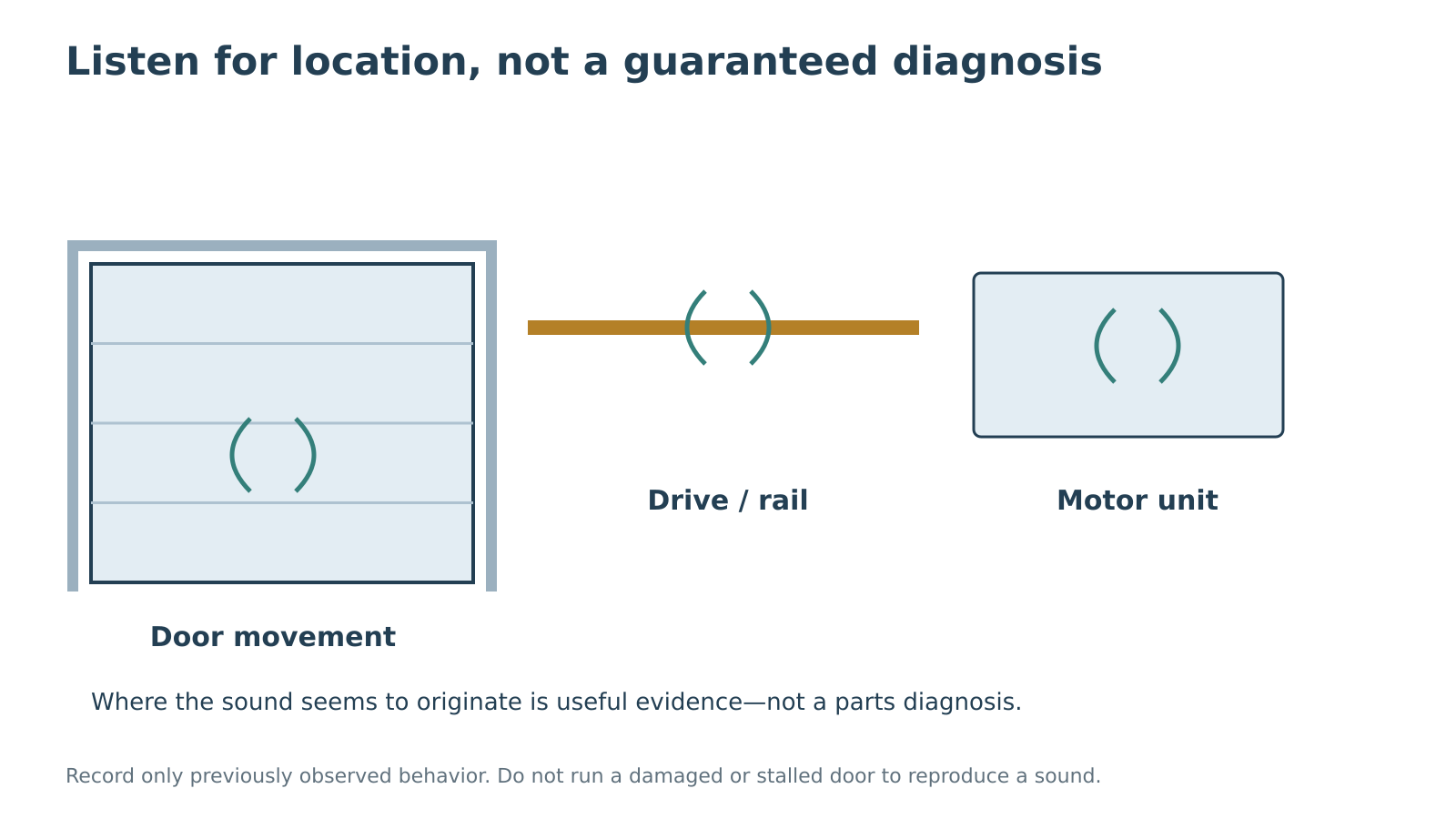
Locate the sound as best you can
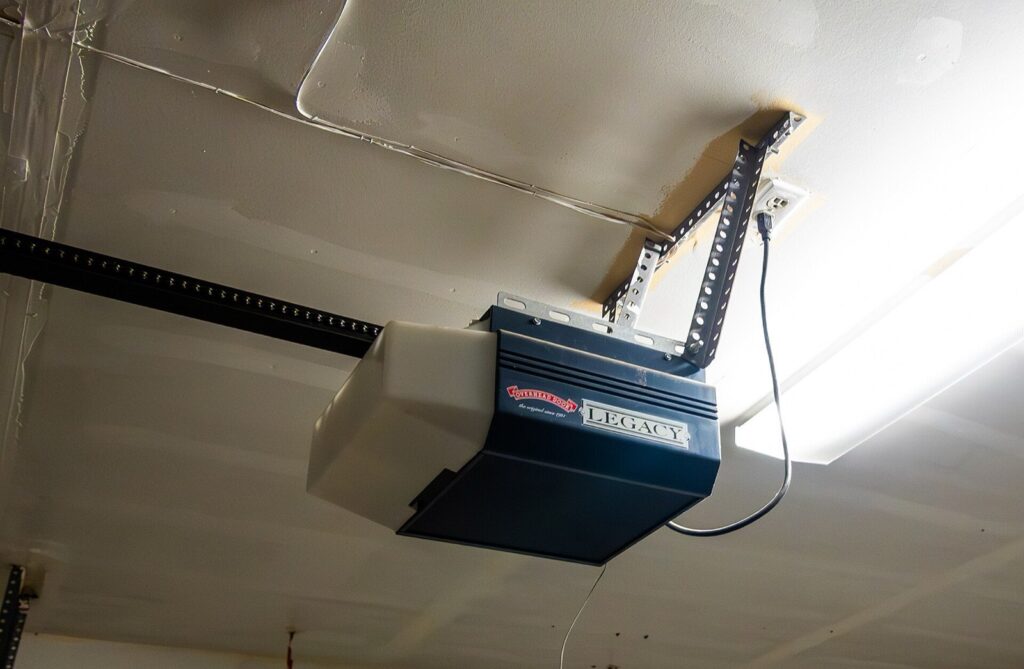
The drive and rail: the sound seems to come from above the vehicle route, along the opener’s rail or near its trolley. Describe whether it is a repeated rattle, a brief contact sound or a continuing noise. A chain-drive system and a belt-drive system do not have identical maintenance requirements.
The motor unit or its mounting: the sound seems concentrated at the opener housing or transmitted into the ceiling. A room above the garage may amplify an otherwise hard-to-locate vibration. Report where it is heard, but do not assume that the loudest room identifies the defective part.
Chamberlain Group’s noise troubleshooting separates door-related, opener-related and installation-related issues. That is a useful organizing principle, not a guarantee that a homeowner can isolate the source by listening alone. Connected structures transmit vibration, so “seems to come from” is often the most accurate wording.
 Select the diagram to view it at full size.
Add the phase of travel
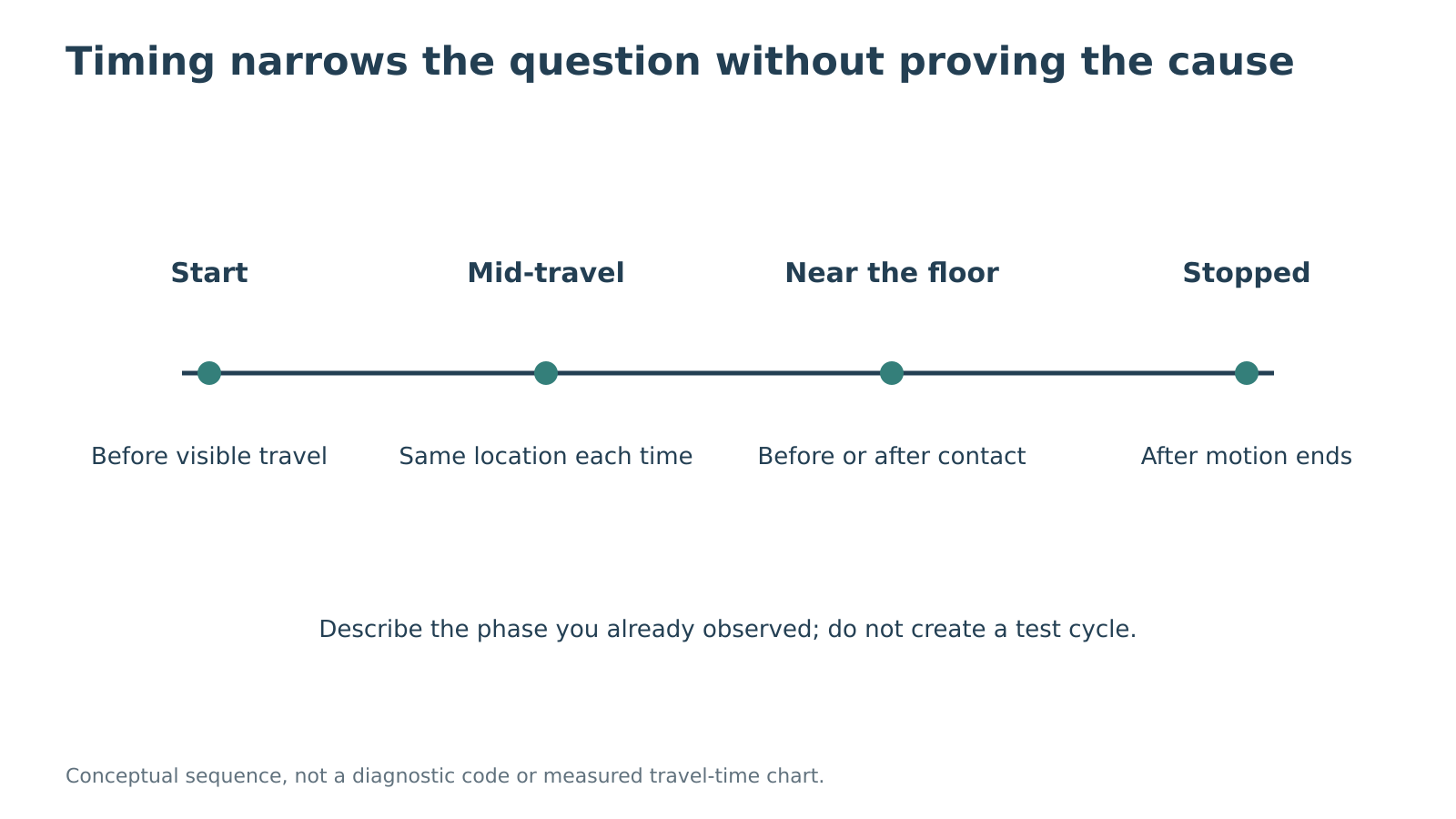
A noise at the instant the opener starts is different evidence from a scrape at the same point halfway through travel. A sound near the floor may occur before contact, at contact or after movement has stopped. Those distinctions can be more useful than whether you call it a squeal or a screech.
Use simple timing descriptions: “just as movement begins,” “near the curved track,” “through most of the opening,” or “after the door reaches the floor.” If you know the noise occurs in one direction only, include that. Do not run another cycle solely to fill a blank in your notes.
| Observation | Useful detail | What it does not prove |
|---|---|---|
| A repeated scrape | Same side and apparent travel location | That the track simply needs lubricant |
| A rail-area rattle | Whether it began after work or changed with movement | That tightening the chain is the answer |
| A ceiling vibration | Where it is heard and when it begins | That the motor itself has failed |
| A loud bang followed by abnormal movement | Current door position and visible damage | A safe reason to attempt another cycle |
These are reporting examples, not a diagnostic chart assigning a repair to each sound. The same description can arise from different installations, and several problems can be present together.
Write down what changed before the noise
Recent work can be relevant even when it was not performed on the noisy part. A new opener, replaced roller, changed door section or impact near a track belongs in the history. So does a door that has become noticeably slower, less even or harder to operate.
Include what you have already tried. If lubricant was applied, identify the product and where it went as accurately as possible. If a nut was turned or a setting changed, say so. This information helps the next person avoid assuming that the installation is still in its original condition.
Weather and temperature can be recorded when a clear pattern has already been observed, but correlation is not proof. “Only on cold mornings” is a useful clue; “the cold has ruined the motor” is an unsupported conclusion. Keep the note descriptive until the actual condition is checked.
A sound that disappears temporarily also does not prove a repair. The operating conditions may have changed, or the noise may be intermittent. Judge the outcome against the identified cause and required verification, not just the quietest cycle you happened to hear.
 Select the diagram to view it at full size.
Why lubricant is not a universal answer
Maintenance can matter, but products and application points are system-specific. A dry component, damaged bearing, deformed track and loose mounting are different conditions. Lubrication cannot restore a cracked part or correct the shape of a damaged track.
Do not spray indiscriminately into the track, onto electrical parts or throughout the opener housing. Use the actual door and opener maintenance instructions for permitted products and locations. Some components have restrictions that a general “lubricate everything that moves” instruction ignores.
Before selecting maintenance, compare the observed symptom with the care instructions for the actual door and opener. Record the product, permitted application point and interval rather than treating every sound alike. If the noise began suddenly or accompanies abnormal travel, assessment comes before an attempt to quiet it.
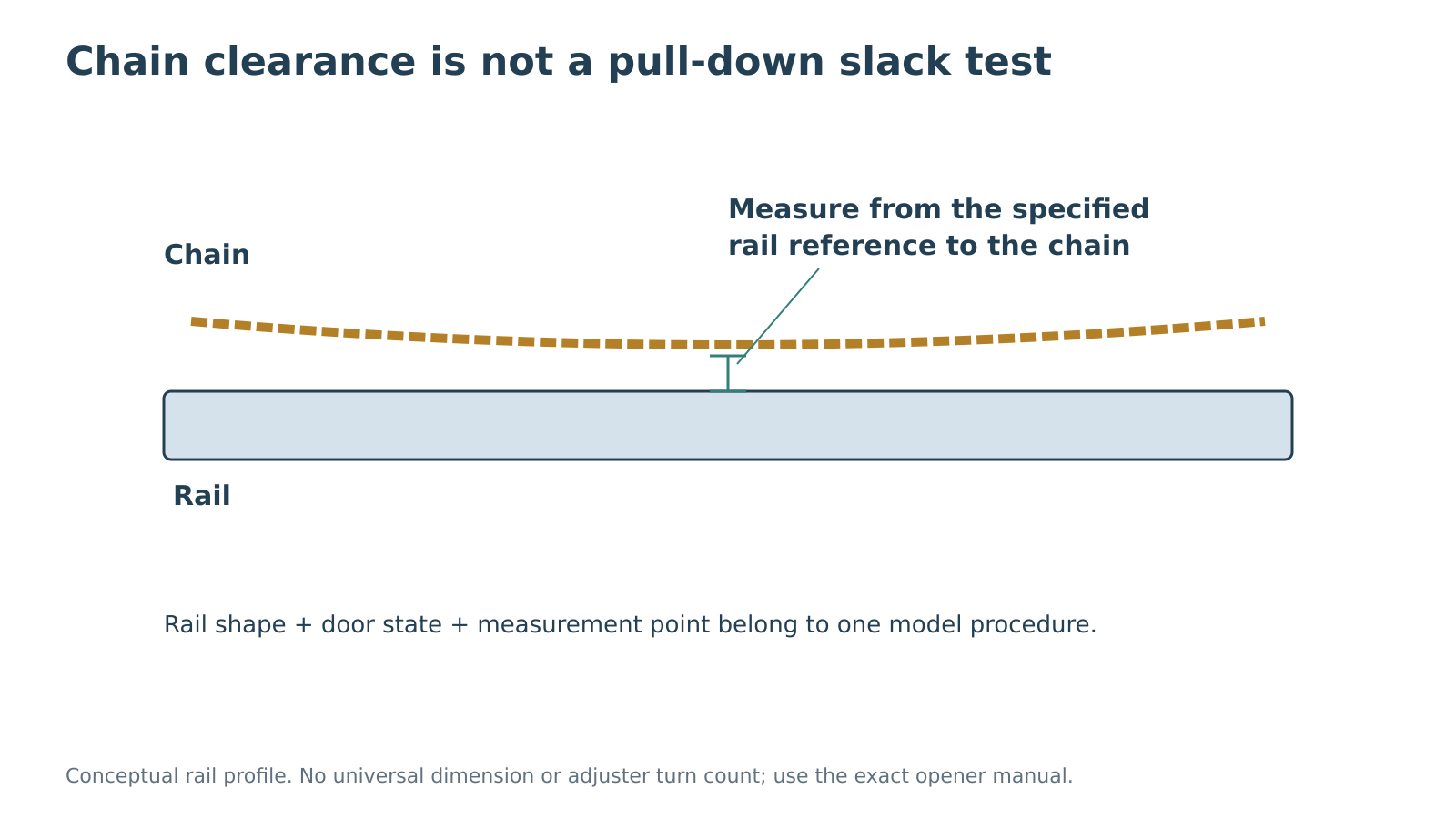
The same distinction applies to chain tension. A chain that looks slack in one state is not automatically misadjusted, and too much tension can also cause noise. Our chain-tension guide explains the model-specific reference conditions rather than treating sound as a setting.
Make a recording only if it adds safe evidence
An existing recording can help communicate a sound, but a phone microphone may emphasize some frequencies and suppress others. A clip is useful evidence, not a substitute for inspecting the door. Mention whether the phone was beside the track, near the motor or in a room above the garage.
Do not create another recording when the door is damaged, stuck, tilted or behaving unpredictably. Do not stand beneath it or recruit someone to hold a phone close to moving hardware. A written description and stationary photograph are enough to start the service conversation.
For an already available clip, preserve the ordinary context rather than trimming it down to one isolated click. The moment just before and after the sound may show whether it occurred at startup, during travel or at a stop. There is no need to add dramatic sound effects or a guessed diagnosis to the file name.
A useful request is short and specific
Try this structure: location, travel phase, change in behavior, recent history. For example: “There is a new scraping sound on the right near the curve during opening. It started after a bicycle struck that side. We stopped using the door.” That is a fictional reporting example, not a claim about a customer job.
Ask the technician to explain the identified source, why the recommended work addresses it and which final operating checks were completed. If the source remains uncertain, that uncertainty should be recorded rather than hidden behind a generic parts replacement.
For noise concentrated around the drive or motor, opener assessment is a relevant next step. For a visible roller concern, see roller wear recognition. A better description will not repair the door by itself, but it makes a guess less likely to become an unnecessary or unsafe intervention.