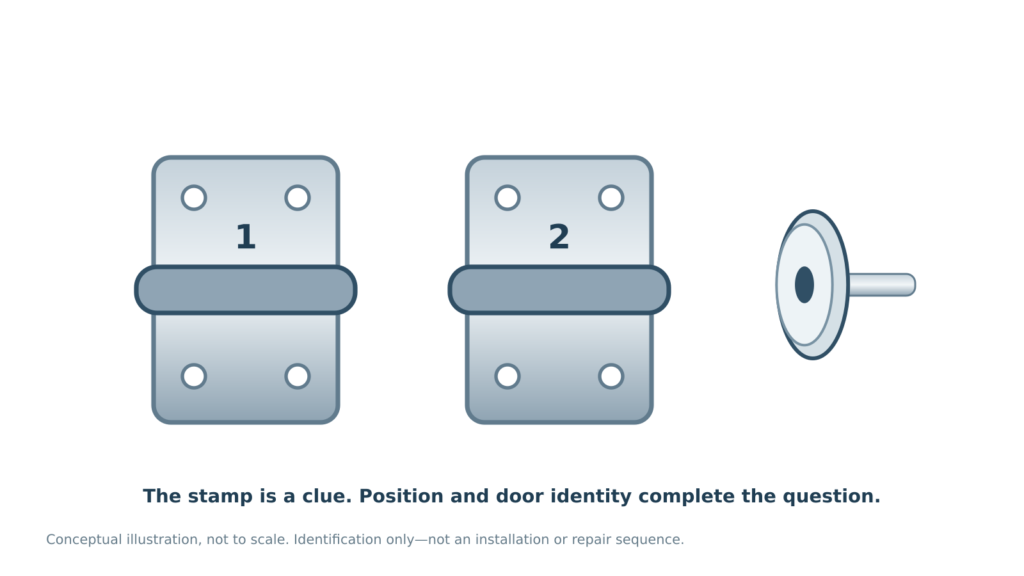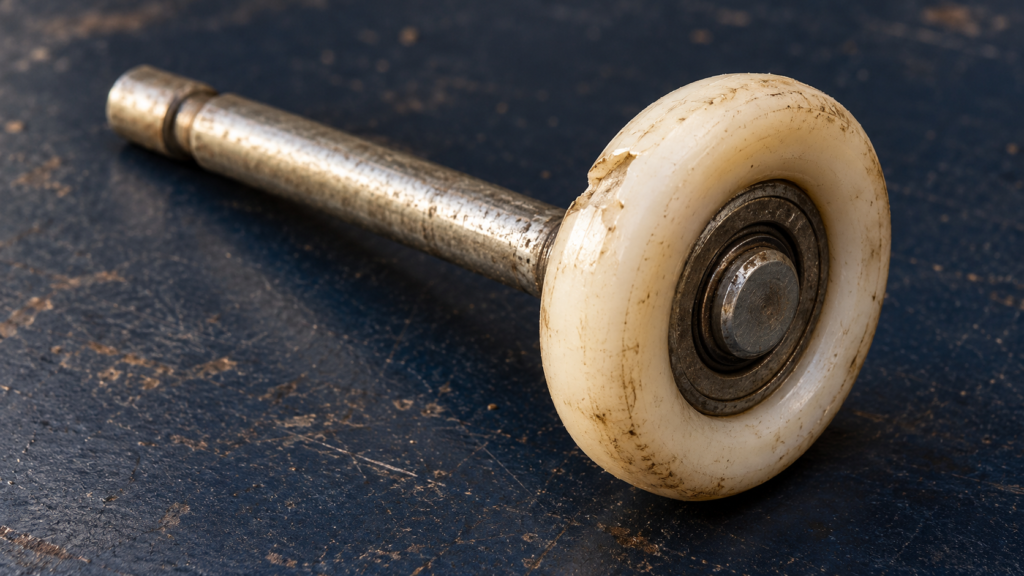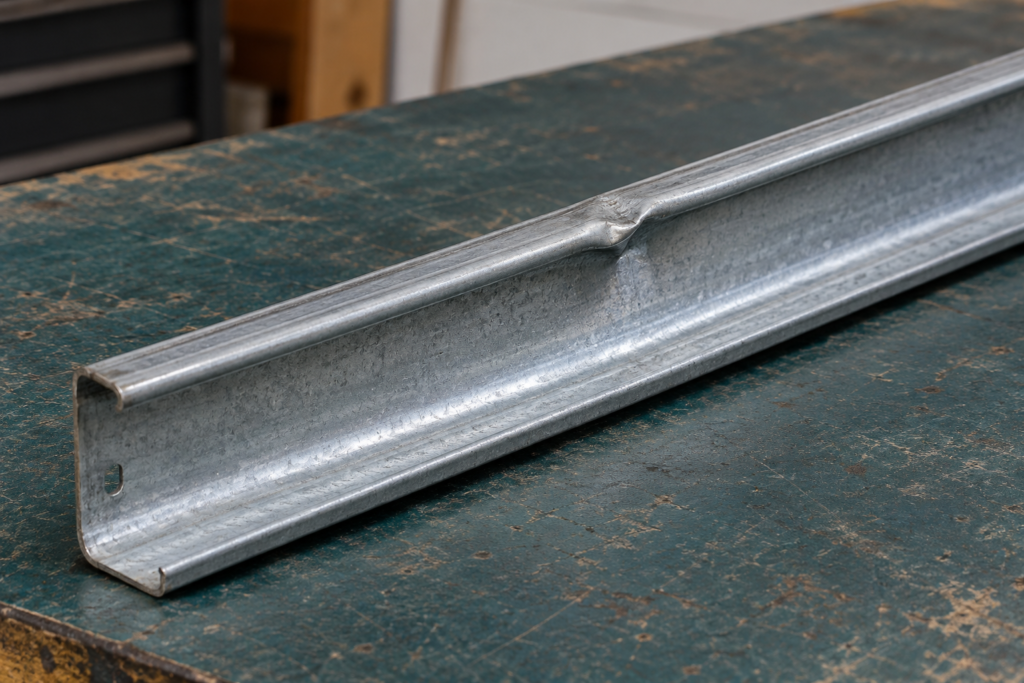
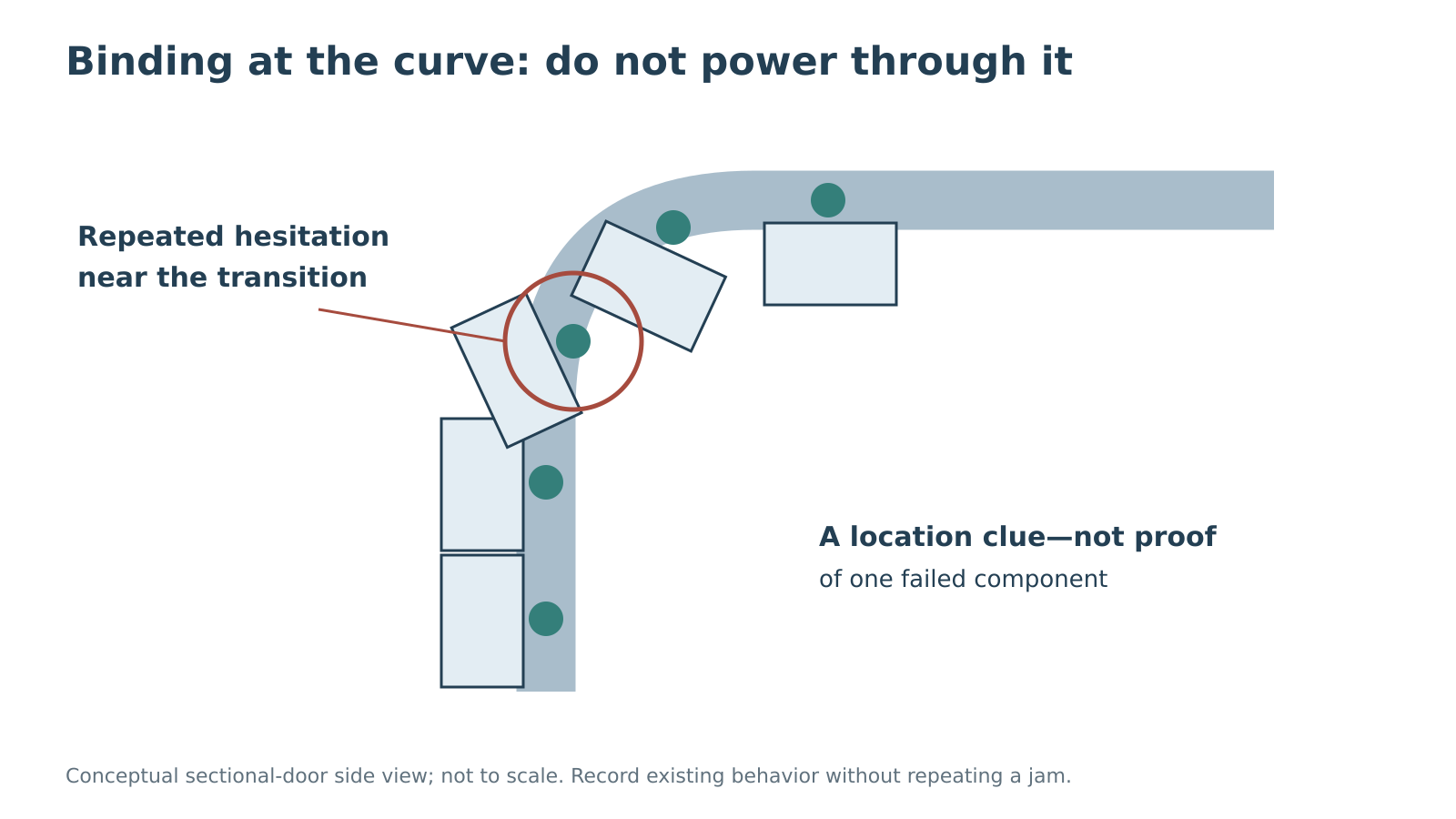
The curved transition is a location clue, not proof of one failed part. Sections and rollers are simplified for explanation.
Binding at the track curve identifies where the symptom occurs, not which part has failed. Record the location and visible changes without forcing the door or straightening hardware.
If your sectional garage door repeatedly hesitates, scrapes or jams near the track’s curve, stop trying to power it through. The location is useful evidence, but it does not identify one failed part. The curve is where rollers and connected door sections change direction together; a problem anywhere in that relationship can become noticeable there.
This guide addresses binding near the transition from vertical to horizontal travel. It is different from a confirmed off-track roller, a visibly bent track or a closing failure caused by a safety-sensor beam. The goal is to preserve useful observations and understand the assessment—not to supply a track adjustment procedure.
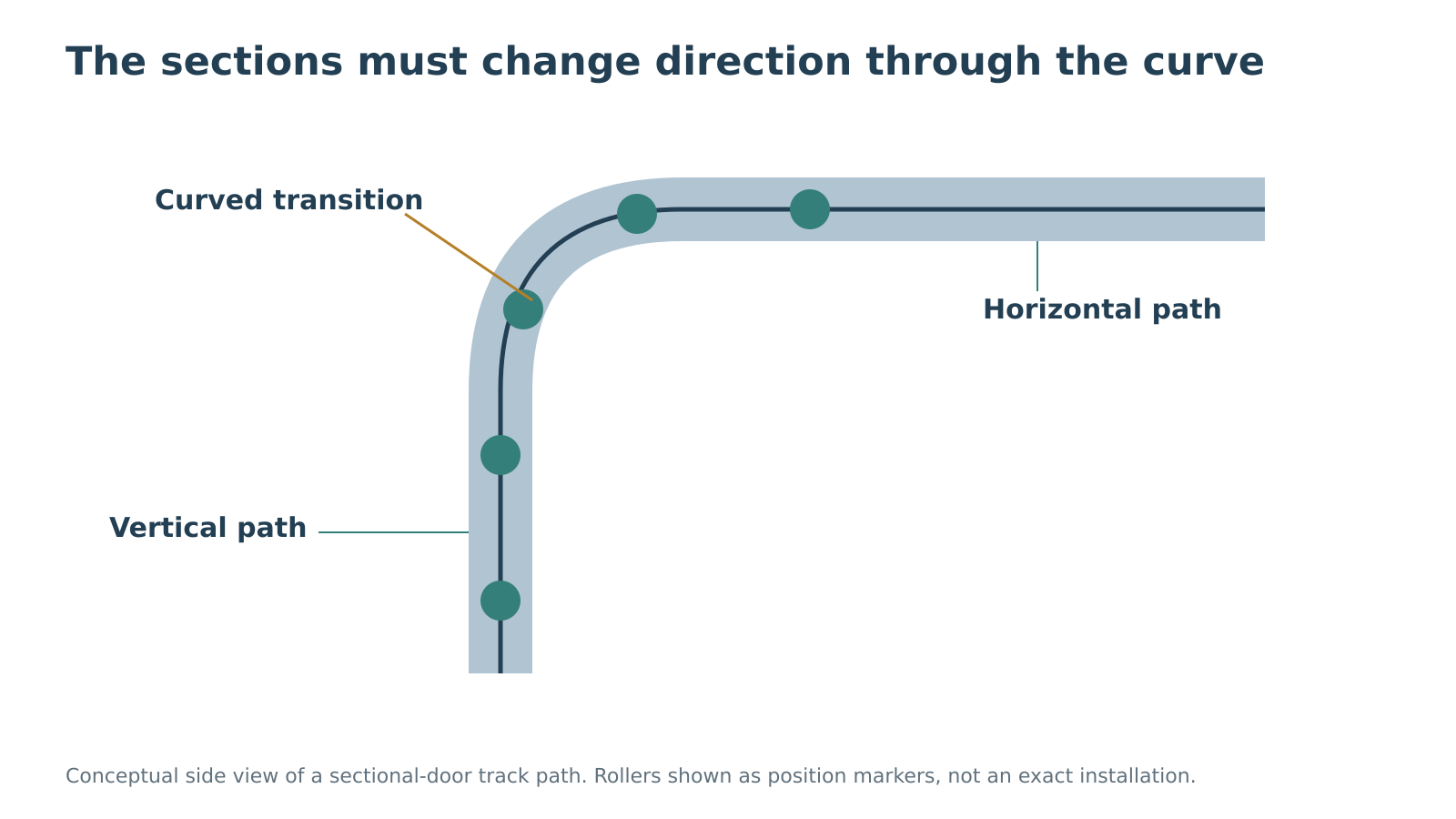 Select the diagram to view it at full size.
Why the curve is a revealing location
A sectional door is not one rigid slab. Hinges connect sections so their angles can change while the rollers follow the tracks. Near the curve, that change in angle is more apparent than along a straight vertical run. The door, roller positions and guiding path must work as a compatible system.
This does not mean that the curve is automatically defective whenever a door stops there. A worn or damaged roller, affected hinge connection, distorted section, track condition or abnormal door movement may all be relevant to an assessment. The visible stopping point can be where a problem becomes evident rather than where it began.
Genie’s maintenance guidance describes rollers, hinges, track and counterbalance components as parts of the same door system. Clopay advises professional attention for bent or twisted tracks and damaged components. Neither principle supports solving an unexplained jam by increasing opener force or making repeated attempts.
The most helpful description is therefore “the door binds near the right-hand curve,” not “the curve needs to be widened.” One is an observation; the other has already chosen a repair without establishing the cause.
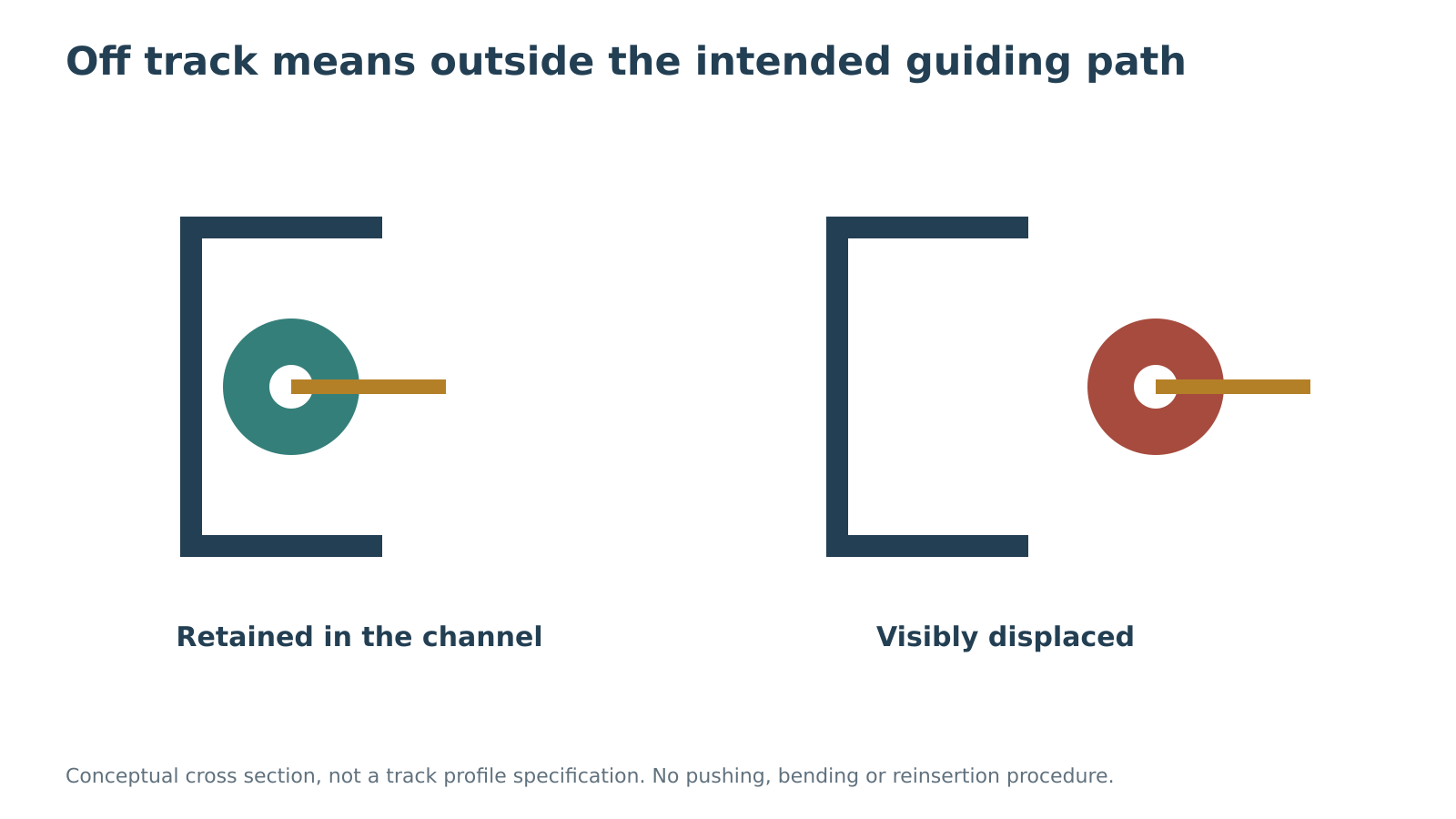 Select the diagram to view it at full size.
Identify the symptom without recreating it
A stopped door may now obscure the place where the problem occurred. Leave it in its current position. Moving it to expose a hinge or roller can change the loading and turn a reportable jam into a more serious displacement. Photographs do not need to show every part to justify a service visit.
If a roller is visibly outside the track, report actual derailment and use the off-track recognition guide. If the metal track has an obvious kink or crush, report that separately and see the bent-track guide. Binding without either visible condition remains a valid description.
Know when an observation becomes a stop-use condition
A door that jams, becomes tilted, deforms a section or shows a loose cable should remain out of use. Keep people clear of the opening. Do not pull the emergency release on a suspect open door, push one side upward or have someone support a corner while you press the control.
A motor that continues to push or pull does not prove the door is safe to move. Nor does a successful second attempt mean the first jam was harmless. The relevant question is whether the mechanical system is sound, not whether the opener can overcome the resistance on this occasion.
If the door is stuck with a vehicle inside or the opening cannot be secured, state that when arranging service. Access needs can influence how the visit is planned, but they do not justify improvised lifting or support. Use a separate normal pedestrian entrance if available.
If controls can be kept from accidental use without entering the hazard area, do so. Disconnecting electrical power does not remove spring tension or support an unstable door. It should never be treated as permission to loosen track hardware.
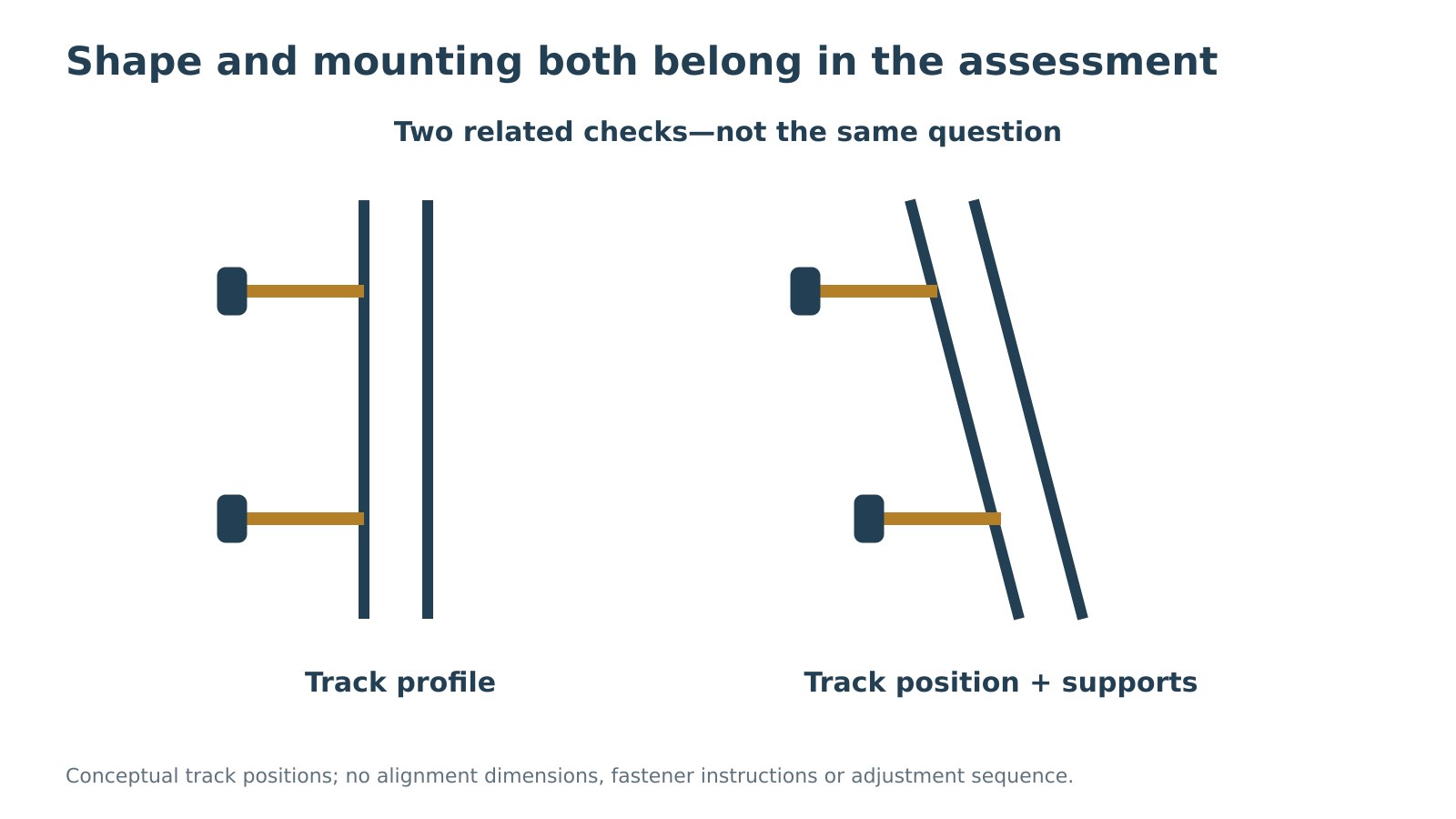 Select the diagram to view it at full size.
Details that help distinguish geometry from maintenance
Report whether the problem began after an impact, roller replacement, hinge work, new section or other modification. A part can look similar yet differ in the dimensions or position that matter to door travel. The hinge identification guide explains why a number or visual resemblance is not a universal interchangeability rule.
Also report visible changes in the surrounding structure: a support that appears displaced, a new gap at an attachment, or a section joint that looks different from its neighbors. Do not shake the track or loosen fasteners to find out how much it moves. Stationary evidence is enough to identify a concern.
A squeak may prompt a maintenance question, but binding is a movement problem. Lubricant cannot correct the geometry of an incompatible component or restore a deformed track. Product and application choices still belong to the specific door’s maintenance instructions, not to a generic spray-everything response.
Similarly, the track’s curved shape is intentional. A homeowner should not decide that the bend itself is damage and try to straighten it. The technician needs to distinguish the designed transition from local deformation, incorrect positioning or an unsuitable component.
Photograph the relationship, not just the scrape
From a safe position, a wide picture can show the current door height, the affected side and the relation between the sections and track. A second zoomed view may show a visible concern at the curve or nearby attachment. Do not climb beneath the horizontal track or stand under the door to get it.
A photograph of a shiny wear mark can be useful, but it is not a measurement of alignment. Reflections, viewing angle and the absence of scale can be misleading. Describe what caught your attention and let the assessment establish whether the mark is relevant.
Include any existing door model identification and records of recently installed parts. If those labels are inaccessible, say so rather than moving the door or reaching into the mechanism. An old invoice can be more useful than a risky close-up of a hidden label.
A brief written account should separate facts from uncertainty: “It stopped near the curve; I could not see whether the roller was still inside,” is perfectly useful. There is no benefit in converting an uncertain view into a confident diagnosis.
What the repair explanation should connect
Ask which condition caused or contributed to the binding and how the recommended work addresses it. The answer may involve a component, the guiding path, the door’s condition or more than one issue. The scope should not be reduced to “adjusted track” if a damaged roller or section also required attention.
Where replacement parts are proposed, ask how compatibility with the door was established. Track shape, rollers, hinges and section attachments are not chosen independently simply because each fits in the available space. Keep the identified model and part information with the work record.
Ask what was checked after the correction: smooth intended travel, appropriate counterbalance and the opener’s specified safety functions once the door is mechanically sound. The precise verification belongs to the installed system’s documentation. A brief movement past the former sticking point is not the whole handover.
For an assessment of the guiding system, see garage door track service. The valuable homeowner contribution is a clear account of the location, direction and history. Repeated cycling adds risk and may damage the evidence; a careful description helps the repair address more than the point where the door happened to stop.