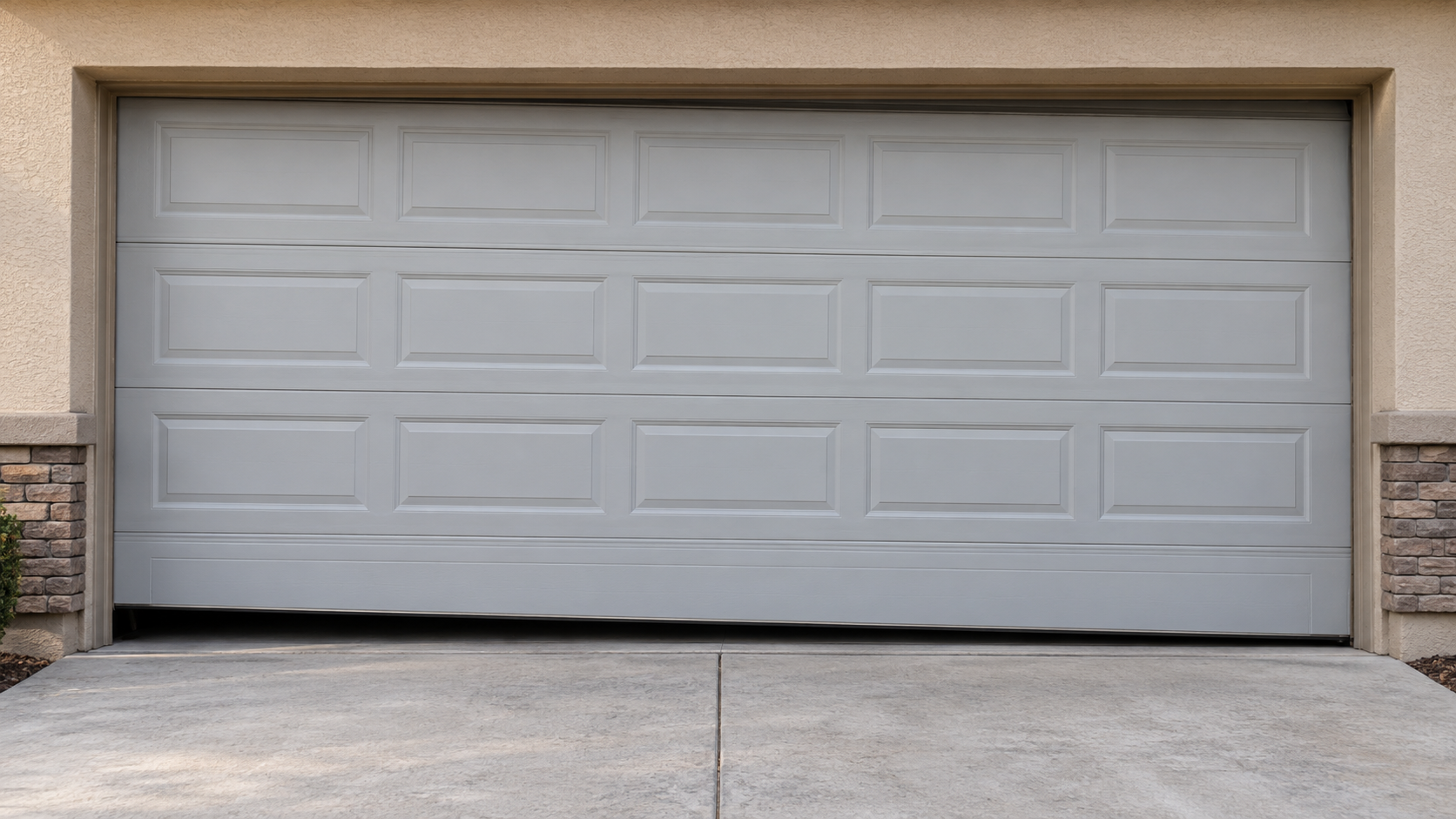
An uneven gap alone cannot identify the cause; report movement you actually observed.
A door opening crooked needs assessment of the complete moving system. Stop operating it and describe the uneven movement; do not try to level it by adjusting cables or hardware yourself.
The first useful distinction is between a door that moves crooked and a stationary door with an uneven-looking gap underneath. Those observations can look similar in a photograph, but they do not establish the same problem. This guide helps you describe the difference from the door’s current position, without operating it again or assuming which part failed.
Uneven travel is different from an uneven floor gap
Think back to what you actually saw. Did the door’s lower edge change angle while it rose? Did one side stop while the other continued? Or did you first notice daylight beneath one corner after the door was already closed? The first two describe movement. The last describes a gap, which needs its own context.
A floor line is not automatically a level reference. A sloping or irregular surface can create an unequal-looking gap beneath a stationary door. Compare the door’s orientation with the floor’s shape separately; the gap alone does not establish the cause or prove that a closed door is safe.
If the concern is only weather entering beneath an otherwise normally operating door, the seal and floor relationship need a separate assessment. If there was actual asymmetric travel, do not treat a thicker seal as the answer. A cosmetic attempt to hide the gap would not explain what happened during movement.
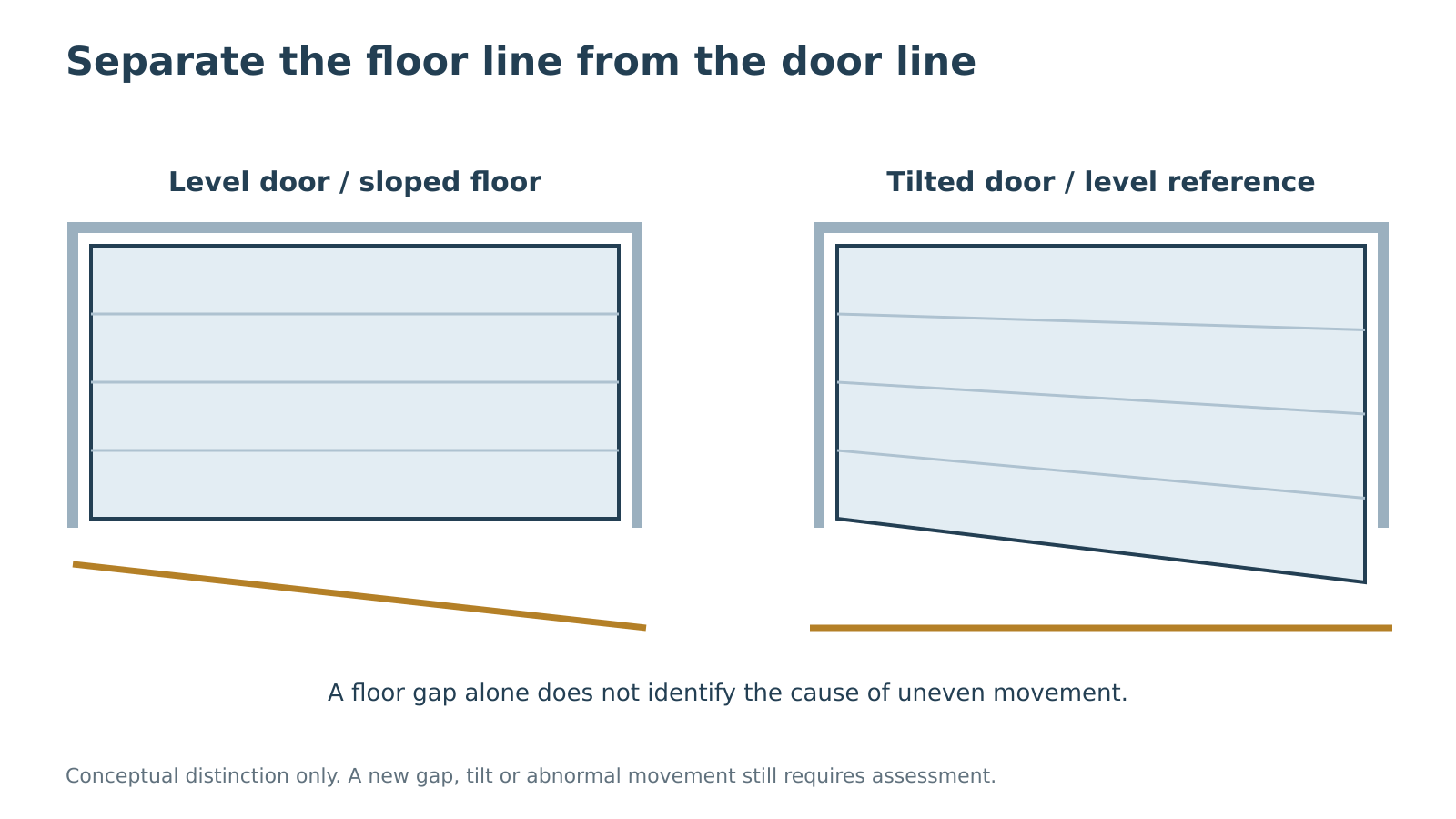 Select the diagram to view it at full size.
Record the position before naming the cause
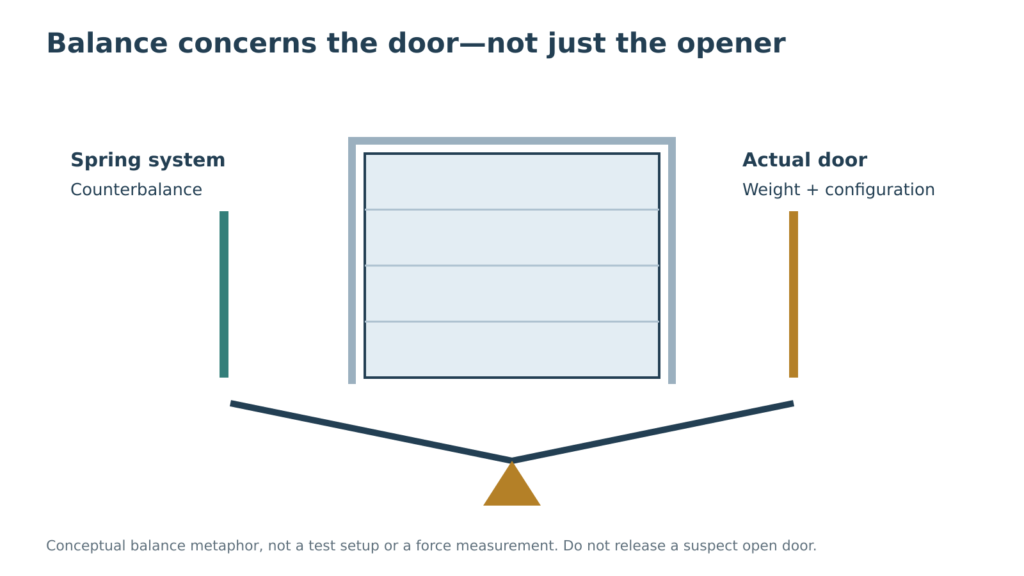
Genie lists crooked opening as a possible sign of a balance problem. That is a warning sign, not a one-to-one diagnosis. A photograph of a tilted door cannot establish the exact condition of its spring system, cables, rollers and supporting hardware.
For the service request, begin with the current state: fully closed, partly open, apparently stuck, or visibly displaced. Then describe the change you witnessed. Include which side appeared lower, specifying whether you were looking from inside or outside. Otherwise, “left side” can mean the opposite side to someone approaching from a different direction.
Keep sequence separate from interpretation. “It made a noise, the right side stopped and I released the wall button” tells a technician more than “the track needs aligning.” If you were not present when it happened, report who saw it and which details they can confirm. Do not ask that person to repeat the movement to obtain a better account.
A previous photograph can be valuable if it shows the same view before the problem. Compare dates and door position rather than assuming differences in camera angle show a mechanical change. The purpose is to provide context for inspection, not to measure a tilt from a phone image.
What visible clues are worth reporting?
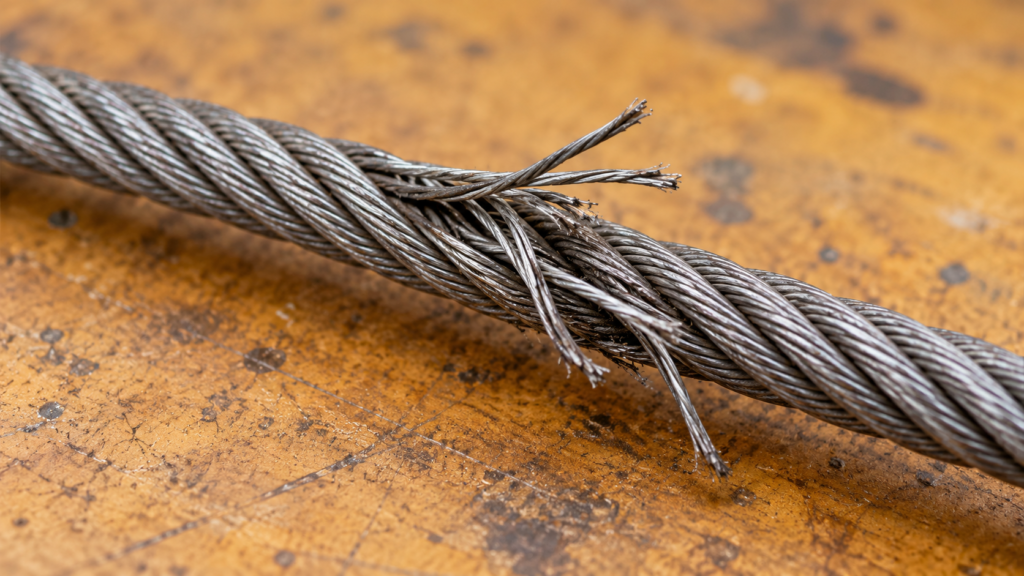
From a safe standing position, note any obvious displaced roller, visibly damaged track, loose-looking cable loop, distorted section or separated-looking attachment. You do not need to get close enough to count individual cable strands or read a stamp. If the detail is inaccessible without reaching into the mechanism, leave it for the technician.
Genie’s component guidance explains that rollers guide the door along its tracks and that lift cables connect the counterbalance system to the door’s lower hardware. These components are part of a connected assembly. A visible clue helps direct the inspection but does not tell you which adjustment to make.
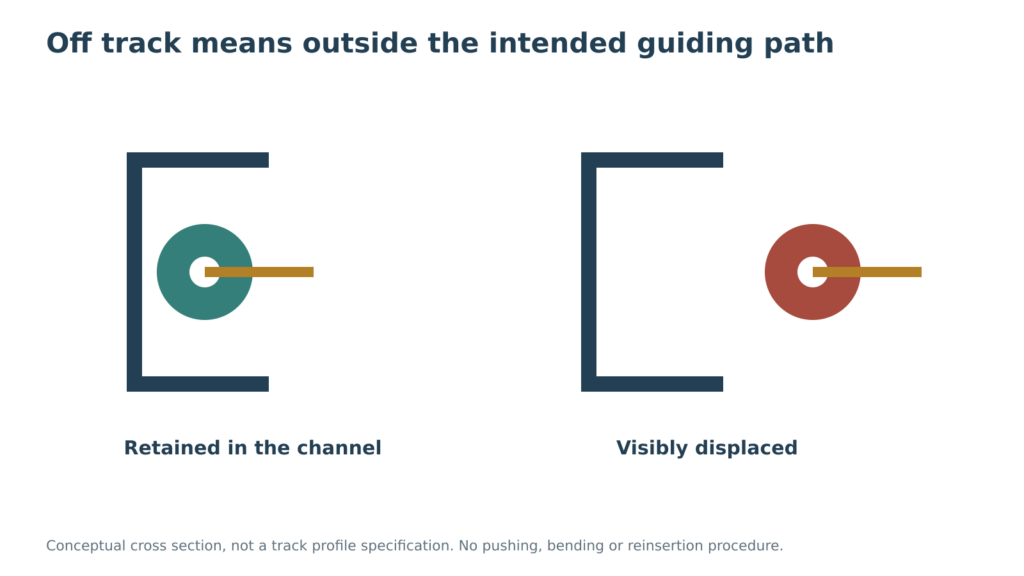
If a roller is clearly outside the track, use the separate off-track recognition guide. That guide explains what to report when a roller is visibly displaced. Here, the defining concern is uneven movement even when you cannot see a roller out of position. A door does not need an obvious displaced wheel before the asymmetry deserves attention.
A wire near a floor sensor is also not the same thing as a lift cable. Their functions are different. Do not tug a loose line to identify it. Tell the service provider where it is visible and share a photograph taken without entering the door’s path.
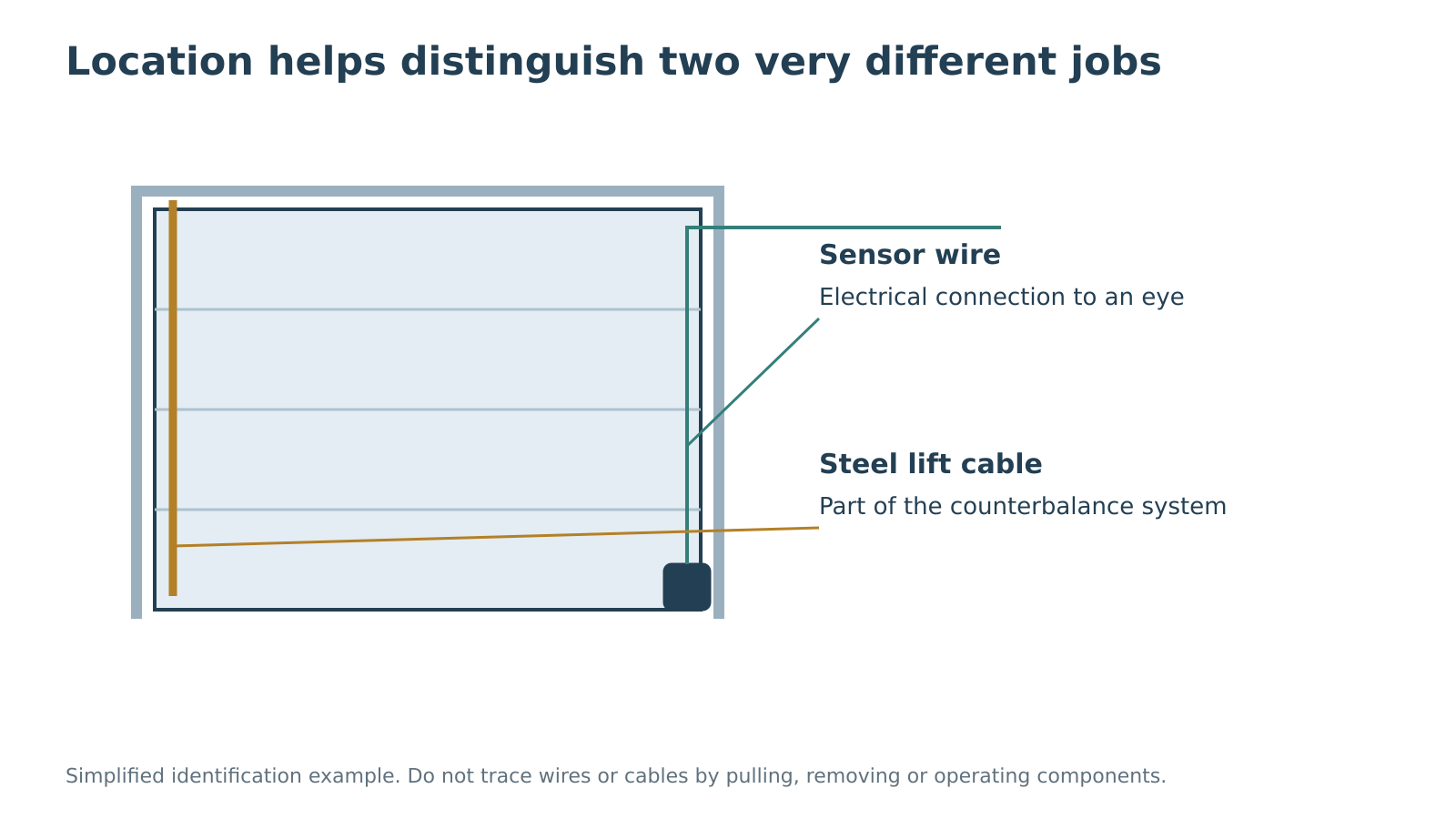 Select the diagram to view it at full size.
Why a remote, reset or travel setting is not a leveling repair
The control that starts the motor does not establish why the two sides moved differently. Changing the remote battery may address a separate command problem, but it is not an assessment of a tilted door. Resetting the opener, repeating a travel setup or increasing force would similarly skip the mechanical question.
Keep any error indication as supporting information. Record the opener brand and model from documentation already available, plus the exact light or display you saw. Do not combine that information into a universal code: different operators use different indicators. Most importantly, do not allow an online code lookup to overrule the visible door condition.
“The opener now responds” and “the door has been inspected” are different statements. A change in the first does not establish the second. This distinction is particularly useful when a household member suggests trying another control because the door used to behave intermittently. The newly observed asymmetry needs to stay at the center of the service request.
Leave the loaded hardware—and the release—alone
Genie warns against operating jammed doors or doors with broken springs and reserves work on springs and their attachments for trained service personnel. Do not loosen a bottom bracket, shift a cable, bend a track or push a tilted section back into place. Those are not safe observation steps.
Do not disconnect a suspect open or partly open door from its opener. An emergency release is not a tool for correcting an uneven position. Also avoid supporting the door with household objects while attempting a repair; a visible prop does not establish that the assembly is controlled.
Keep people and pets away from the opening and tell other household members not to operate the door. If an alternate pedestrian entrance is safely available, use it. Do not crawl beneath a partly open door to reach the release, a lock or something stored inside. Explain any access limitation when booking service so the arrival plan accounts for it.
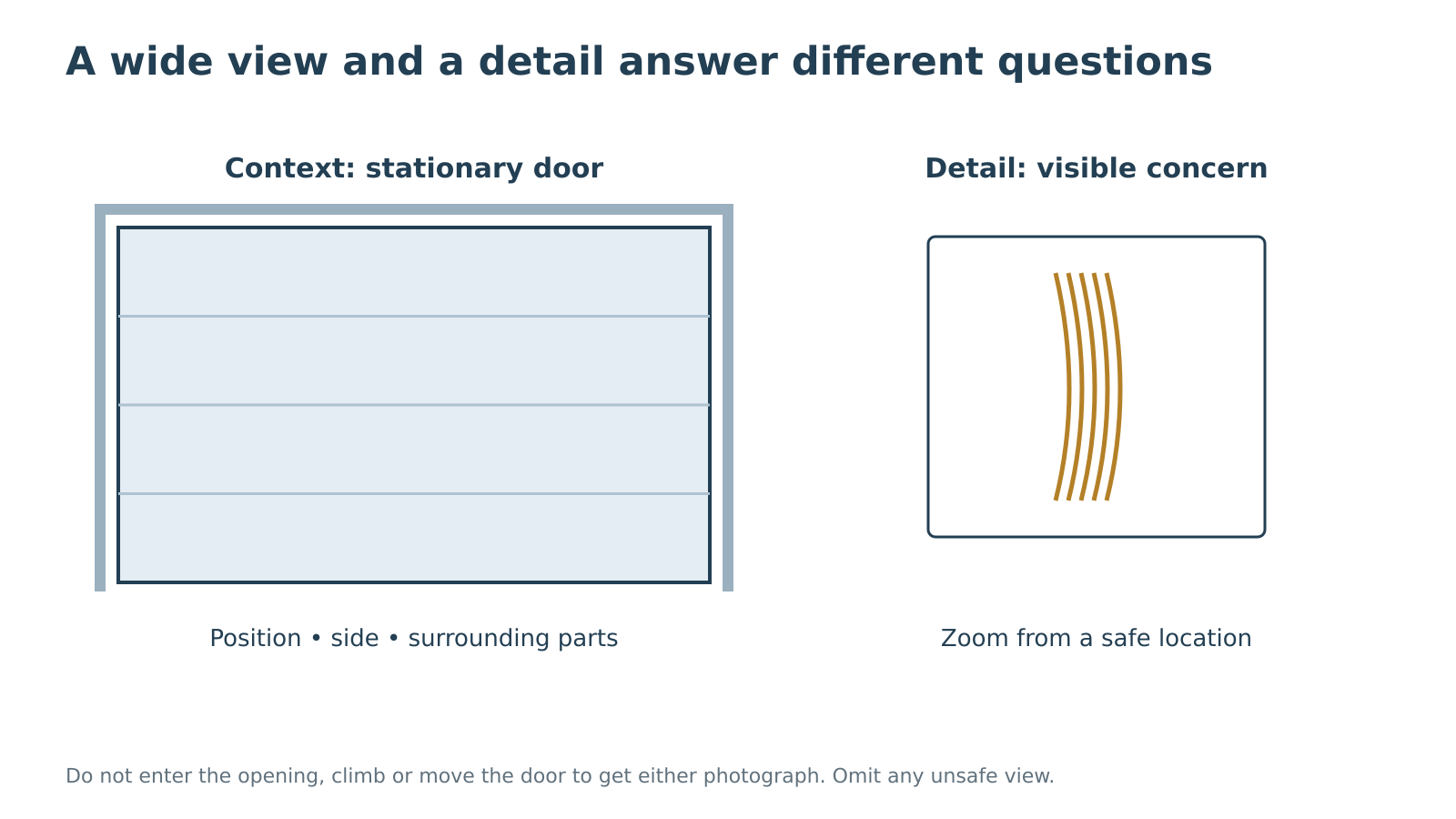 Select the diagram to view it at full size.
A useful photo set does not require a new operating cycle
Start with one wide view showing the door in its current position and the surrounding opening. Add a closer view only if you can take it from the same safe side without reaching under or standing beneath the door. A zoomed photograph is preferable to moving closer to uncertain hardware.
Include an ordinary description with each image: “view from driveway,” “right side as seen from inside,” or “gap noticed after closure.” This makes a small set of photographs more useful than a long collection without orientation. Avoid cropping away all surrounding structure; the location of a detail is part of the evidence.
A photo can support triage, but it is not approval to resume use. If a provider asks for a video, explain that the door has already moved unevenly and ask whether the existing still images and account are enough until inspection. Do not deliberately reproduce a hazardous symptom for documentation.
What the inspection should resolve
The assessment should distinguish the observed tilt from a floor or seal issue, identify relevant damage or component problems, and establish what must be done before the door can operate again. Ask the provider to explain the finding in terms of your original observation rather than only listing parts.
If several items are recommended, ask which address the immediate movement concern and which are separate maintenance or replacement options. Keep the written findings and any part descriptions. If the cause remains uncertain, that uncertainty should be explicit; it should not disappear behind a generic statement that the door was adjusted.
For background on supports and loaded attachments, see the garage door bracket identification guide. For an inspection of uneven travel, Local Garage Experts offers track and connected-hardware assessment. Call (323) 924-8777 daily from 6 a.m. to 11 p.m. Free estimates, free diagnostics and no service call fee are available.
The useful outcome is not a straighter-looking photograph. It is an explained mechanical condition, appropriate work and a clear handover about safe operation.