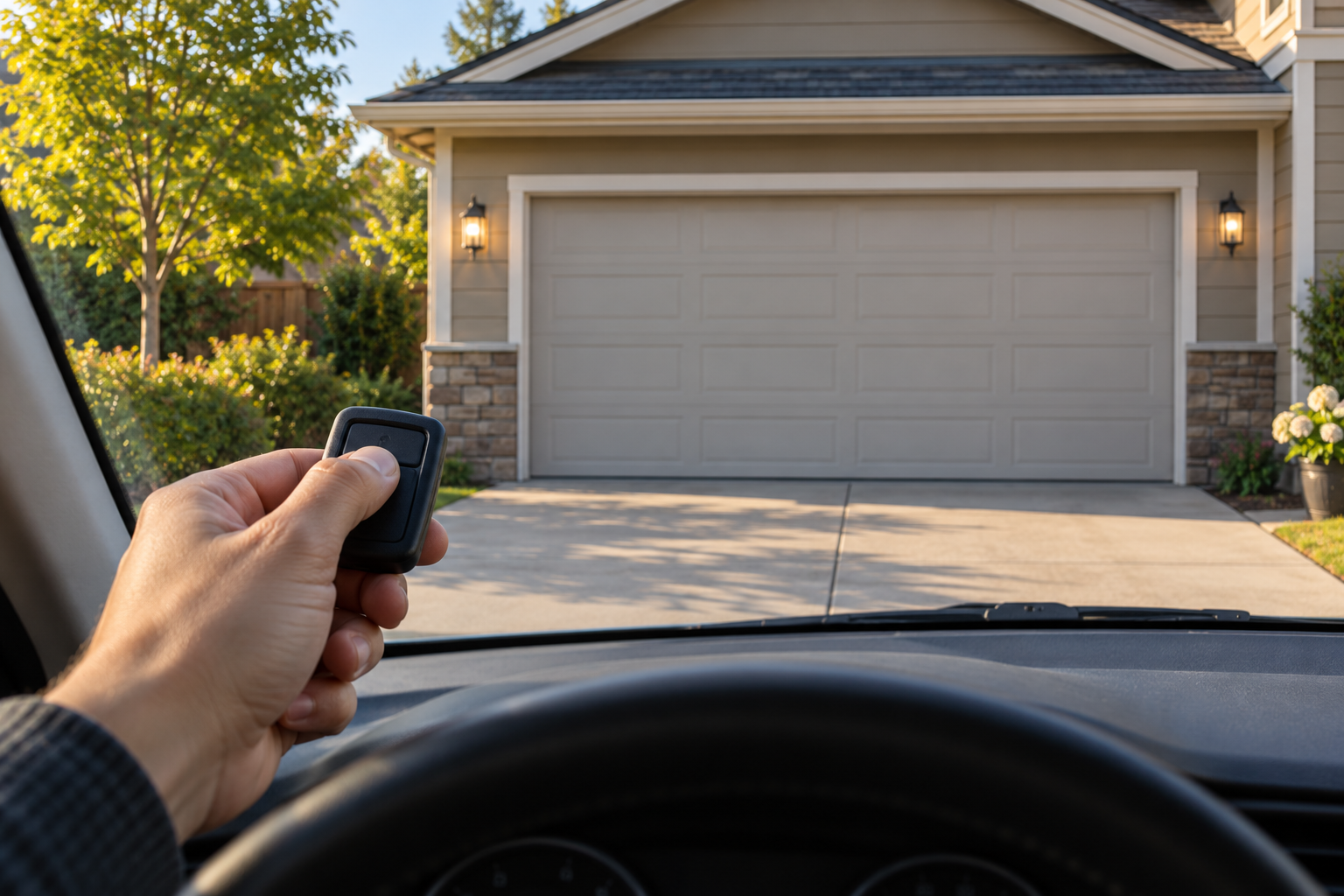
Short remote range can have several causes. Record a repeatable pattern from safe stationary locations, check the exact remote’s instructions, and avoid resetting all working controls before identifying the fault.
When a garage-door remote works beside the opener but not from the usual driveway approach, the problem is different from a remote that never works. The receiver can recognize at least some commands. What changed may be the handheld transmitter, its position in the car, the surrounding radio environment, or the receiver installation—not necessarily the programming.
The useful goal is to make the symptom repeatable without cycling the door endlessly. This guide explains how to compare a few safe observations, recognize a lighting-related pattern, and decide when a receiver or antenna needs professional assessment. It does not promise a universal distance. A number printed in a product advertisement is not a reliable diagnosis for a particular garage, vehicle and neighborhood.
First decide whether this really is a range problem
Record what happens at the location where the remote normally worked. Does the opener remain silent? Does its main lamp respond? Does the door start moving and then stop? The last observation is a movement problem, not simply a missing radio command. If the door reverses, binds or looks damaged, stop range testing and address that fault rather than trying to obtain a stronger signal.
Compare the local wall control only when the door is safe to operate and the doorway is clear. If neither local nor handheld controls produce normal movement, narrow your investigation to the opener and door first. If the handheld responds reliably nearby but inconsistently farther away, the range question is worth pursuing. Write down that specific pattern instead of the broad description “remote broken.”
Keep the phone app out of this first comparison. A connected app uses a different communication route from a conventional handheld transmitter. Its success may help establish that the opener can move the door, but it does not measure the handheld radio link. Likewise, a working exterior keypad is a useful comparison only when its location, battery and compatible receiver are understood.
Choose repeatable, safe observation points
Keep the variables simple: same remote, same button, same position and same clear view of the door. If you move the car and change the battery and replace a bulb between attempts, a better result tells you little about which change mattered. Note whether the door was open or closed at the start and whether the opener lamp was illuminated. Those details can expose a pattern hidden by casual repeated button presses.
Chamberlain’s close-range troubleshooting guide includes removing a remote from its visor position for comparison. Do this only while stationary. If it works in your hand but not in its usual mounted position, record that difference before modifying anything. Changing where a remote is held is a reversible observation; splicing an antenna wire is not.
There is no need to create dozens of cycles. A clear, repeatable difference is enough to guide the next step. Pause between necessary operations and follow your opener’s operating instructions. If testing becomes frustrating, stop and preserve your notes rather than repeatedly pressing buttons while someone else approaches the doorway.
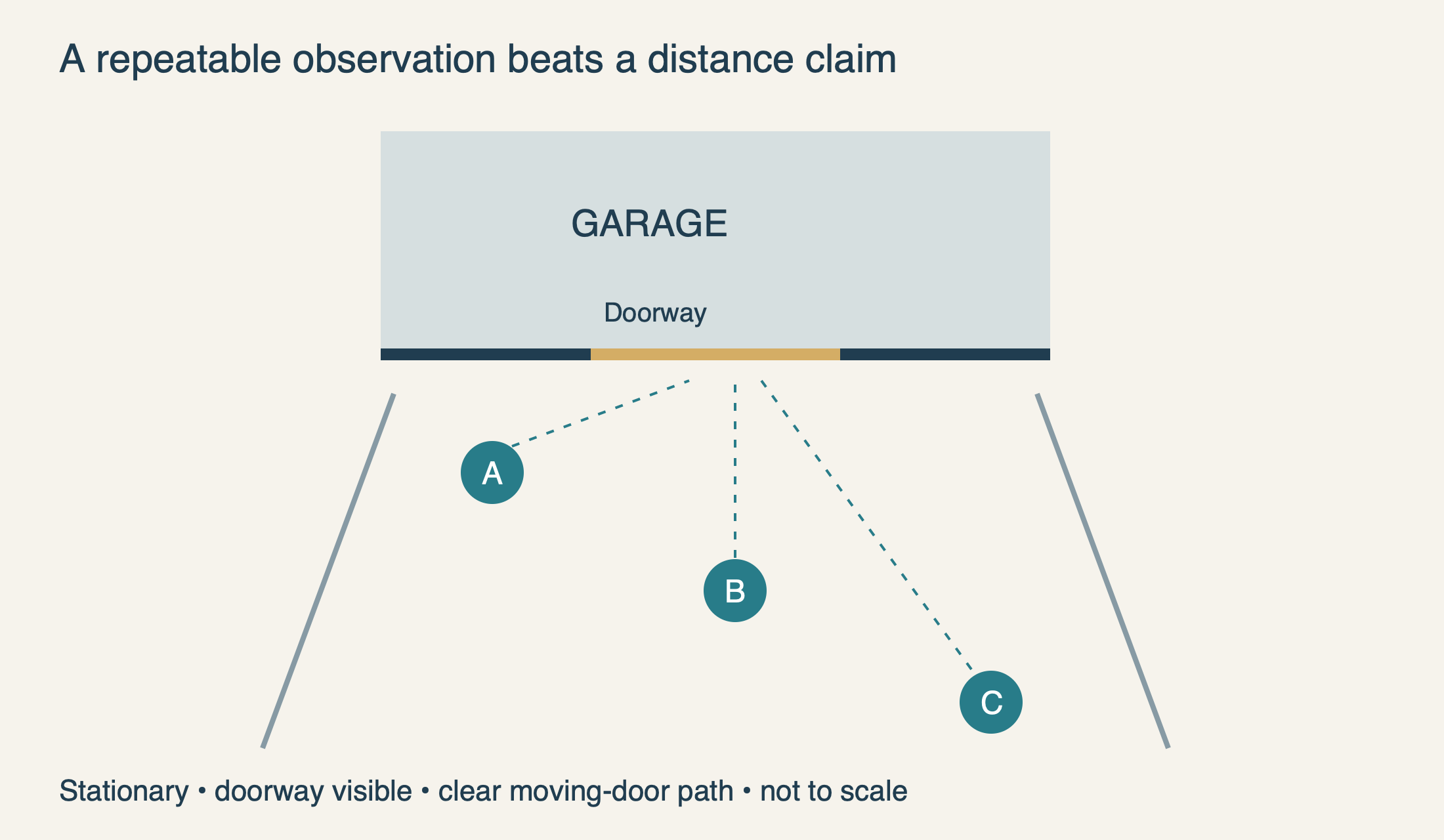 Select the diagram to view it at full size.
Compare transmitters before replacing the receiver
If another already-programmed handheld is available, compare it from the same safe location. When one performs normally and the other does not, inspect the weaker remote’s condition and battery specification. A cracked housing, sticky button or questionable battery replacement can explain why the two devices behave differently without implicating the entire opener.
Fit the correct fresh battery if the device instructions call for that check. Our remote battery guide explains model identification, polarity and secure handling of coin cells. Do not assume every remote takes a CR2032 just because another one in the household does. A light on the remote is an observation, not a complete assessment of its transmission performance.
If all working remotes lost useful range at roughly the same time, think about what they share. A recent lighting installation, charger, relocated equipment or change around the opener is more informative than buying several identical batteries without checking the pattern. If the problem has existed since installation, record that too; a longstanding location issue is different from an abrupt failure yesterday.
Why the opener light belongs in the investigation
Some LED bulbs and other electronics can interfere with garage-door radio controls. This does not mean that LED lighting as a category is unsuitable. Chamberlain’s bulb guidance identifies reduced remote range as one possible sign of an incompatible bulb and directs owners to model-specific size and wattage limits.
A useful clue is a repeatable difference between the same remote at the same location while the opener lamp is on and while it is off. Use the normal light control if the equipment provides one, or observe after its normal light period ends. Keep the area safely illuminated by another suitable light. Do not reach into a powered socket or remove a hot bulb to hurry the comparison.
If a bulb was recently changed and the pattern consistently follows its operation, check the replacement against the opener manual and the manufacturer’s tested options. For replaceable-bulb models, both physical fit and permitted wattage matter; the bulb must not press against the lens. An integrated LED assembly is not a screw-in bulb and should not be dismantled as this test.
Even a convincing light-related pattern is a reason to investigate, not a universal diagnosis. An opener lamp may turn on at the same time as other equipment or door activity. Repeating the same limited comparison is more useful than declaring that a particular bulb brand always causes interference. Keep the exact bulb description with your notes if professional help is needed.
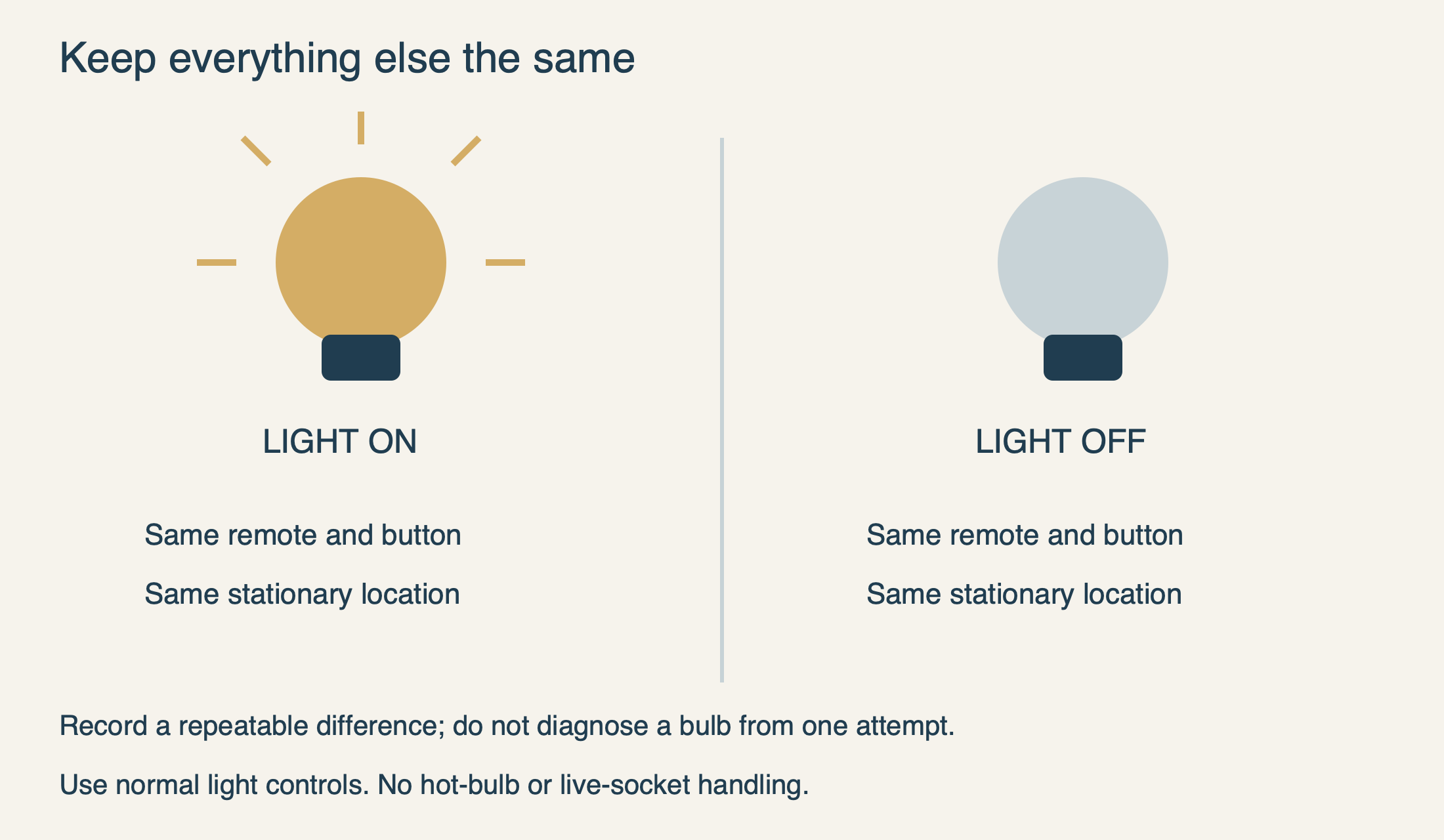 Select the diagram to view it at full size.
Look for a recent change without shutting down the house
The manufacturer’s range guide includes nearby electronics among possible interference sources. Start with the history: what was installed, moved or plugged in just before the symptom appeared? A new accessory near the opener is worth noting even if it is not intended to transmit radio signals. The timing helps prioritize investigation but does not prove that the accessory is defective.
Homeowner checks should remain modest. You may compare operation with a nonessential, safely accessible plug-in accessory switched off through its normal control, provided doing so will not interrupt a safety, medical, security or other essential function. Keep the opener supplied normally. Do not disconnect door-control terminals, dismantle chargers, run the opener from improvised extension wiring or shut down whole-house circuits to hunt for a signal.
If a simple change seems to help, document it and confirm it once under the same conditions. A single successful press after several failures may be coincidence. Conversely, do not reconnect equipment that shows heat damage, burning smell or damaged insulation just to reproduce the result; stop using it and obtain appropriate electrical assistance.
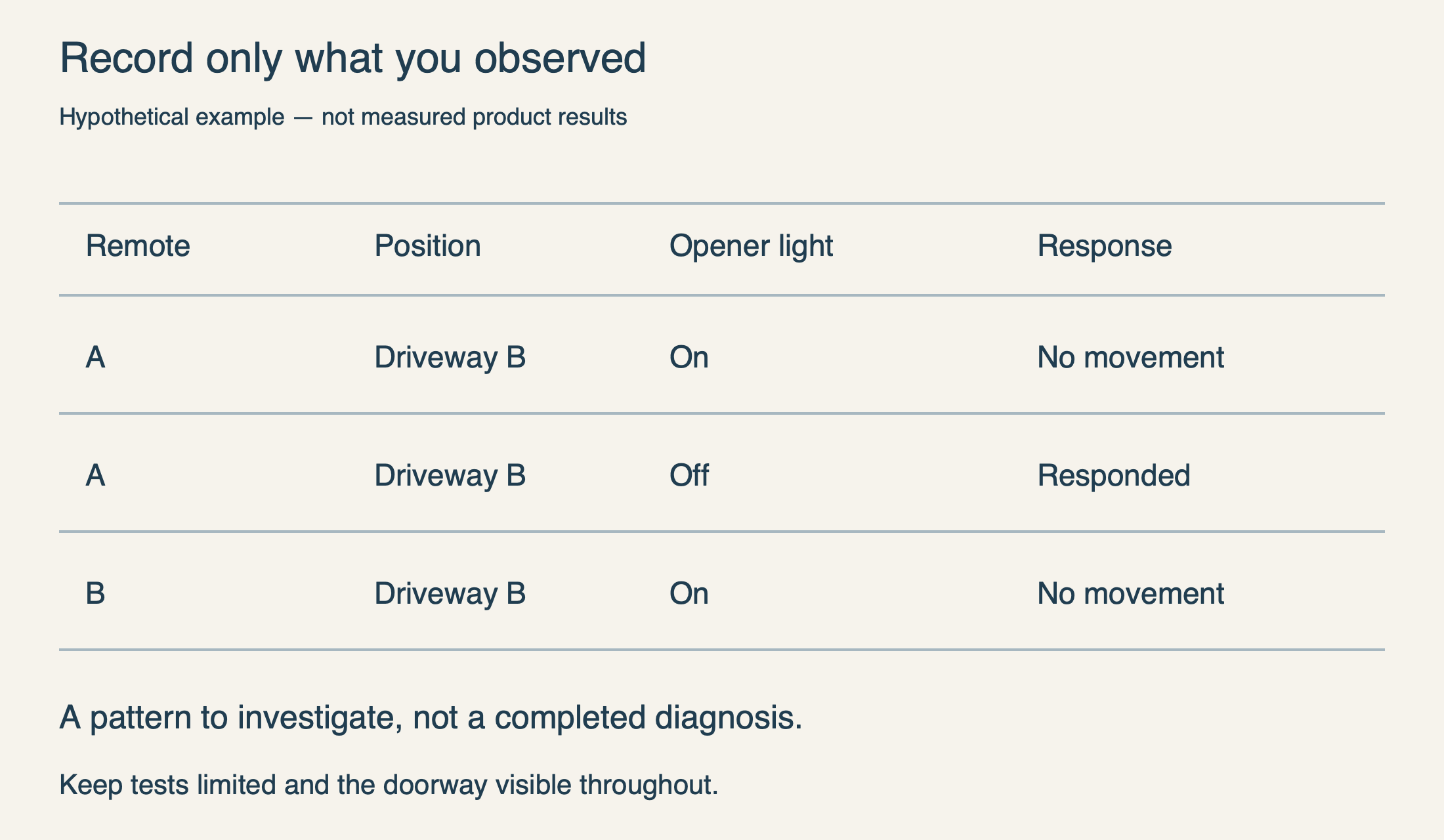 Select the diagram to view it at full size.
Know when the remaining checks are service work
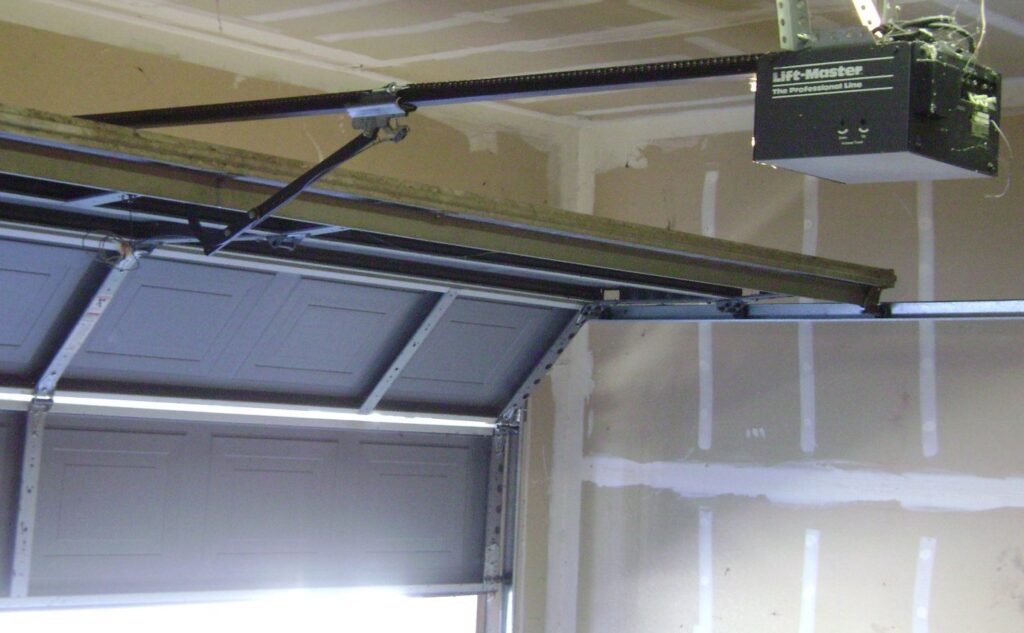
Observe the opener from the floor. If a visible antenna looks damaged or trapped, report what you see; do not extend it with spare wire or modify the receiver. Receiver generations, antenna arrangements and approved accessories differ. A modification that appears to improve one test may introduce a compatibility or installation problem that the manufacturer never approved.
Lock mode and erased programming also belong in a complete assessment, but they should not be confused with demonstrated short-range operation. The manufacturer’s remote-failure guide treats these as separate branches. If the receiver consistently responds nearby, repeatedly relearning the same remote is not a substitute for understanding why location matters.
For persistent garage door opener remote range problems, give the technician a concise comparison: remote and opener models, when the range changed, whether all remotes are affected, the safe location used, and any repeatable relationship with lighting or another device. Our garage door opener repair service can assess the receiver and installation beyond those homeowner observations. The aim is reliable operation from an appropriate, visible approach—not maximum distance at the expense of knowing what the door is doing.
Sources & manuals
Model-specific details are identified above.