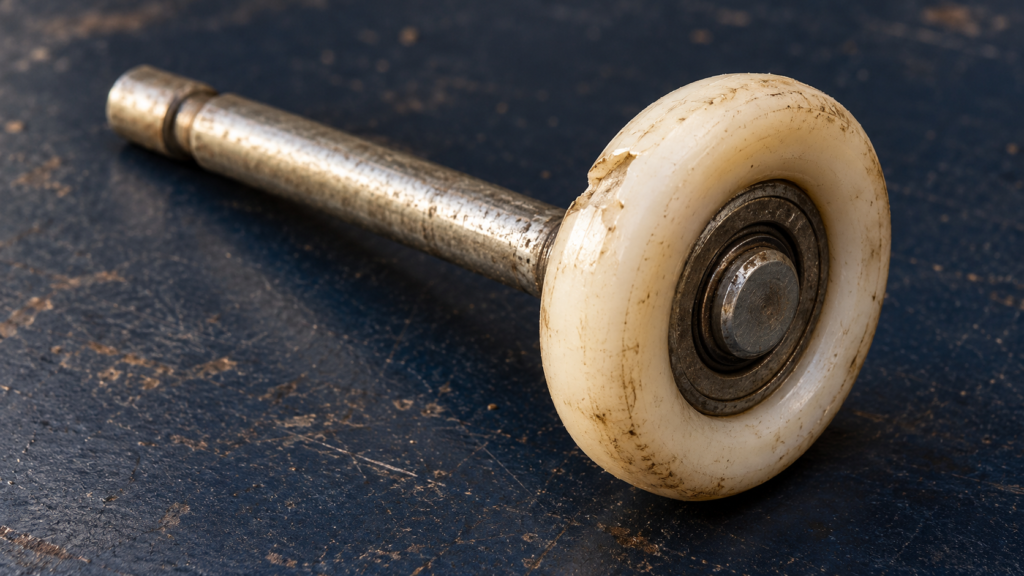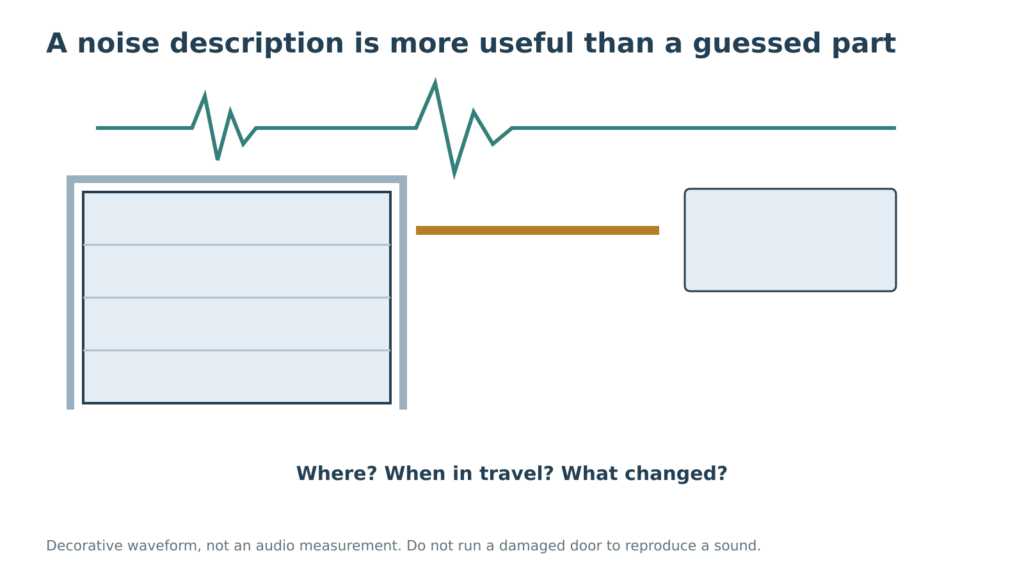

A maintenance record connects each task with the correct manual and service history.
Build the maintenance schedule from the actual door and opener manuals. Record observations, required intervals and the next responsible action; stop routine checks if the door becomes unsafe.
A useful garage door maintenance checklist is not a long list of parts to spray, tighten or adjust. It is a record of what your particular door and opener require, when each task is due, what was actually observed and what needs professional attention.
Start with the equipment documentation, not a universal seasonal schedule. A door, its finish and its opener can have different care requirements. Organizing those requirements in one place makes it easier to keep up with routine care without mistaking a dangerous repair for a normal weekend task.
Make one equipment record with two identities
The door manufacturer and the opener manufacturer may be different. Keep both identities in the record. A motor label does not identify the door’s finish, sections or replacement hardware, and a door invoice does not necessarily identify the opener’s current model.
Collect the model names, available serial information, installation invoices and relevant manuals. Use paperwork or safely accessible labels; do not climb around the mechanism or move an uncertain door simply to complete a form. If information is missing, mark it unknown and ask the manufacturer or service provider to help establish it.
Save the manual itself, not only a bookmark to a search result. Record its document number or revision and the pages containing care requirements. A file named “garage manual” becomes much less useful when an opener is replaced and two different documents are left in the same folder.
Add a brief change history: replacement sections, opener replacement, added insulation, finish work or hardware changes. Keep the date and invoice when available. If work happened before you owned the home, do not invent a date; note that the history is incomplete. This record helps a future technician understand what is installed rather than assume it remains in its original configuration.
Separate the task, its interval and who should do it
A checklist entry needs more than a component name. “Springs” is not a task. “Visible concern reported; professional assessment requested” records an action without suggesting an adjustment. Likewise, “clean door” needs a reference to the actual finish-care instructions, not an unspecified bottle of cleaner.
Sort entries into three practical groups: safe observation from an accessible position; care specifically described for your equipment and suitable for you to perform; and professional inspection or repair. This sorting is an organizational aid, not a technical determination that every task in a manufacturer’s general article is appropriate for every homeowner.
For a task that involves movement, electricity or access near the mechanism, read its prerequisites and warnings together with the procedure. If the condition or access is uncertain, leave the task pending for qualified help. Completing a checkbox is not more important than respecting the conditions under which the instruction applies.
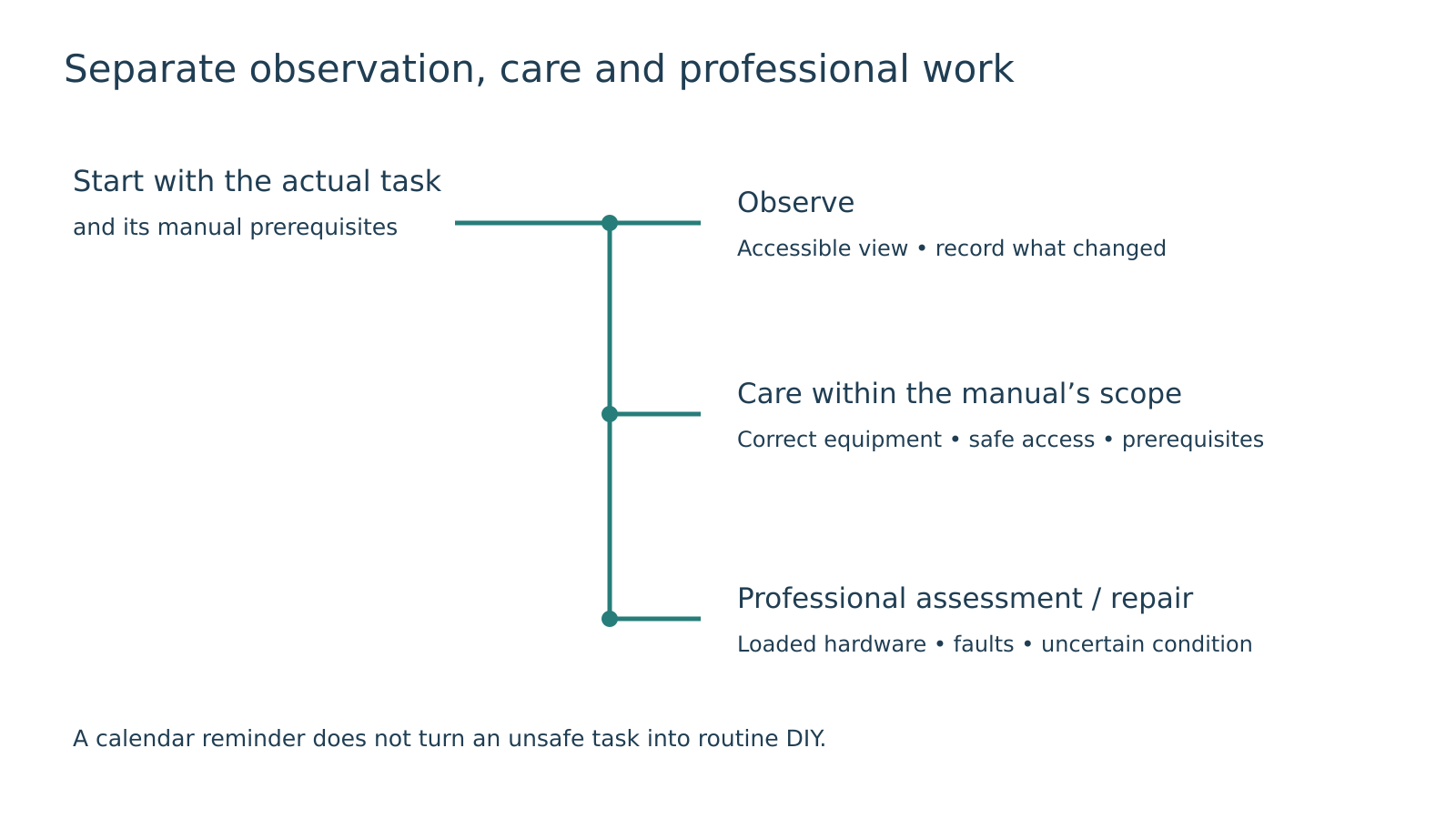 Select the diagram to view it at full size.
Build the calendar from the actual manual
Different intervals often refer to different tasks. A general door inspection, a finish wash and an opener safety check are not interchangeable. A reminder labeled “annual garage maintenance” can accidentally hide a more frequent requirement if the task list is not itemized.
For one specific example, the LiftMaster 8365W and 8365W-267 manual 114A5083, printed page 34, places safety-reversal testing in its monthly schedule. It lists yearly care for door rollers, bearings and hinges, and separate rail care every two to three years. These are intervals for that documented equipment—not a universal schedule or a lubrication procedure for other doors and operators.
The same manual, page 26, requires safety-reversal testing after adjustments as well as monthly. That creates an event-triggered requirement alongside the calendar reminder. If a technician adjusts the system, ask which post-work checks were completed and record them; do not simply wait until the next scheduled date.
Clopay’s general guide describes reviewing components at least annually and potentially as often as every three months. That broader guidance does not replace a specific opener’s monthly requirement. When instructions appear inconsistent, first identify whether they concern the same component and task. Then ask the manufacturer or qualified provider to resolve any remaining conflict for the actual equipment.
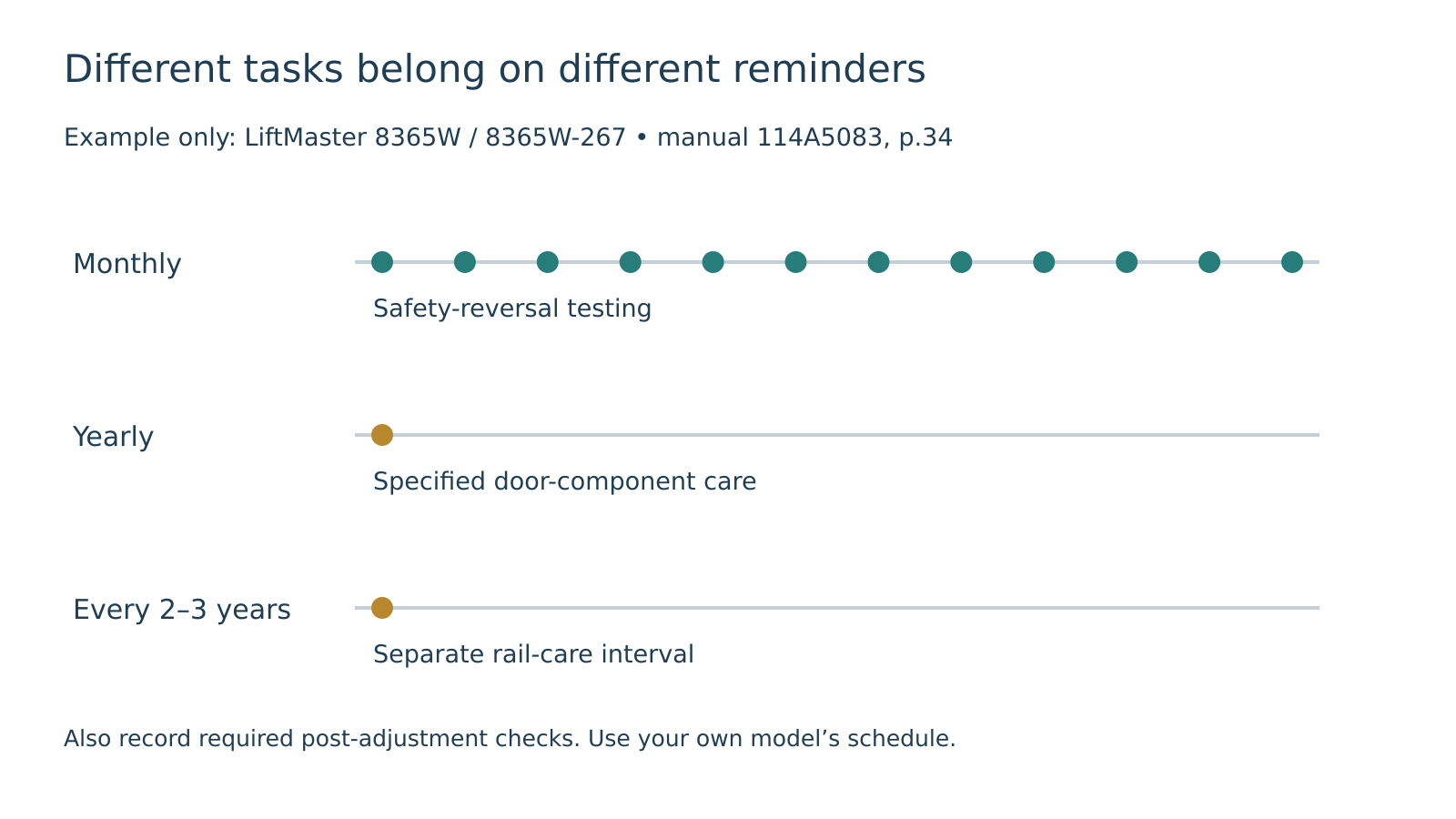 Select the diagram to view it at full size.
Use reminders that carry their own instructions
Create a reminder for each applicable task or group with the same interval. Include the model, manual page, person responsible and link to the saved document. “Review 8365W manual page 34; complete applicable scheduled checks safely” is more useful than “service garage.” The reminder should bring you back to the source, not attempt to replace it.
Record the date a task was completed separately from its due date. If it was postponed, leave the original due date visible and add the reason and next action. Moving the reminder forward without recording the missed task creates the appearance of a complete history where there is none.
Assign responsibility when several people use the garage. A shared calendar entry is not proof that someone completed it. One named person can maintain the record, while a professional completes tasks outside the household’s safe scope. This avoids both duplicate work and the assumption that somebody else handled it.
Record observations, not conclusions you cannot support
Useful observations are specific and limited: a new sound heard during ordinary use, a visible crack in a roller, a change in the bottom seal, or a finish mark that was not present before. Add the location and whether the observation occurred while the door was stationary or during normal operation. Do not repeat a faulty operating cycle to make the entry more detailed.
“New scraping sound near the right side, viewed from inside” is more useful than “needs lubrication.” The first records evidence; the second assumes a remedy. “No change noticed from accessible view” is also more accurate than “all hardware safe,” which a casual visual check cannot establish.
If the door becomes crooked, unexpectedly heavy, unstable, visibly damaged or jammed, leave the routine checklist. Stop using it and arrange assessment rather than continuing with tests or cleaning. Do not release a suspect open door or try a manual balance test to complete the schedule. The balance warning-sign guide explains that distinction.
For a sensor-related concern, the sensor identification and alignment guide covers the separate diagnostic question. A steady indicator or a successful command should not be recorded as proof that every safety function has been checked.
Use a four-column log that shows the next decision
The printable log below uses four columns: component or task, observation and date, manual interval and source, and next action with responsibility. Keep it with the equipment record. Start a new sheet when it becomes crowded rather than reducing entries to abbreviations nobody else can interpret.
Open the full-size four-column log for printing.
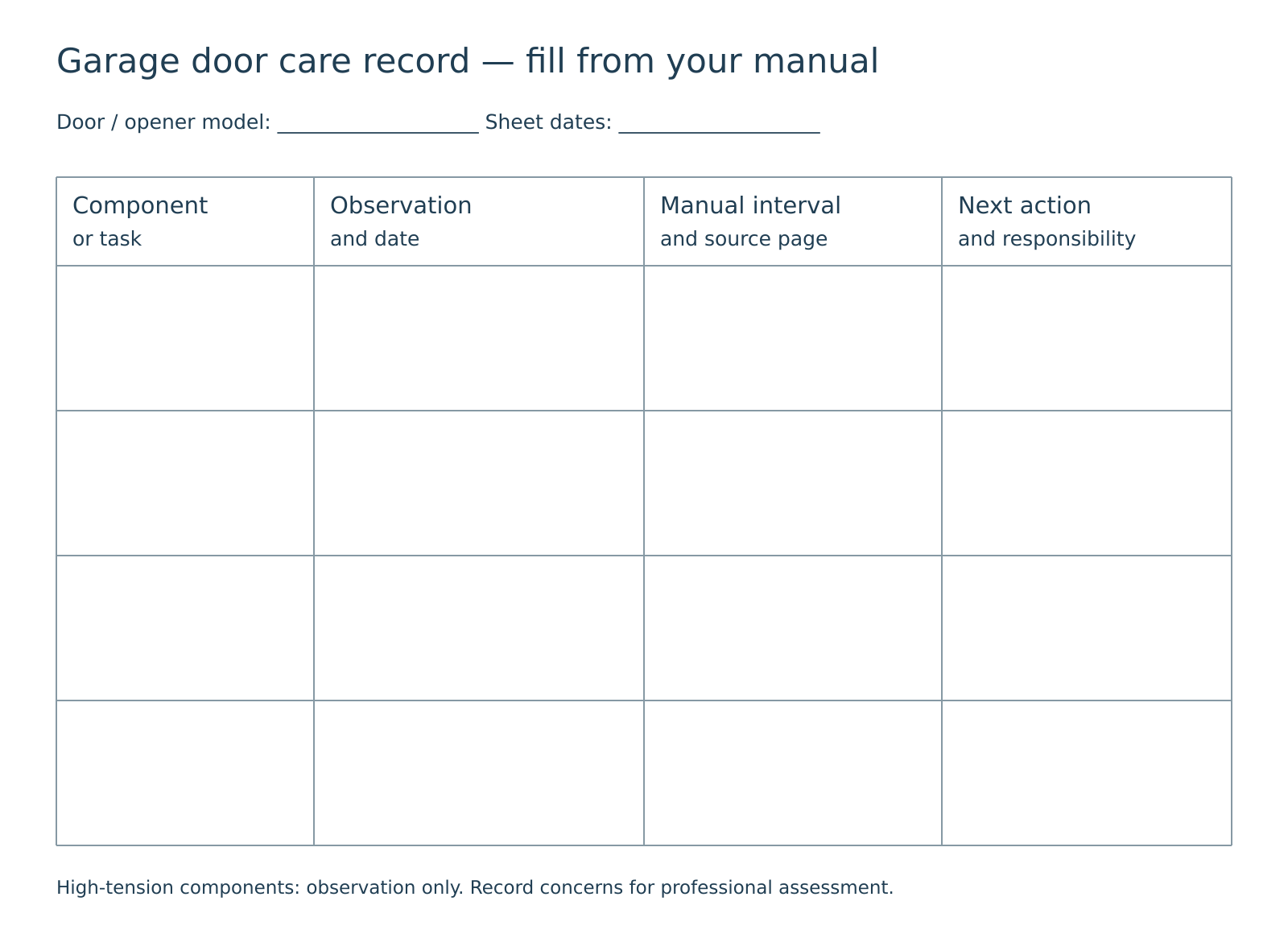 Select the diagram to view it at full size.
A hypothetical entry might read: “Door finish / October 12: new mark on lower section / care guide for the actual finish, page noted / ask manufacturer which cleaning method applies; owner to follow up.” The entry does not invent a cleaning interval or promise that a mark is harmless. It preserves the question until the appropriate instruction is confirmed.
For professional work, record the provider, date, findings and invoice reference in the action column or an attached note. A short entry such as “inspection booked” remains open until there is a result. Once work is completed, add what changed and whether any restrictions remain. Do not erase the original observation; it explains why the visit occurred.
The form is intentionally not prefilled with universal frequencies. Its value comes from connecting your equipment’s instructions with your own record. A blank interval marked “confirm manual” is more honest and useful than a confident number copied from an unrelated product.
Review the record when the equipment changes
After an opener or section replacement, revisit the schedule and archived manuals. Keep the old invoice for history, but clearly identify which instructions apply now. Ask the installer to explain the appropriate care and any checks needed after the work.
A maintenance log is not a warranty promise, inspection certificate or guarantee against failure. It is a practical way to make requirements visible and preserve observations without guessing. If an entry identifies a mechanical defect, use the relevant professional track and connected-hardware assessment rather than turning the form into a repair tutorial.
The best checklist leaves you with three clear answers: what is due, where the instruction comes from and who will handle the next action. That is more valuable than a page of boxes marked complete without knowing what was actually done.