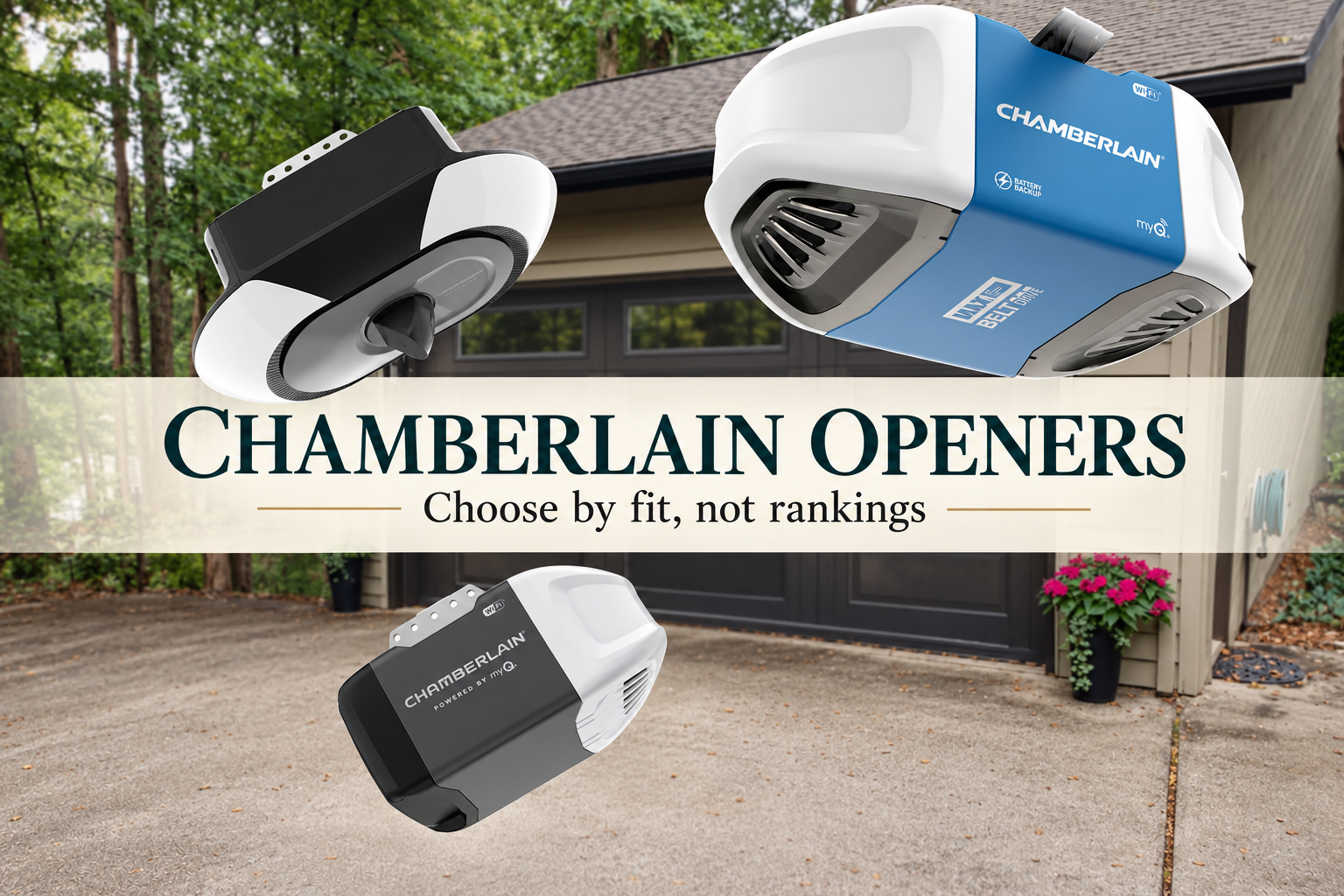
Compare the exact model and installation requirements, not appearance alone.
Choose a Chamberlain opener by its exact model, door compatibility, installation requirements and current features. Similar-looking products and model families do not guarantee the same equipment or capabilities.
The right Chamberlain garage door opener is the one that fits the door, the garage and the way your household uses it. A long popularity ranking is less useful than three verified answers: will it install correctly, will it provide the features you actually need, and what is included in the complete job?
This guide compares documented Chamberlain designs rather than claiming to have tested or ranked fifteen products. B4613T provides a practical belt-drive example, RJO101 shows what a wall-mounted system requires, and C2405 helps explain the trade-offs of a non-backup chain-drive design. These are model-specific comparisons, not a promise of local stock, a current sales ranking or a recommendation to buy whichever listing has the largest horsepower number.
Start by noting your door’s height and width, its construction, the existing opener model and any overhead obstructions. If the door currently strains, tilts or makes unusual mechanical noises, have that problem assessed before choosing a stronger opener. New electronics should not become a substitute for a healthy door.
Compare Chamberlain garage door opener models by architecture
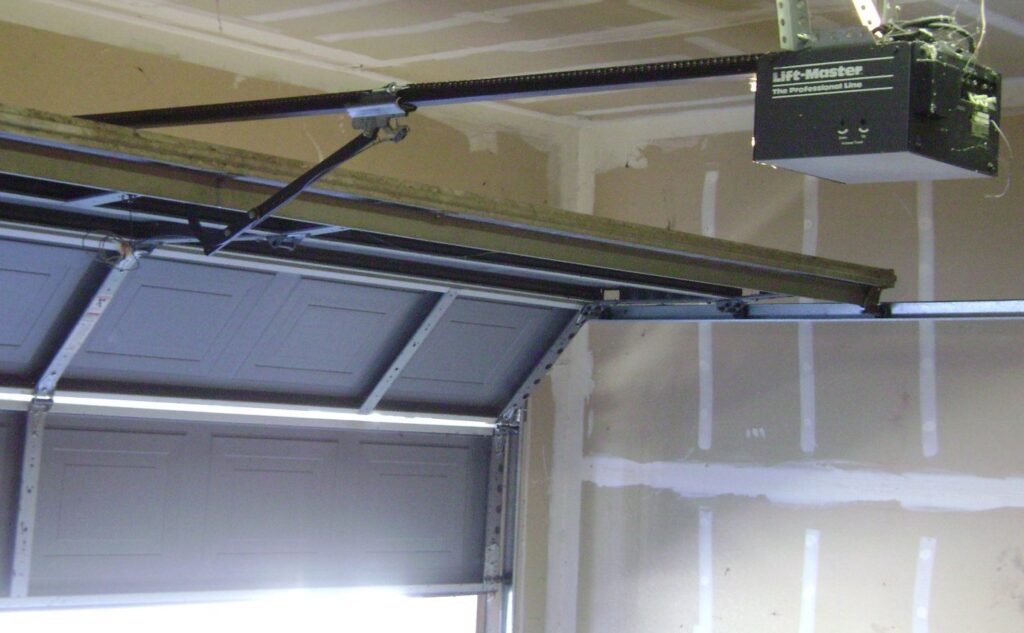
A ceiling-mounted opener uses a rail and trolley along the garage ceiling. Belt and chain describe the drive arrangement, not the entire feature package. Battery backup, lighting, camera capability and compatible controls still need their own lines in the comparison. A model prefix or a retailer photograph is not a reliable substitute for the specification sheet.
A wall-mounted unit occupies space beside the torsion shaft rather than running a trolley rail back into the garage. That can make an attractive layout where ceiling space matters, but it is a different installation—not simply a small motor that can be mounted wherever convenient. Door construction, shaft arrangement and side clearance become decisive.
For an attached garage near a bedroom, discuss transmitted vibration and the condition of the door as well as the drive type. We do not assign invented decibel ratings or promise silence. The detailed chain-versus-belt comparison covers that broader choice; the next sections focus on actual Chamberlain specifications.
B4310 vs. B5330 vs. C4310: a current comparison chart
If you are comparing the B4310 with other Chamberlain models, start with the drive system and control generation. The chart below summarizes the manufacturer’s U.S. product specifications checked November 6, 2026. It is our comparison, not a factory-issued PDF or a claim that these products have been tested side by side.
On a small screen, swipe the chart sideways. With a keyboard, focus the chart area and use the arrow keys.
| Feature | B4310 | B5330 | C4310 |
|---|---|---|---|
| Drive / motor | Belt / DC | Belt / DC | Chain / DC |
| Advertised power label* | 3/4 HP | 1 HP | 3/4 HP |
| Battery backup | Yes | Yes | Yes |
| Camera field of view | 130° | 130° | 130° |
| Lighting arrangement | Two replaceable bulbs, sold separately | Two replaceable bulbs, sold separately | Two replaceable bulbs, sold separately |
| LEARN button designation | White | White | White |
| Published limited motor / drive warranty | Motor 5 years; belt 5 years | Motor 5 years; belt 5 years | Motor 5 years; chain 1 year |
*Chamberlain describes these DC-motor horsepower labels as comparisons with AC-motor lifting capacity. They are not door-weight limits or permission to operate an unbalanced door. Read the complete warranty terms and installation manual for the exact package.
What changes the choice? B4310 and B5330 share the listed belt-drive, backup, camera and lighting features; B5330 carries the higher comparative power label. C4310 provides a chain-drive comparison with the same listed backup and camera features. Determine door suitability and installation scope before deciding whether any difference is useful for your household.
What should not carry over by assumption? These product pages warn that most older accessories are incompatible. An existing B4613T or B970 remote, keypad or wall control should not be promised as reusable merely because the brand matches. Our white-LEARN-button compatibility guide explains why the exact accessory model matters across this newer platform.
For the current manuals and complete specifications, use the manufacturer’s B4310 page, B5330 page and C4310 page. You can print this page for a shopping discussion; confirm the seller’s model suffix, included controls and current documentation before ordering.
B4613T: a belt-drive example with integrated lighting and backup
Chamberlain’s B4613T specification lists a DC belt drive, battery backup and motion-activated integrated LED lighting rated at 1,000 lumens. It lists Security+ 2.0 controls, smartphone control and soft start/stop. It is not a chain-drive model, and battery backup is not absent from this documented configuration.
This combination is worth comparing when you want conventional ceiling mounting, connected access and built-in lighting without choosing a wall-mount installation. Integrated lighting also means there is no ordinary screw-in bulb to select for that light assembly. Consider where its light will fall around parked vehicles rather than treating the lumen figure as a guarantee of even illumination throughout the garage.
The model’s published 3/4 HP label should not become a homemade door-weight chart. The installation manual requires a properly balanced door. Door suitability and condition still need assessment, especially with unusual construction or dimensions. A larger advertised power figure is not permission to operate through binding or compensate for a damaged spring.
Check the exact package before paying: remotes, keypad, wall control and extension components can make otherwise similar offers different. A product illustration can show optional or generational accessories. Write down the seller’s complete model suffix and included-part list, then compare it with the corresponding manufacturer documentation.

RJO101: ceiling space is the benefit; fit is the gatekeeper
The RJO101 product page identifies a wall-mounted DC direct-drive opener with battery backup, remote LED lighting and an automatic door lock. Those features describe RJO101, not every older RJO model. A familiar tall, narrow case does not prove identical backup, lighting or accessory arrangements.
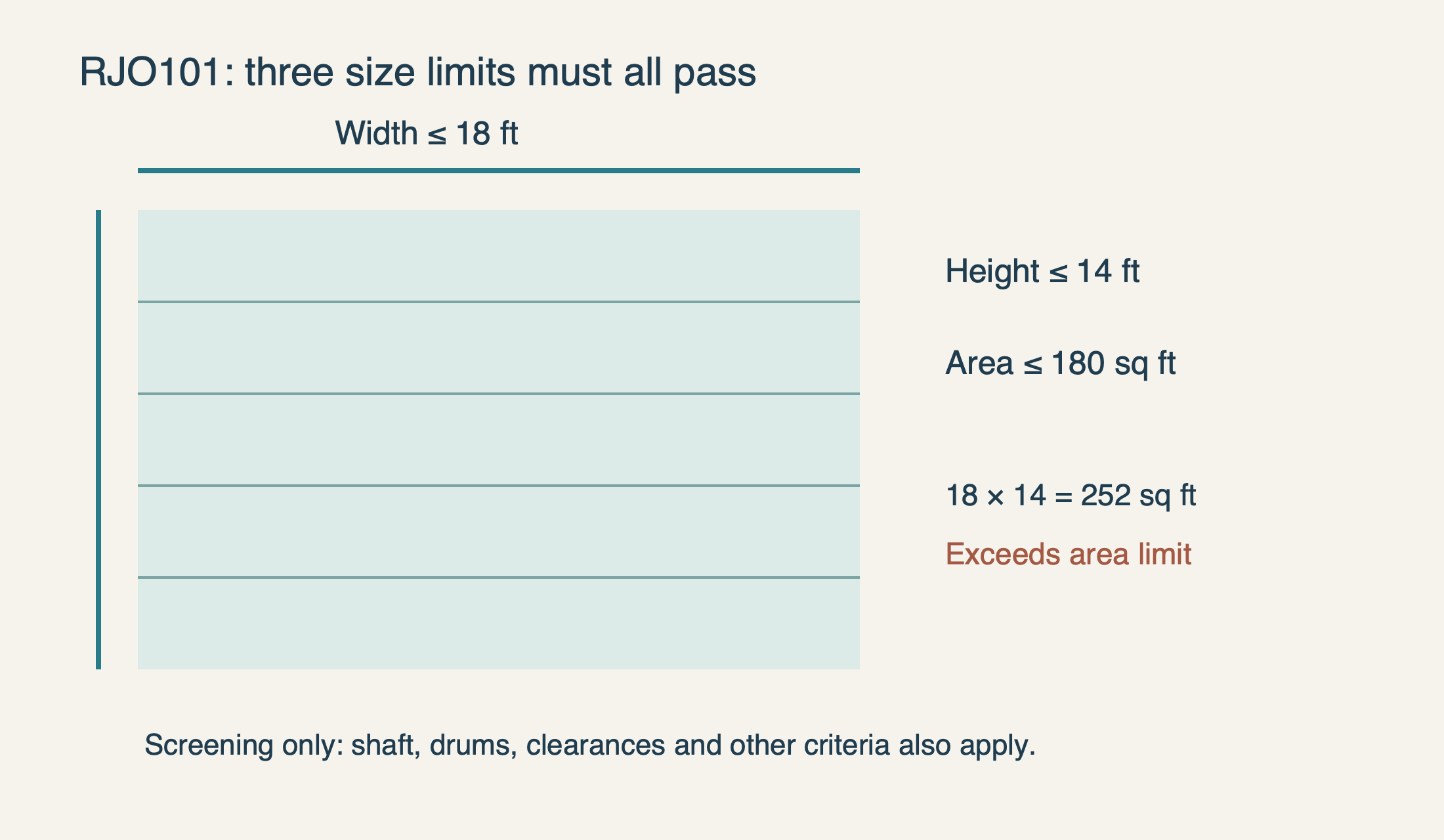
The manufacturer’s pre-purchase checklist is especially useful. It specifies a sectional door up to 14 feet high, up to 18 feet wide and up to 180 square feet in area. All limits apply together: an 18-by-14-foot door has 252 square feet of area, so it does not qualify merely because its width and height each match a listed maximum.
The same checklist specifies a 1-inch torsion bar, at least 1½ inches extending beyond the bearing plate, at least 3 inches between the bar center and ceiling, and at least 8½ inches between the bar end and a side wall or obstruction. These are screening dimensions, not the complete installation specification. It also excludes extension-spring arrangements.
 Select the diagram to view it at full size.
Older model names are useful identifiers, not automatic buying recommendations
If you already own a B970, B550, B750, B1381 or RJO20, retain that exact model number when finding manuals and parts. A successor with similar styling may use a different lighting assembly, control generation or accessory package. Comparing an old instruction manual with a new retail listing without noting the generation can create expensive mistakes.
The older RJO20 artwork below shows the side-mounted layout clearly. It does not establish that RJO20 includes every RJO101 feature, and it should not be used as an installation drawing. For an existing opener, the serial/model label and matching manual take priority over the image on a shopping page.

Battery backup changes the California shortlist
C2405 illustrates why features need separate comparison. Chamberlain lists this model as an AC chain-drive opener with smartphone control but no battery backup. Its product page specifically excludes non-backup openers from sale or installation in California under the applicable requirement. It is a comparison example here, not a recommendation for a new Los Angeles installation.
Chamberlain’s California guidance explains that the requirement has applied to newly sold or installed residential openers since July 1, 2019, including replacement situations described in the guidance. It does not say that every unchanged existing opener must immediately be discarded. Confirm the current requirements for your project with the installer or local authority, particularly when replacing the door as well as the operator.
Backup operation also does not mean every connected feature continues normally during an outage. The linked B4613T-family manual states that myQ app control and the camera do not work while the opener runs on battery power. Plan household access around the documented backup behavior, not an assumption that the garage and home internet remain fully online.
Measure the installed system, not just the motor housing
The B4613T-family installation manual calls for a rail extension kit when the door is more than 7 feet high. That is a purchase-planning point: the base box may not contain the parts needed for your opening. Specify the door height before comparing offers, and have the seller identify the approved extension for the exact opener.
Chamberlain’s installed-length chart also distinguishes rail length from overall installed length. Different housing and lighting arrangements occupy different total space. A rail measurement alone therefore does not confirm clearance from a beam, storage rack or rear wall. Use the configuration-specific dimensions and allow the installer to check the entire operating envelope.
Do not assume that reusing an old rail, sensor set or wall control is the easiest way to make a new model fit. Ask which existing components are approved for reuse and which will be replaced. The installation should end with model-required operational and safety checks, not merely a successful first opening.
Make the final comparison a complete scope of work
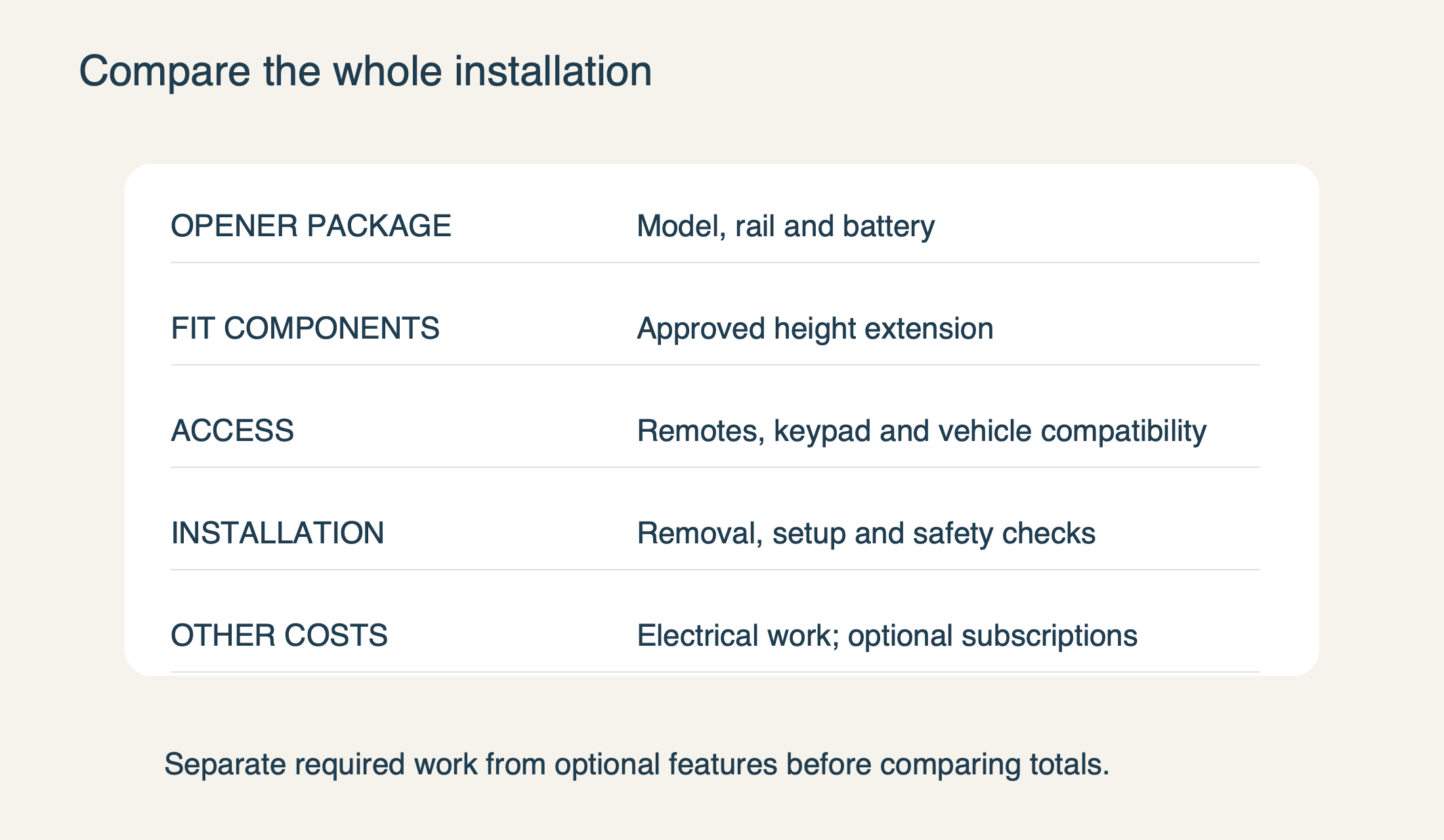
Ask for an itemized scope covering the opener and rail, any height extension, controls, backup battery, removal of the old equipment and installation. Separate necessary electrical work or door repairs from optional conveniences. This makes two quotes comparable without inventing a universal installed price.
For connected features, define what you want the app to do before buying. Door status and access sharing are different needs from video history or a particular voice-assistant integration. Verify supported functions and any recurring charges with the current manufacturer offering; “smart” does not mean compatible with every platform. Our myQ guide explains those distinctions in more detail.
The final choice should survive a simple explanation: this model fits this door, its documented features match these household needs, and this quote includes the parts and work required. If you are deciding whether to repair the existing system or replace it, our garage door opener assessment and repair service can help establish its condition. That is more useful than a top-place ranking unsupported by testing or sales evidence.
 Select the diagram to view it at full size.
Sources & manuals
Model-specific details are identified above.
- Chamberlain B4613T: Product Specifications
- Chamberlain RJO101: Product Specifications
- Chamberlain C2405: Product Specifications
- Chamberlain RJO101 Pre-Purchase Checklist
- Chamberlain LED Belt Drive Installation Manual (114-5822-010)
- The Installed Length of My Chamberlain Garage Door Opener
- Chamberlain: Required Battery Backup in California