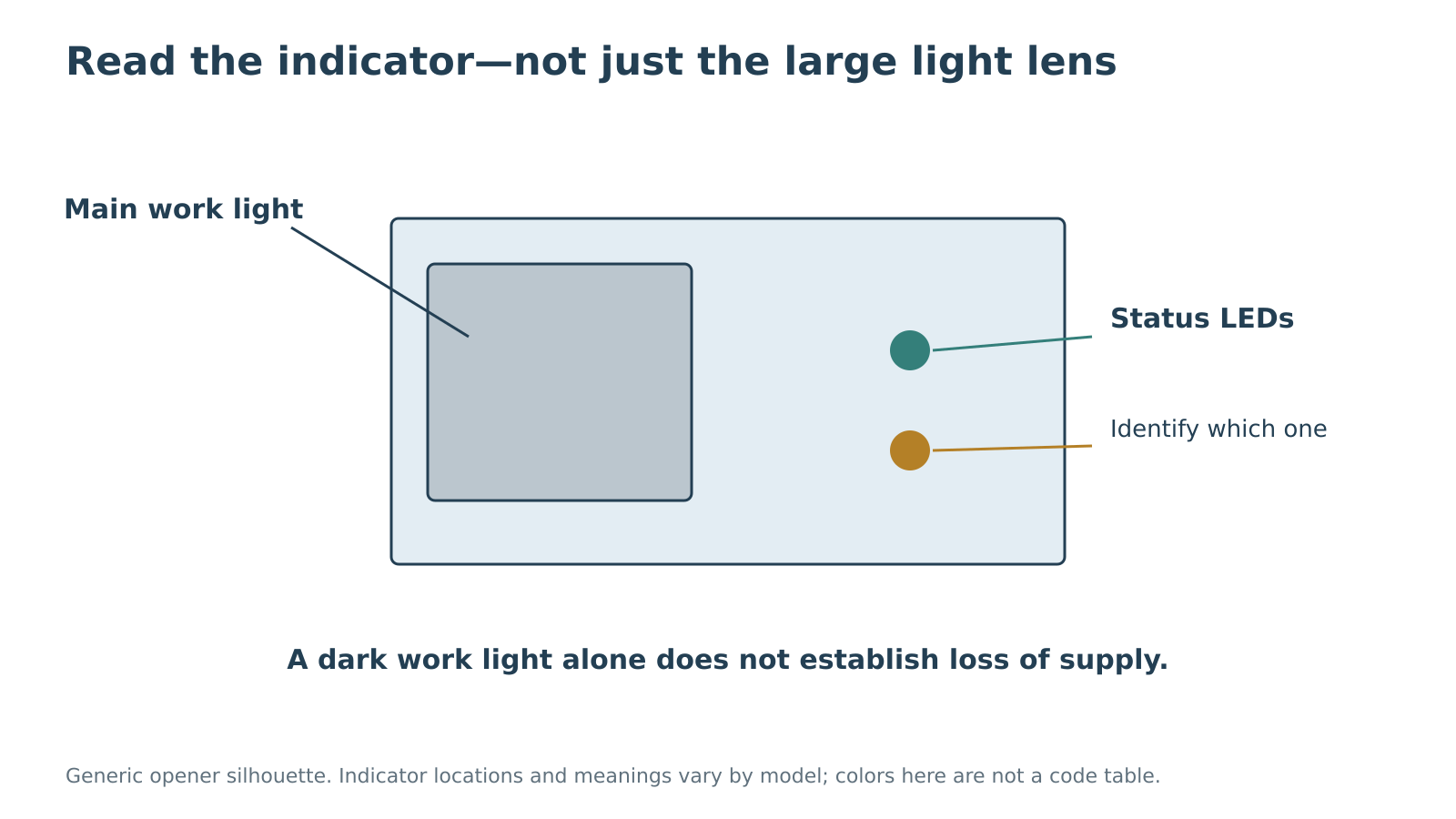
A dark work light alone does not prove electrical failure.
A dark work light does not prove the opener has lost power. Separate supply, indicator and backup-battery observations, and leave wiring faults or unsafe electrical conditions to qualified service.
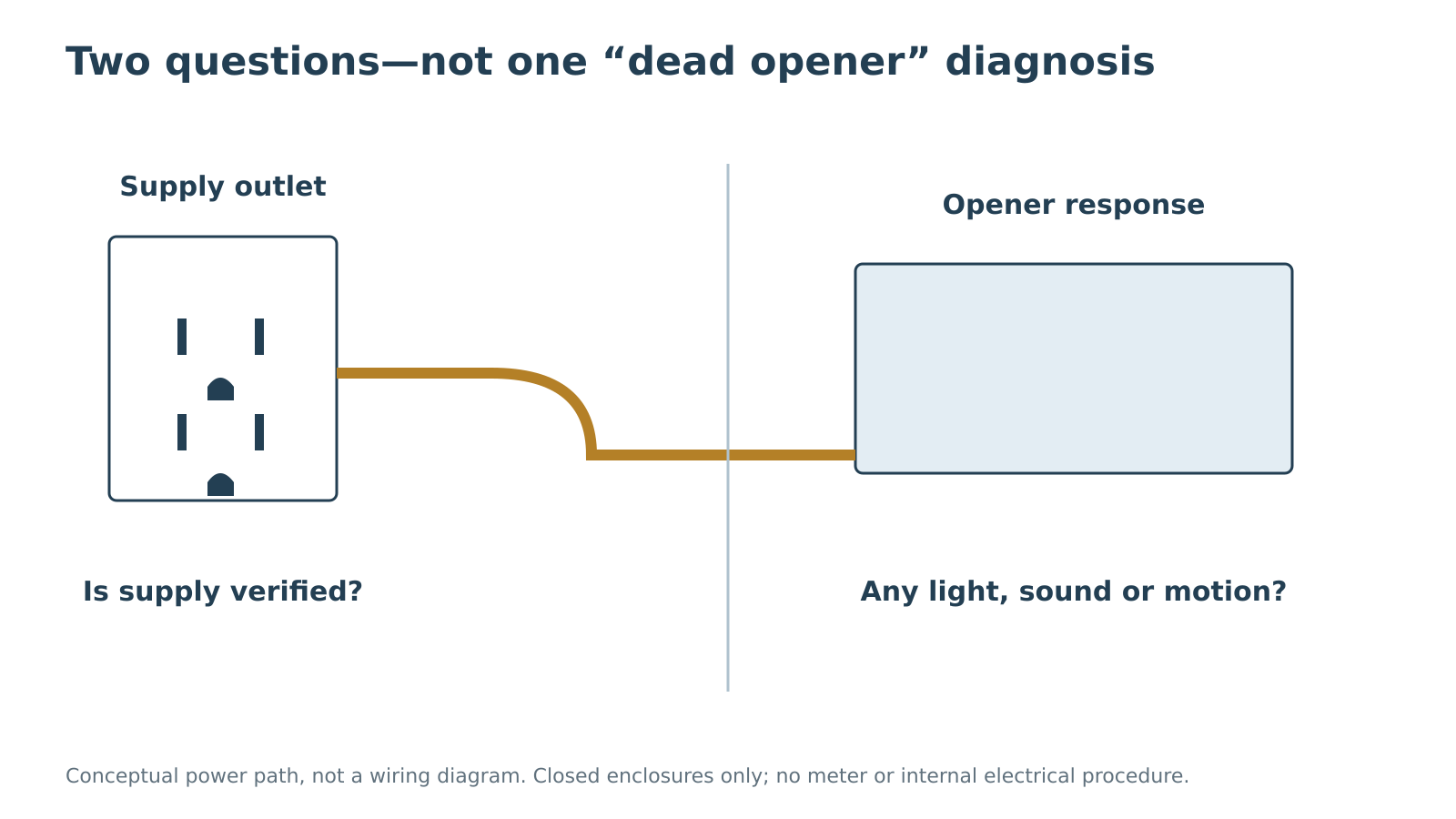
When a garage door opener seems completely dead, separate two questions: is electrical supply reaching its outlet, and is the opener responding internally? A dark work light alone does not answer either question. Look at the whole pattern—indicators, sound and response to the normal controls—before deciding that the motor or circuit board has failed.
This guide covers an opener with no apparent lights, sound or response. It keeps household-level observations separate from electrical repair. If there is smoke, a burning smell, water around electrical equipment, a damaged cord or a visibly damaged outlet, stop checking and arrange appropriate professional help.
 Select the diagram to view it at full size.
First make sure “no power” describes the symptom
Chamberlain Group’s no-power troubleshooting guide identifies a completely unresponsive pattern: no lights or LEDs, no sound or movement, and no activation from the wall control or remotes. If an indicator or diagnostic pattern is present, the next question is usually a more specific fault rather than a wholly inactive system.
A battery-backup model adds another distinction. An opener can show signs of life while household AC power is absent because it is using its backup battery. Identify the battery-status indicator in that model’s manual rather than interpreting any green or orange light as a universal power verdict. Chamberlain’s indicator guide treats battery and Wi-Fi LEDs separately.
If the motor hums or clicks, use the sound-without-movement guide. If the wall control works but the remote does not, the remote-only failure guide is a better fit. These distinctions prevent unnecessary work on a supply circuit that may not be the problem.
 Select the diagram to view it at full size.
Look at accessible connections without opening anything
Also note whether the connection runs through an unexpected timer, switched device or other accessory. Chamberlain’s guidance calls for a direct connection to a working outlet and warns against using a switched outlet. Do not change fixed wiring or install an adapter to create a workaround.
A nearby ceiling light working does not prove that the opener’s outlet has power. Different outlets and lights can be supplied or controlled differently. The relevant observation concerns the actual receptacle used by the opener, not whether some other item in the garage happens to function.
If the opener is hardwired rather than connected by an ordinary accessible plug, do not open its electrical connection compartment. Record the installation type and have the supply checked by a qualified person. The simple plug-in observation below does not apply to hardwired equipment.
 Select the diagram to view it at full size.
One low-risk outlet check can separate the next steps
Chamberlain’s North American support guidance uses a known-working 120-volt device to check the same outlet. For a homeowner, that can be an ordinary small lamp only when the receptacle is dry, undamaged and safely accessible, the lamp is suitable for that supply, and no unsafe climbing or access around the door is needed.
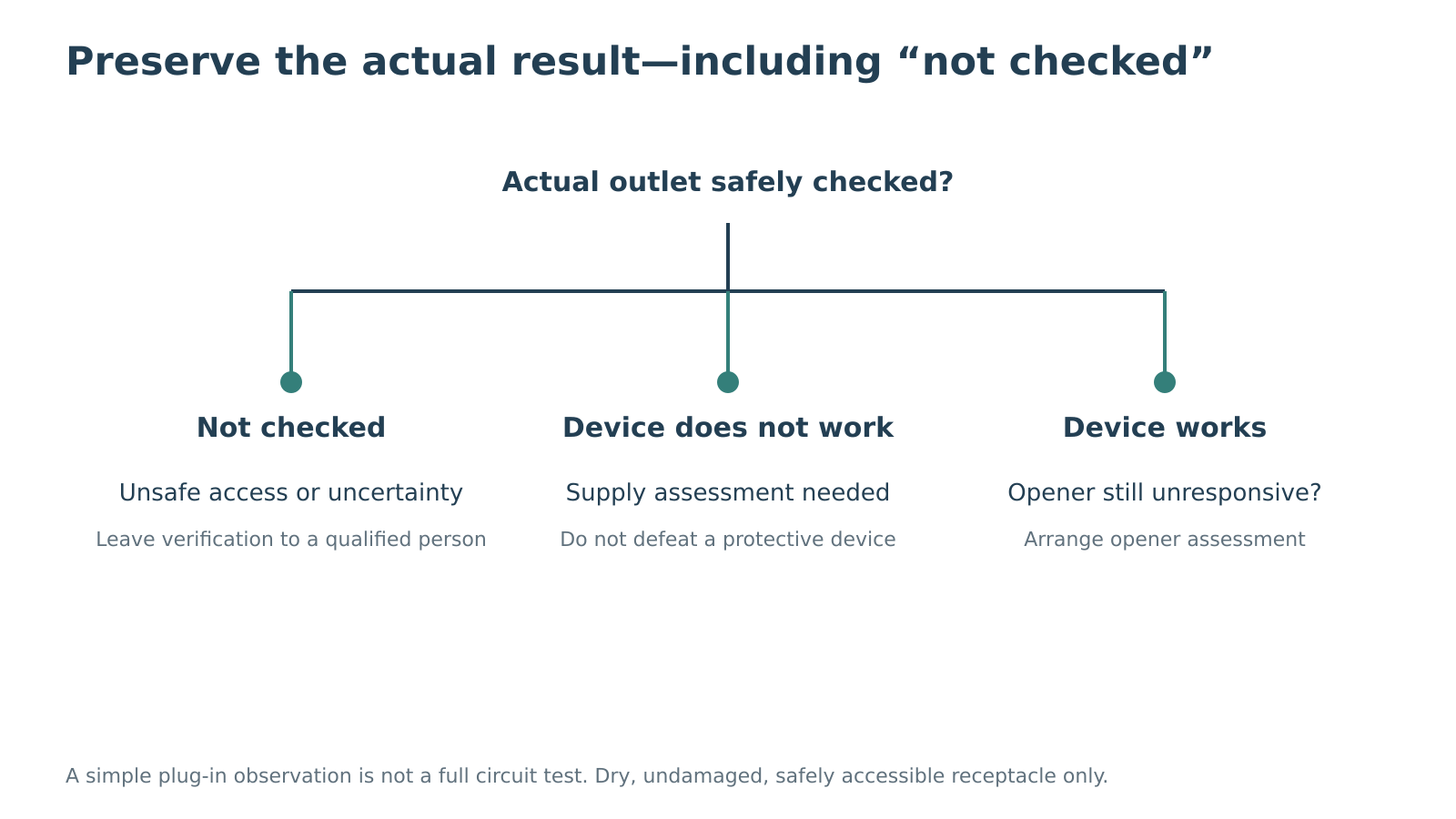
Do not perform this check if there is heat, scorching, sparking, a burning smell, moisture or visible damage. Do not insert meter probes, remove covers or test exposed conductors. If the outlet cannot be accessed safely, “outlet not verified” is an acceptable result—not a reason to improvise an extension arrangement.
If the known-working device does not operate at that receptacle, report that finding. It points the next assessment toward the supply, but it does not identify which protective device, connection or circuit condition is responsible. If it does operate, the outlet was able to power that device at that moment; an opener that remains unresponsive still needs its own assessment.
Keep the result precise. “A known-working lamp did not light in the opener’s outlet” is better evidence than “the entire garage circuit is dead.” “The lamp worked, but the opener has no visible indicators” is better than “the board is definitely bad.” A basic check narrows the question without replacing electrical diagnosis.
When the next call is about the supply
If the outlet has no confirmed power, consider what else is known: a wider outage, recent electrical work or a protective device that has operated. You may record the visible status of an accessible, familiar breaker or GFCI device without opening its enclosure. Do not remove a panel cover, handle wiring or repeatedly reset a device that trips again.
A tripped protective device is not an inconvenience to defeat. The cause of repeated tripping, visible damage or an unexplained dead receptacle belongs with a qualified electrician. Do not move the opener to a different circuit as a permanent workaround or substitute an extension cord for a corrected installation.
Chamberlain’s no-power guide directs users to an electrician if supply power cannot be restored. The practical distinction is between an electrical supply issue and a fault inside the opener; both may need professional attention, but they are not automatically the same service task.
If household power has just returned after an outage, the post-outage guide addresses backup state and local-versus-connected control. Do not assume that a router reconnecting proves the opener’s outlet has recovered, or that an offline app proves the opener is electrically dead.
When the outlet works but the opener does not respond
With supply confirmed and no internal response, Chamberlain’s support process directs attention to the opener’s internal electrical system. Its service guidance discusses the logic board and less common cord or internal-connection issues. That is a professional diagnostic path, not a reason to buy a board from a symptom description alone.
The correct part and repair scope depend on the opener’s model and condition. Do not remove the housing to inspect a board, capacitor or terminal block. Battery-equipped units also make “unplugged” an incomplete description of the equipment’s power state. Internal servicing should follow the manufacturer’s full isolation and service instructions.
Avoid repeated unplugging and reconnecting as a trial-and-error reset routine; the manufacturer specifically cautions against it. Nor should a factory reset be the first response to a completely unresponsive device. Erasing stored settings does not establish whether the supply or internal electrical system is sound.
For this branch of the problem, garage door opener service is the appropriate route. Provide the power-check result along with the model and symptoms, rather than requesting a predetermined component replacement.
Keep access separate from electrical diagnosis
A nonworking opener may leave a vehicle inside, but that does not establish that the door is safe to lift manually. If the door is crooked, jammed, unstable or has visibly damaged springs, cables or rollers, do not release it from the opener. In particular, do not pull the release on a suspect open door.
For an otherwise sound door, manual operation remains a separate, model-specific procedure with its own warnings. Use the exact manual or obtain help rather than treating a no-power checklist as authorization to move an uncertain door. Tell the service provider if there is no alternate normal entrance or if access is blocked.
A complete report takes five facts
Record the opener model, which lights or sounds were observed, whether any normal control worked, whether the actual supply outlet was safely checked, and what happened immediately before the failure. Include a known outage or electrical work without claiming that timing proves the cause.
Keep “not checked” separate from “checked and failed.” That distinction saves time and avoids a technician repeating an unsafe assumption. The useful outcome is a clear next destination—supply assessment, opener assessment or a different symptom guide—not a circuit-board diagnosis made from a dark light bulb.