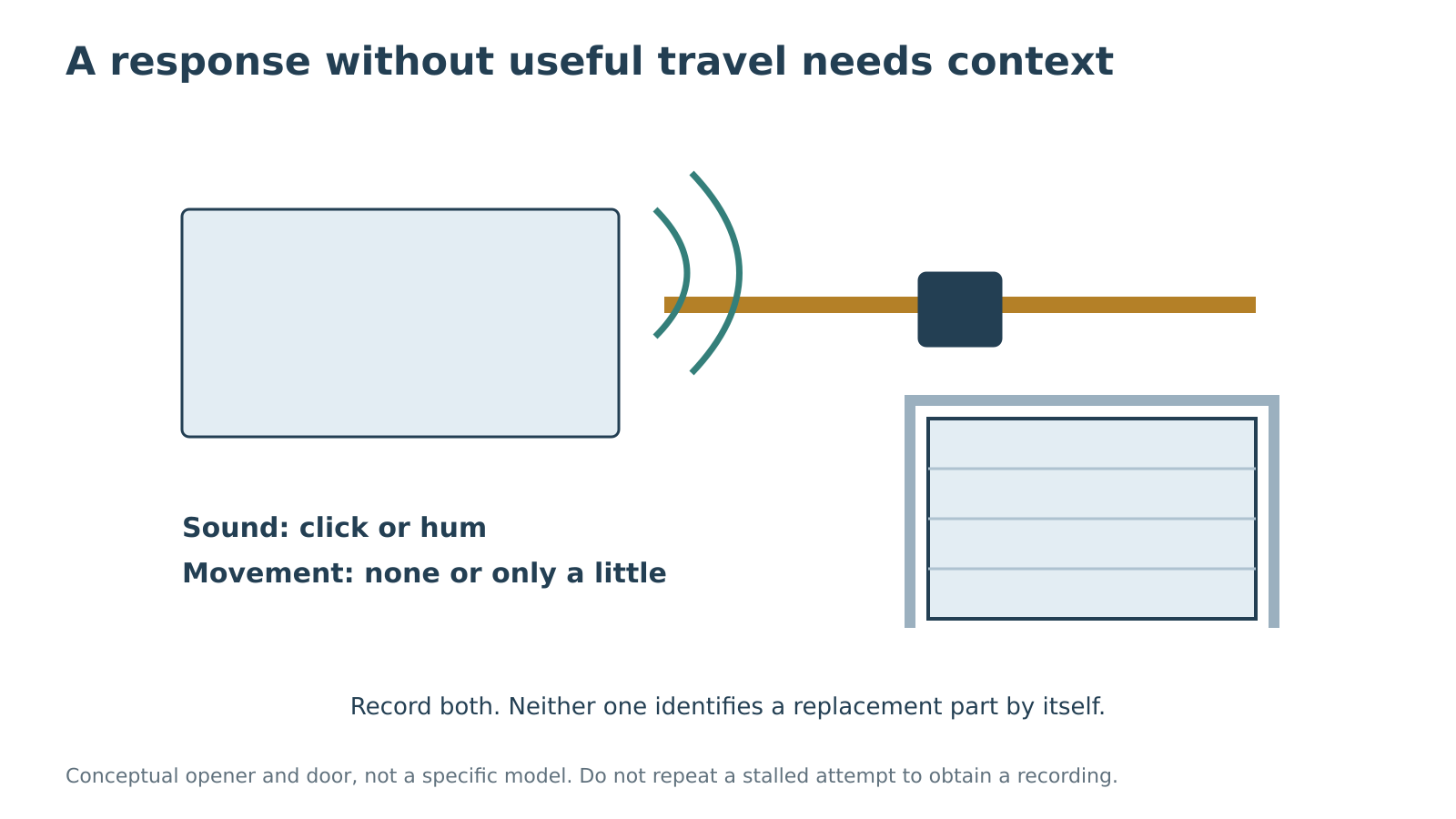
Sound plus travel behavior is useful evidence. This schematic does not identify a failed motor or other part.
A hum or click plus no movement is a symptom, not proof that the motor has failed. Keep clear of visible mechanical damage, record the sequence, and match diagnostic indicators to the exact model.
An opener that hums or clicks but does not move the garage door is responding in some way. That makes it different from a completely unresponsive, apparently unpowered unit—but it does not identify a failed motor, capacitor or circuit board. Stop repeated commands and record what happened before trying to choose a part.
The distinction that matters is not just the sound. Did the door stay completely still, move a short distance, or remain stationary while part of the opener’s drive moved? Those observations lead to different questions. None requires you to open the motor housing or release a suspect door.
Stop the stall from becoming another experiment
A stalled opening attempt can involve the door as well as the operator. The spring system counterbalances the door’s weight; the motor is not intended to compensate for a broken or unsuitable counterbalance system. A stronger opener is therefore not a diagnosis or a safe workaround.
For a suspect open door, do not pull the emergency-release cord. Chamberlain’s manual-operation guidance warns against proceeding when springs, cables or rollers appear damaged. The current door position and access problem belong in the service request, not in a trial manual-lifting test.
Describe the sound and the movement separately
“One click, no visible movement” is different from “a brief hum and a small upward movement.” A longer running sound while the door stays still is different again. Use ordinary language and approximate timing from what you already observed; there is no need to make another attempt with a stopwatch.
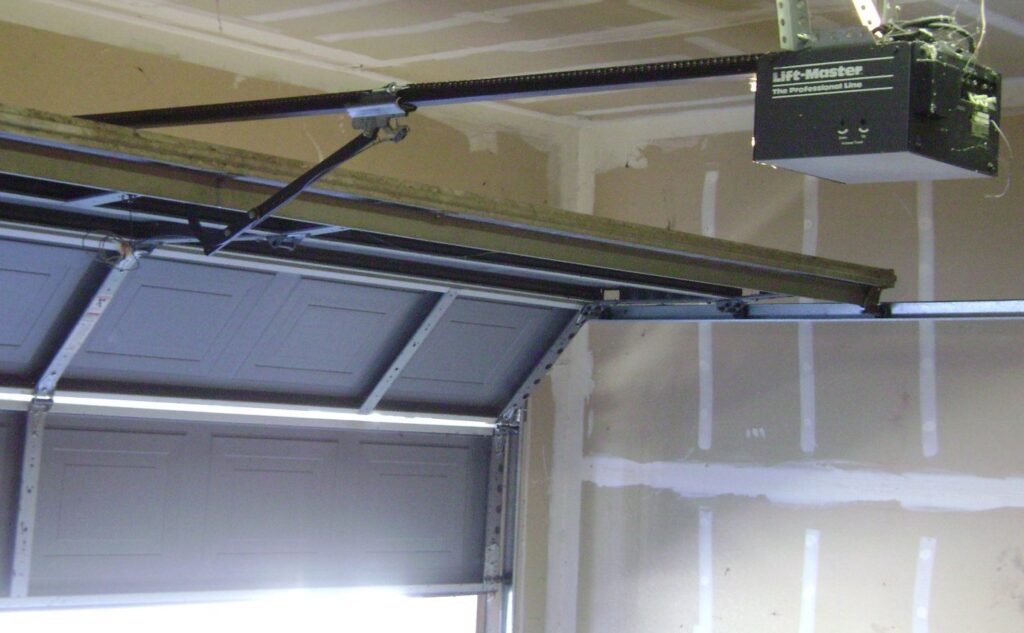
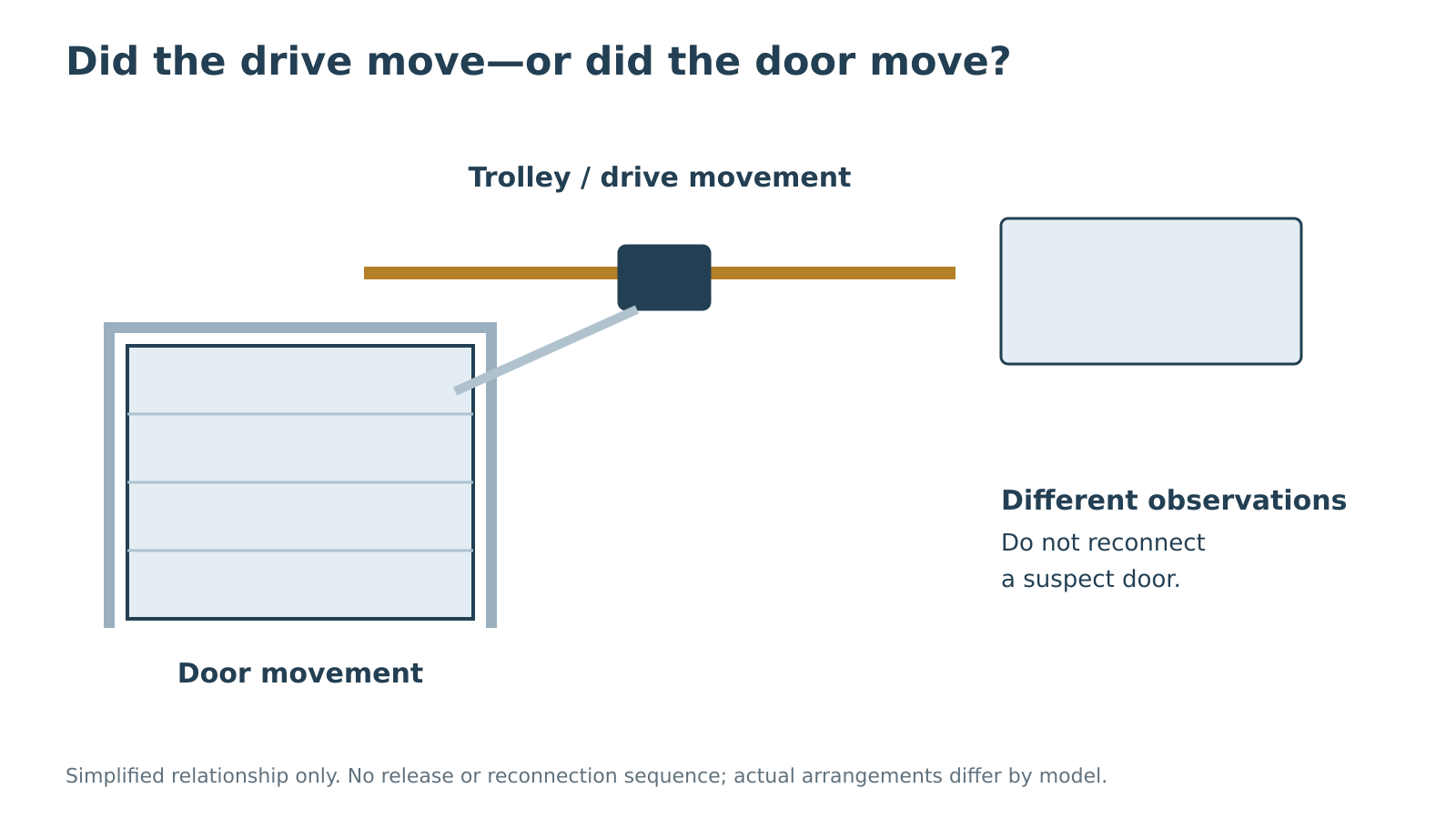
Identify what moved if you can do so safely. The trolley is the moving connection along a ceiling-mounted opener’s rail. The door sections are a separate assembly. If the trolley appeared to move while the door did not, that is important evidence, but do not reach up to reconnect anything on the basis of that observation alone.
Also note whether the attempt was to open or close. Clicking during a closing refusal can have a different context from a motor humming during an opening stall. If the door actually closes partway and reverses, the closing-pattern guide addresses that separate problem.
| What was observed | What to add to the report | A conclusion to avoid |
|---|---|---|
| Single click, no travel | Which control was used; any indicator pattern | “The logic board is definitely bad” |
| Brief hum, door still | Door position; visible damage or lock concern | “It just needs a stronger motor” |
| Short travel, then stop or reversal | Approximate distance already seen; direction | “More force will finish the movement” |
| Drive movement but door still | Whether manual release was used earlier | “Any release-cord instruction will reconnect it” |
 Select the diagram to view it at full size.
A real diagnostic example shows why sound alone is insufficient
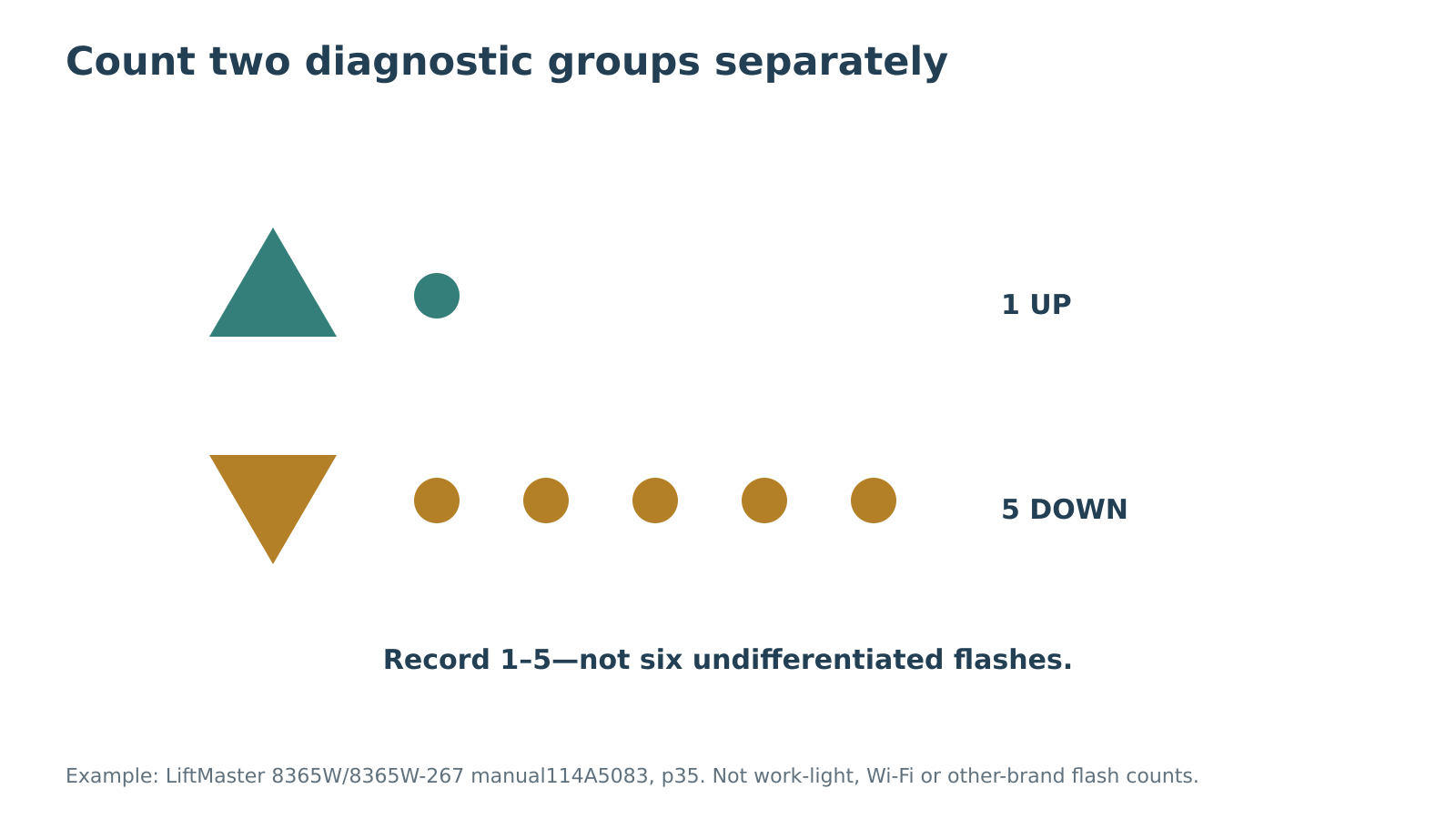
The LiftMaster 8365W and 8365W-267 owner’s manual, document 114A5083, uses separate UP and DOWN arrow counts. On printed page 35, its 1-UP/5-DOWN entry includes several symptom descriptions: approximately 6–8 inches (15–20 cm) of movement followed by stopping or reversal; no movement with a single click; and a 1–2-second hum without movement.
The useful lesson is that one code can still require more than one observation. In that manual, the troubleshooting paths consider binding or obstruction before possible internal-component conclusions. This article does not reproduce the manual-release or internal-repair procedures, because a stalled or damaged door is not an appropriate place for an unqualified trial.
Those numbers are a scoped example, not thresholds for every opener. A Genie unit, a model without UP/DOWN arrows or another manual revision may use a different diagnostic system. Do not apply the 8365W table because a video shows a similarly colored button.
If your actual model has those arrows, record the two counts separately: one UP and five DOWN is 1–5, not six undifferentiated flashes. Keep the model, indicator location and symptom with the count. A flashing work light or Wi-Fi LED is not interchangeable with the diagnostic arrows. The diagnostic-code guide explains the identification step.
 Select the diagram to view it at full size.
Look for visible context from a clear position
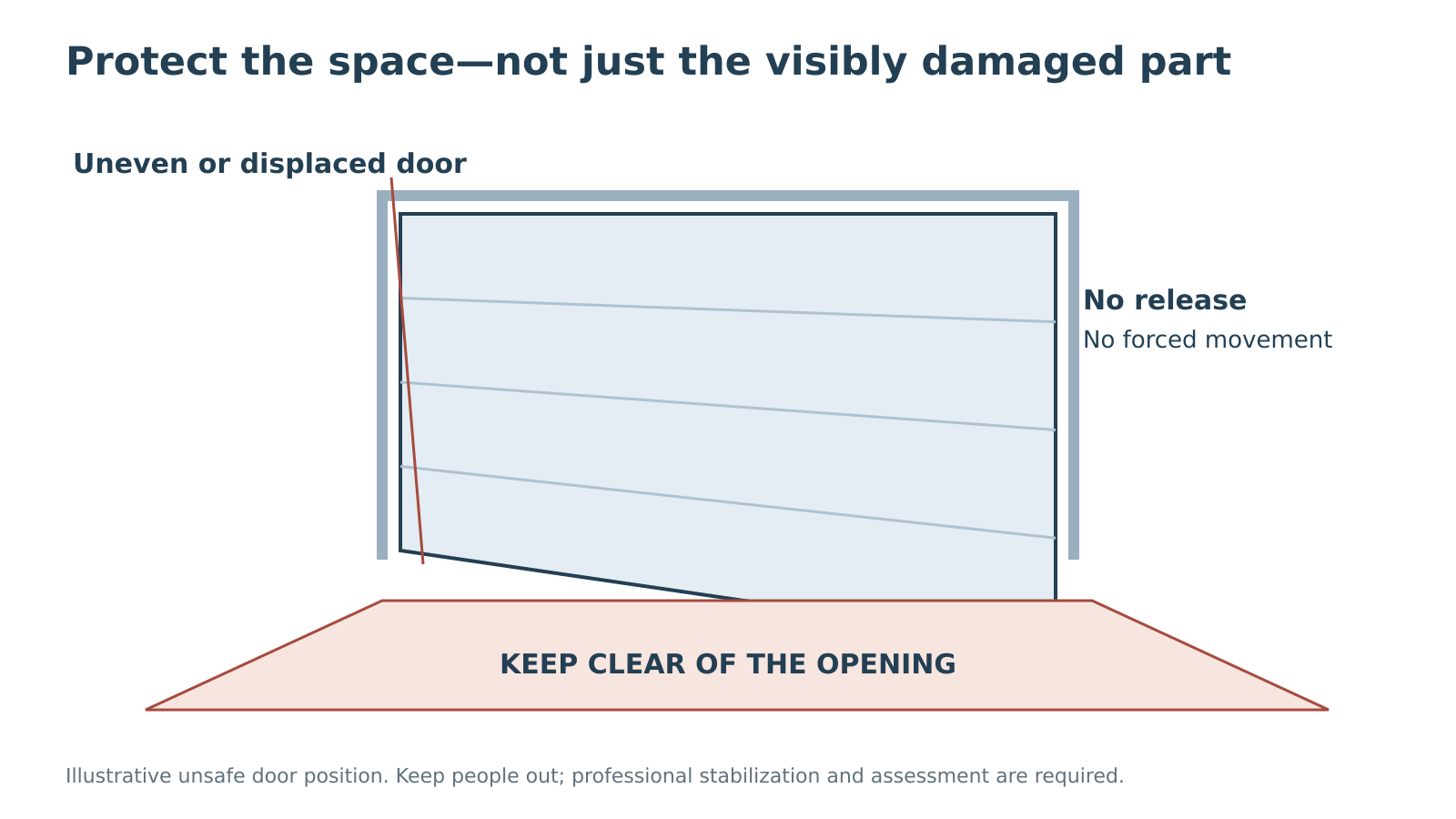
Without moving or touching the door, note whether it is level, whether a cable is visibly loose or frayed, and whether a roller appears displaced. A clear visible defect is enough to stop use. You do not need to inspect every spring or find a hidden broken part before arranging assessment.
A known manual lock is relevant history. Tell the technician if a slide lock was engaged or used during an outage. Do not attempt to force the opener against it or reach into a suspect assembly to change its condition. Automatic lock systems on some openers are different from a basic manual slide lock; identify the installed system rather than assuming one set of instructions fits both.
Recent work is also important. A symptom that began immediately after an internal part was replaced, a section changed or the opener disengaged should be reported with that history. A repair sequence copied from a different drive type can lead the next assessment in the wrong direction.
Chamberlain’s humming guidance explicitly separates chain/belt, screw-drive and wall-mounted openers. Its possible explanations differ by design. This is why a general search result naming a capacitor, gear or coupling cannot establish the correct part for your unit.
 Select the diagram to view it at full size.
Disengagement is a possibility—not permission to pull the cord
During an outage, someone may have disconnected the door from the opener for manual use. If the drive later runs while the door remains still, that history is worth checking against the model’s instructions. The release and reconnection arrangements are not identical across square rails, T-rails and wall-mounted systems.
Do not experiment with cord direction while the door is partly open or mechanically uncertain. Do not use the cord as a handle to raise or lower the door. A reconnection procedure assumes conditions that must be met; the mere possibility of disengagement does not establish that those conditions exist.
If the door is visibly damaged, heavy, unstable or jammed, professional assessment comes before reconnection. If it is otherwise sound but you cannot identify the correct procedure, obtain the exact manual or manufacturer help. Leave the status as “may have been disengaged” rather than repeatedly operating the drive to prove it.
Why internal parts are not homeowner diagnostic shortcuts
A click can indicate an electrical response without telling you which internal function succeeded or failed. A hum can be associated with more than one operating condition. Even a manufacturer troubleshooting chart depends on the right model, symptom and preceding checks.
Do not open the housing to inspect capacitors, bridge connections, turn internal gears or bypass a safety input. Do not buy a replacement component solely because another owner described the same sound. A proper assessment should distinguish door resistance, engagement and internal operator faults before specifying the repair.
If a technician recommends an internal part, ask what evidence supports that conclusion and whether the door’s mechanical condition was checked. The answer should connect to your observed symptom. A parts list is not a diagnosis, and a temporary change in sound is not the same as completed verification.
Give the service provider an observation, not a guessed repair
Include the model, sound, direction, amount of movement and any indicator counts. Add the current door position, visible damage, recent outage or work, and whether anyone used the manual release. An existing recording may help, but do not create another stalled cycle for a video.
For the operator assessment, see garage door opener service. If the visible concern is the counterbalance system, our spring-system guide explains the professional-service boundary. The best next step is to preserve the evidence of the stall and have the connected system assessed—not to make the motor keep trying.